
Nadiem Reads Duplik, Denies Charges in Chromebook Corruption Case
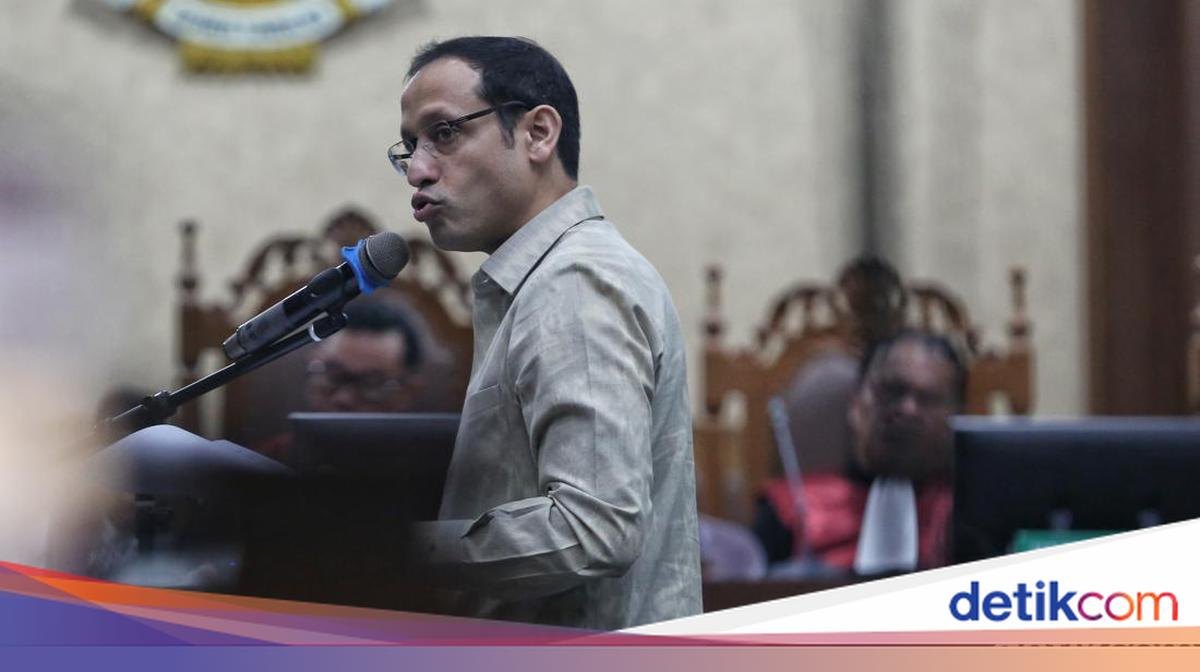
Former Minister of Education, Culture, Research, and Technology Nadiem Anwar Makarim has denied the charges brought by public prosecutors in the alleged corruption case involving the procurement of Chromebooks and Chrome Device Management. Nadiem claimed he was unaware of an annex concerning the locking of the Chrome OS in Ministerial Regulation Number 5 of 2021. “I honestly admit that when I signed this document, I did not realise that one of the 10 annexes, imagine just one of 10 annexes, contained specifications locking the Chrome OS. I honestly did not know. As I have stated, it is impossible for me to read every page of the annexes of routine regulations like this,” Nadiem said while reading his personal duplik at the Central Jakarta Corruption Court on Tuesday (23/6/2026). Nadiem admitted he placed full trust in his secretary-general to compile all the annexes. He stated that under state administrative law, a minister is not responsible for budgets and procurement carried out through regional budgets. “This Ministerial Regulation was raised, Number 5 of 2021, solely because it is the only document I signed. However, even if there was an overpricing of laptops purchased with the Special Allocation Fund budget, that is beyond the authority of a minister,” he said. Nadiem claimed he was carrying out the mandate of the 7th President of the Republic of Indonesia, Joko Widodo, to implement digitalisation in education and utilise technology. He said President Jokowi directly ordered the rapid development of an educational technology platform during the first plenary cabinet meeting. “Imagine, President Joko Widodo immediately stated, even in 2019 when I started my term, that breakthrough steps were needed quickly by utilising existing infrastructure and technological advances. And in the first cabinet meeting, imagine, Your Honour, the first cabinet meeting, the President mentioned building a special technology platform for the Ministry of Education and Culture,” he said. Nadiem stated his main focus in educational digitalisation was application development attached to policy. He said the narrative that the Chromebook project spent IDR 9.9 trillion was a distortion of budget governance. “So the IDR 9.9 trillion figure was not all for Chromebooks. IDR 6.7 trillion was used to purchase Chromebook laptops, the remainder for buying projectors, modems, Wi-Fi, and others. And, Your Honour, of that IDR 6.7 trillion, the amount using the Ministry of Education and Culture’s state budget was IDR 2.72 trillion. So the budget spent on purchasing Chromebooks over three years under my management and responsibility was IDR 2.72 trillion, divided over three years,” he explained. Nadiem introduced the backgrounds and track records of his core team, including Sudarmo, Najelaa Shihab, Iwan Syahril, Anindito Aditomo, consultant Ibrahim Arief, his former special staff member Fiona Handayani, and fugitive Jurist Tan. He described them as the nation’s best sons and daughters, not a shadow organisation. “Your Honour, my core team are young leaders with extraordinary education and track records in their respective fields. I believe in their competence and integrity, and each chose to serve the country despite having to sacrifice their personal financial stability,” Nadiem said. “They are the nation’s best sons and daughters, not a frightening shadow organisation. Even though they were my subordinates, they were actually my mentors in a new world I had to master,” he added. Nadiem admitted he invited the core team to a WhatsApp group named ‘Edu Org’ on 28 August 2019. He said the group was renamed ‘Mas Menteri Core Team’ after he was inaugurated as Minister of Education and Culture. “In order to prepare and learn about the challenges of the education world that I would face. In that WA group, we discussed various education policy topics. And thanks to this WA group forum, I had the opportunity, several months before the inauguration, to ‘study’ education, to ‘study’ governance,” he said. Nadiem stated the group’s purpose was for him to gain an understanding of the education world before his inauguration. He said the discussion topics in the group were about education policies such as curriculum, assessment, and educational digitalisation. He claimed there was no discussion about Chromebook procurement before he took office. “Throughout my tenure, there was never any discussion in this group before I took office about procuring laptops. Chromebook procurement was never mentioned. This WA group was purely a discussion and planning forum so that when I started my term, I would not lose time and would not have to start from zero,” he said. Nadiem said there was a mistranslation from English regarding conversations before he became minister that seemed to plan the removal of strategic roles within the Ministry of Education and Culture. He presented the WhatsApp conversation. “The phrases ‘replace humans with software’, ‘remove humans with software’ and ‘replace with software’ were efficiency efforts to close corruption loopholes within the ministry, to close errors that humans could make, and so that humans do not perform routine tasks because they can be automated, so budgets can be cut and be more targeted,” Nadiem said. Nadiem then explained the meaning of the phrases ‘find internal agents’, ‘change agents and empower them’. He also explained the meaning of the phrase ‘bring in fresh blood from outside’. “The phrase ‘find internal agents, change agents and empower them’ actually means the opposite of what the prosecution alleges. It means finding talents from within the ministry and giving them strategic roles. The best civil servants must be given significant roles, that is what was meant, the exact opposite of the prosecution’s accusation,” Nadiem said.