
Nadiem Makarim Sentenced to 10 Years, Immediately Appeals
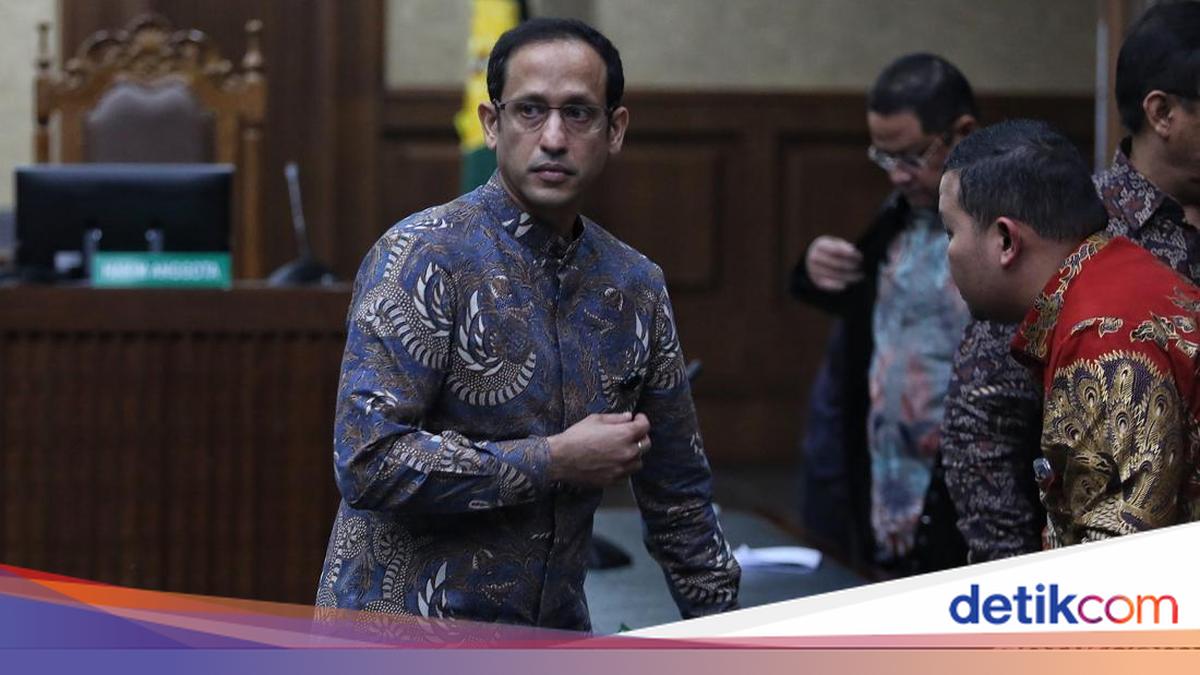
Former Minister of Education, Culture, Research, and Technology Nadiem Makarim has been sentenced to 10 years in prison. The judge ruled that the criminal act was premeditated in a corruption case concerning the procurement of Chromebooks.
The verdict was read in a trial held at the Central Jakarta District Court on Monday (30/6/2026). The judge declared Nadiem proven guilty of committing corruption as charged in the subsidiary indictment.
“Declaring the defendant Nadiem Anwar Makarim has been legally and convincingly proven guilty of committing a criminal act of corruption jointly, as per the subsidiary indictment,” said chief judge Purwanto S Abdullah while reading the verdict.
“Sentencing the defendant Nadiem Anwar Makarim to imprisonment for 10 years,” the judge added.
The judge stated that the primary indictment was not proven. Nadiem was found guilty under the subsidiary indictment, violating Article 604 in conjunction with Article 18 of the Corruption Eradication Law in conjunction with Article 20 letter c of Law No. 1 of 2023 concerning the Criminal Code. The judge also fined Nadiem Rp 1 billion, with a subsidiary of 190 days of confinement.
Sentenced to Pay Rp 809 Billion in Restitution
Nadiem was also sentenced to pay restitution amounting to Rp 809.5 billion. If unpaid, his assets will be seized and auctioned.
“Sentencing the defendant to an additional penalty of paying restitution of Rp 809,597,125,000, with the provision that if the defendant does not pay the restitution within one month after the verdict obtains permanent legal force, the defendant’s assets may be confiscated by the prosecutor and auctioned to cover the restitution, and if the defendant has insufficient assets, it will be replaced with imprisonment for 5 years,” the judge stated.
The judge outlined the basis for calculating the restitution. The procurement of Chromebooks and Chrome OS was carried out for Nadiem’s benefit so that Google would increase its investment in PT Aplikasi Karya Anak Bangsa (AKAB), a company he founded. The judge said this led Nadiem to issue Minister of Education and Culture Regulation Number 5 of 2021.
“That the defendant, as minister, issued Minister of Education and Culture Regulation Number 5 of 2021, which tested the specifications of Chrome OS and the procurement of Chromebooks worth more than Rp 1.5 trillion, making Google, as the owner of the Chrome OS licence, the sole party to fundamentally benefit,” the judge said.
“That policy resulted in Google subsequently realising an investment into PT Aplikasi Karya Anak Bangsa of USD 69 in August 2021, occurring several months after the ministerial regulation was issued, as part of a total investment reaching USD 786,000,” the judge continued.
The judge stated this sequence of events could not be considered a coincidence. There was an action to benefit the corporation founded by Nadiem through the flow of investment from Google.
“The temporal and substantive correlation between the issuance of a policy benefiting Google and the flow of Google’s investment into the defendant’s corporate system is not a coincidence but a tangible manifestation of the aim to benefit the corporation, which forms part of the elements of Article 3 that have been proven,” the judge said.
The judge stated that Google’s investment caused PT AKAB to transfer capital to PT Gojek Indonesia amounting to Rp 809.5 billion. According to the judge, the flow of Rp 809 billion into Nadiem’s corporation could be clearly traced.
“From the Google investment that entered PT Aplikasi Karya Anak Bangsa, on 13 October 2021, PT Aplikasi Karya Anak Bangsa transferred capital to PT Gojek Indonesia amounting to Rp 809.5 billion, which on the same day was returned as settlement of funds based on a loan agreement in a notarial deed, so that the causal chain from the defendant’s corrupt policy to the flow of funds of Rp 809 billion into his corporate ecosystem can be clearly traced,” the judge said.
“There are 7 additional legal bases that cumulatively further strengthen and justify the imposition of restitution of approximately Rp 809 billion on the defendant,” he added.
Recommends Attorney General’s Office Investigate Money Laundering Related to Rp 4.8 Trillion
However, the judge rejected the prosecutor’s demand for Nadiem to also be sentenced to pay restitution of Rp 4.8 trillion. The judge stated the prosecutor was incorrect to demand restitution of that amount in the Chromebook corruption case.
“Considering that based on all these reasons, the request for restitution of approximately Rp 4 trillion cannot be granted in the a quo case, not because of denying the existence of disproportionate assets, but because the chosen legal path is incorrect,” he said.
The panel of judges suggested that investigators from the Attorney General’s Office investigate the Rp 4.8 trillion in a separate case. The judge recommended the funds be investigated using money laundering articles.
“Therefore, the panel of judges recommends that investigators from the Attorney General’s Office of the Republic of Indonesia continue tracing the said assets through a money laundering investigation with the predicate crime of Article 3 of the Corruption Law, which has been proven as per this verdict,” he explained.
Judge Declares Nadiem’s Actions Premeditated
The judge also outlined aggravating factors for Nadiem. According to the judge, Nadiem’s actions were premeditated.
“Aggravating circumstances: the act was carried out in a planned, structured, and systematic manner, resulting in very large state losses and having a broad impact on the provision of education, especially for children in disadvantaged, frontier, and outermost regions,” said the chief judge.
The judge stated Nadiem’s actions contradicted the government’s commitment to eradicating corruption. The judge also noted Nadiem’s affluent economic circumstances.
“The defendant’s actions contradict the commitment of the government and society in eradicating criminal acts of corruption. The defendant, as a minister who should have been a role model, instead abused his position,” the judge said.
“The defendant’s very affluent economic condition means there is no reason of economic need driving the act.”