
Myth vs Fact of Megathrust: Expert Provides Survival Strategies for Earthquakes and Tsunamis
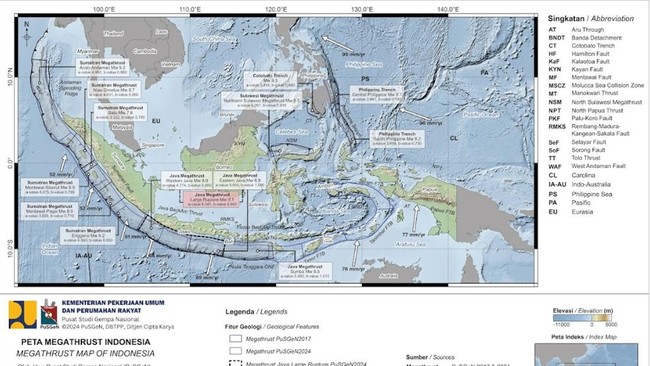
The threat of megathrust earthquakes has once again become a matter of public concern. Amid rising public anxiety, Daryono, a member of the Indonesian Association of Disaster Experts (IABI), warns that there are still many misconceptions regarding megathrusts, ranging from the assumption that a major earthquake is imminent to the belief that every megathrust earthquake will inevitably trigger a massive tsunami.
In fact, ‘megathrust’ is not the name of a specific earthquake. Daryono explains that megathrust refers to a subduction zone or the meeting point of two tectonic plates at shallow depths. It is in this region where an oceanic plate subducts beneath a continental plate, creating an accumulation of pressure that can be released as an earthquake at any time.
Therefore, the existence of a megathuit zone does not mean a major earthquake will occur in the near future. To date, scientists do not possess the technology capable of predicting exactly when an earthquake will occur. What can be done is identifying areas with earthquake potential and calculating the level of risk.
Another common misunderstanding is the assumption that every megathrust earthquake will trigger a large tsunami. In reality, tsunami potential depends on various factors, such as fault mechanisms, the earthquake’s epicentre, the depth of the seismic source, and the magnitude of seabed deformation. Thus, not all megathrust earthquakes automatically produce tsunamis.
Java on Alert
In a separate statement, Daryono revealed that the entire southern coast of Java lies within a megathrust subduction zone with the potential to trigger major earthquakes. However, he believes this threat must be faced with knowledge and preparedness, rather than panic.
“Megathrust is not merely a potential, but a real threat that must be faced with science, preparedness, and a culture of mitigation,” said Daryono.
He reminded the public to learn from the Pangandaran Tsunami on 17 July 2006. At that time, a magnitude 7.7 earthquake in the subduction zone of southern Central and West Java triggered a tsunami that killed more than 668 people and left thousands others injured and homeless.
According to Daryono, that event was a ‘tsunami earthquake’—a type of earthquake that generates a large tsunami despite relatively weak shaking on land. Consequently, many residents and tourists remained on the beach, assuming the earthquake was not dangerous.
“Do not wait for the earthquake to feel strong. If you are on the beach and an earthquake occurs, evacuate the coast immediately,” he urged.
Only 15-20 Minutes Available
He explained that the tsunami waves arrived at the coast only about 15 to 20 minutes after the earthquake occurred. This extremely short window means the public cannot rely solely on official information or early warning sirens.
Therefore, Daryono emphasised the importance of recognising ‘natural warnings’ or natural signs, such as prolonged earthquakes, sudden sea level recession, or a roaring sound from the sea. He believes that recognising these signs can serve as the primary lifesaver when a tsunami threatens.
Daryono also reminded that the megathrust threat is not only felt by coastal communities. Strong earthquakes can impact inland areas far from the coast, while tsunamis pose a higher risk to coastal regions.
He assessed that the public perception that they are powerless against the megathrust threat is also incorrect. Disaster risks can be suppressed through the construction of earthquake-resistant buildings, the provision of evacuation routes, risk-based spatial planning, disaster education, evacuation simulations, and the readiness of the community to save themselves independently.
Furthermore, the public is reminded not to assume the threat has ended once the main earthquake has passed. Aftershocks are still possible, and under certain conditions, tsunami potential must still be monitored, necessitating sustained vigilance.
Daryono noted that two decades after the Pangandaran Tsunami, Indonesia now possesses much better tsunami early warning systems, hazard maps, evacuation routes, and disaster education programmes. However, the work is not yet complete.
“The success of tsunami management is not measured by the number of victims saved after a disaster, but by the minimal number of victims who need saving because the community was prepared before the tsunami arrived,” he asserted.
This message aligns with the advice that megathrust is not a phenomenon to be feared excessively, but rather one to be understood and anticipated. Earthquakes cannot be prevented, but their impact can be reduced through mitigation, preparedness, and rapid response when danger signs appear.
Source: jawawa.id (https://jawawa.id/newsitem/myth-vs-fact-of-megathrust-expert-provides-survival-strategies-for-earthquakes-and-tsunamis-1785592409)
Originally published by CNBC Indonesia (https://www.cnbcindonesia.com/news/20260801173714-4-755722/mitos-vs-fakta-megathrust-pakar-beri-jurus-selamat-dari-gempa-tsunami), translated from Indonesian