
Mystery of 'Little Red Dots' Solved: James Webb Space Telescope Reveals Black Holes Formed Before Galaxies
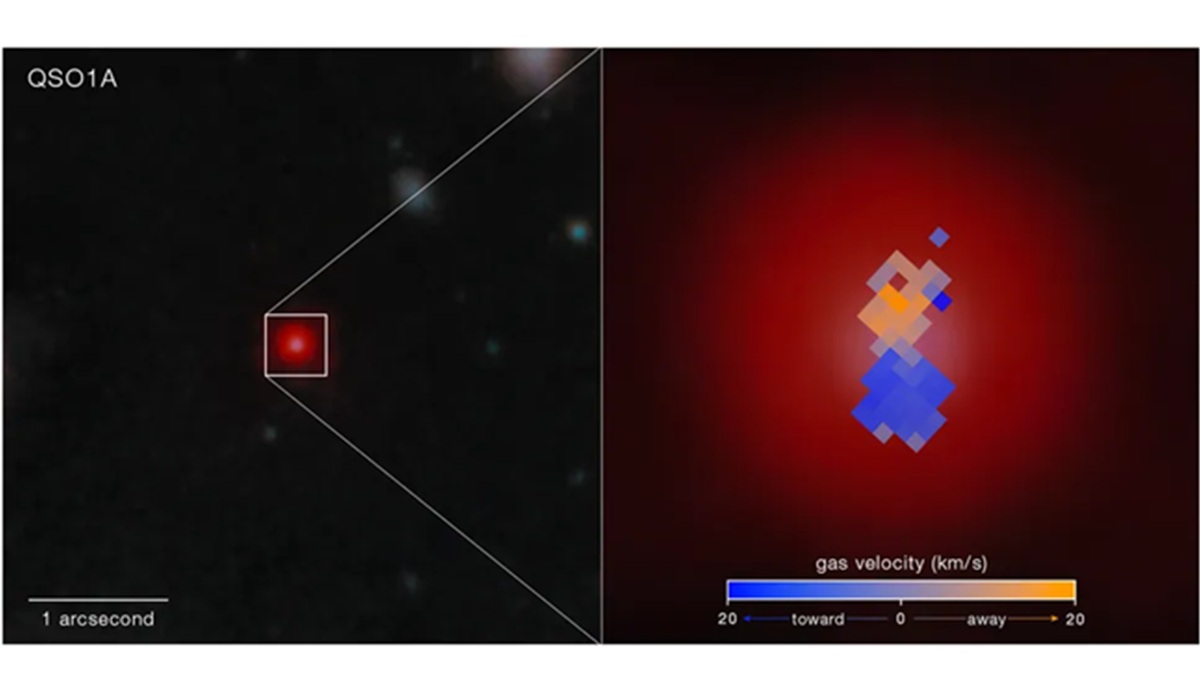
Recent observations of ancient galaxies known as ‘Little Red Dots’ by the James Webb Space Telescope (JWST) have answered a major question for astronomers: which came first, black holes or their host galaxies? The answer overturns long-held modern astronomical theories. Scientists previously believed that supermassive black holes took billions of years to grow by ‘consuming’ gas and dust from their host galaxies. However, a recent study published in Nature and the Monthly Notices of the Royal Astronomical Society reveals that supermassive black holes actually formed before their surrounding galaxies. ‘This is an extraordinary discovery,’ said Roberto Maiolino, a member of the research team from the University of Cambridge, UK, in a statement. ‘It represents a paradigm shift, a complete re-evaluation of the classic scenarios of how black holes form and grow.’ For the study, scientists focused on Abell2744-QSO1 (QSO1), a ‘Little Red Dot’ that existed 700 million years after the Big Bang. The light from this ancient object, spanning 1,300 light-years, has travelled over 13 billion years to reach Earth. Gravitational lensing, predicted by Albert Einstein in 1915, made the study of QSO1 easier. The immense gravity of the Abell 2744 galaxy cluster in front of QSO1 acted as a natural magnifying glass, amplifying its light for clear capture by JWST. Scientists then used JWST’s NIRSpec instrument to map the movement of gas rotating around the object’s centre. They found the gas orbits a central point perfectly, similar to planets in our solar system circling the Sun. ‘This is crucial as it indicates most of QSO1’s mass is concentrated in the central black hole,’ said Ignas Juodžbalis, co-lead researcher from Cambridge University. ‘If the mass were more spread out, like in a star-rich environment, the gas would not exhibit such perfect Keplerian rotation.’ The observations revealed a surprising fact: this supermassive black hole has a mass 50 million times that of the Sun, accounting for 66% of QSO1’s total mass. This ratio is thousands of times higher than the black hole-to-galaxy ratio seen in the modern universe. ‘This is a phenomenal result,’ Maiolino added. ‘It is the first direct measurement of a black hole’s mass within the first billion years after the Big Bang, and the findings align with previous measurements.’ The discovery proves the black hole did not form from the slow growth of a dead star. Instead, it emerged fully formed as a massive object, likely from the collapse of a huge gas and dust cloud, with the surrounding galaxy gradually forming around it over time.
Source: jawawa.id (https://jawawa.id/newsitem/mystery-of-little-red-dots-solved-james-webb-space-telescope-reveals-black-holes-formed-before-galaxies-1780030326)
Originally published by Media Indonesia (https://mediaindonesia.com/teknologi/894909/misteri-little-red-dots-terpecahkan-teleskop-james-webb-ungkap-black-hole-lahir-sebelum-galaksi), translated from Indonesian