
Mystery of Everest’s Green Boots Solved After 30 Years
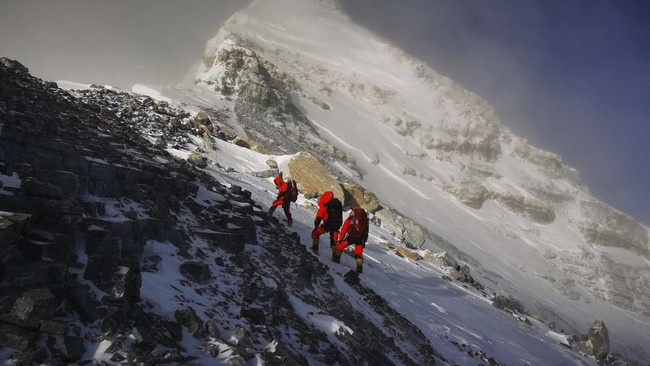
Jakarta, CNBC Indonesia — The mystery surrounding the body of a climber known as “Green Boots”, which has lain near the summit of Mount Everest for 30 years, has finally been revealed. The Indian government now plans to retrieve the body, which has been the subject of debate for decades.
The Guardian reports that Green Boots was found in a limestone-rock alcove at an altitude of about 8,500 metres above sea level, just 350 metres from Everest’s summit. The climber is believed to have died in a severe snowstorm in 1996.
For years, the body was commonly identified as Tsewang Paljor, an Indian climber who died during that expedition. However, this identity was never officially confirmed.
An Indian government document now names Green Boots as Dorje Morup, another climber who died on the same day as Paljor. The change has revived questions about the identity of the person who has served for decades as a landmark on Everest’s climbing route.
The nickname Green Boots comes from the bright green Koflach mountaineering boots worn by the body. Since 1996, it has been a widely recognised marker for climbers travelling along Everest’s north-east ridge from the Tibetan side of China.
The body was found curled up as if asleep beneath a small rocky alcove. The climber was still wearing full mountaineering gear, with a red fleece garment covering the face. It is thought that the climber tried to shelter from the storm, in temperatures of minus 30 degrees Celsius and extremely strong winds, before dying.
For years, many climbers used the location of the body to gauge their position and estimate how long it would take to reach Everest’s summit, at about 8,848 metres. Some even reported to their base-camp teams when they reached Green Boots. Others stopped to rest or shelter from the wind near the body.
In 2006, mountain guide Tshiring Jangbu Sherpa came across Green Boots while seeking shelter from strong winds behind the rocks. At the time, most of the body was covered by a thin layer of snow.
“When I touched it, I brushed away a little of the snow. Then I could clearly see Green Boots lying beneath it,” Tshiring told The Guardian.
Climber’s identity changes after 30 years
For almost three decades, Green Boots was believed to be Tsewang Paljor, a member of India’s Indo-Tibetan Border Police (ITBP) expedition who died while attempting to reach Everest’s summit in 1996. But an Indian government tender document obtained by The Guardian gives a different identity: Dorje Morup.
The document says Morup’s identity had been confirmed in an earlier verification process conducted for a technical assessment or previous tender. It does not explain in detail how the identification was made.
Morup and Paljor were part of an ITBP team seeking to make history as the first Indian climbers to reach Everest’s summit via the northern route. They and another team member set out for the summit on the same day, but none of the three returned.
American climber and Everest blogger Alan Arnette said he was surprised by the change in identity. “It’s a mystery to me why the identity has suddenly changed,” Arnette said.
Nevertheless, he welcomed the plan to bring Green Boots back to India. “I’m glad they’re going to bring him down, but it will be a gruelling task,” he said.
The Indian government has drawn up plans to retrieve Green Boots through a tender process inviting specialist companies to submit bids. The team carrying out the mission must include at least six Sherpas who have successfully reached Everest’s summit several times.
The team must also provide evidence that the mission was completed and bring the body to New Delhi by October 2026 at the latest. The operation is expected to be extremely difficult and dangerous.
Green Boots is in an area known as the death zone, above 8,000 metres, where oxygen levels are extremely low. At that altitude, only about a third as much oxygen is available as at sea level. This makes physical activity far more difficult and can impair decision-making.
According to Tshiring Jangbu, a body frozen together with its mountaineering gear can weigh as much as 200 kilograms. Limbs frozen in fixed positions also make it difficult to move a body across rocky and icy terrain.
In some recovery operations, teams have had to amputate body parts that could not be bent in order to move the remains. Arnette estimates that this recovery mission could cost as much as US$150,000.
Nepal-based expedition company Makalu Adventure estimates that the entire recovery could take up to 40 days. Monsoon-season weather, particularly heavy snowfall, could also complicate the operation, which is planned to take place between June and October.
Hundreds of bodies remain on Everest
Green Boots is not the only climber whose body remains on Mount Everest. An estimated 200 bodies are still on the world’s highest mountain.
Recovering bodies is often difficult because of the extreme terrain, high costs and risks to rescue teams. Helicopters cannot operate safely at such extreme altitudes.
New Zealand climber Guy Cotter, who once coordinated the recovery of an Everest climber’s body in 1997, said returning remains can bring peace of mind to bereaved families. However, he said, such efforts must not put other people’s lives at risk.
“For families, bringing a body down from the mountain can provide peace of mind, provided it does not expose others to excessive risk,” Cotter said. “There have been cases where body recoveries have led to more people dying. The line is very fine,” he added.
Over the past decade, unconfirmed reports have circulated that Green Boots had been moved or buried. Arnette said, however, that several climbers had told him the body was still in the same place as before.
Source: jawawa.id (https://jawawa.id/newsitem/mystery-of-everests-green-boots-solved-after-30-years-1793674296)
Originally published by CNBC Indonesia (https://www.cnbcindonesia.com/lifestyle/20261103074038-33-781747/misteri-green-boots-di-gunung-everest-terungkap-setelah-30-tahun), translated from Indonesian