
Mystery Drones Breach French Navy Base: Who Was Operating Them?
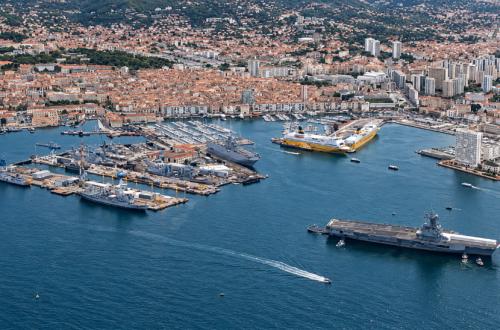
The French Navy has opened an investigation after several unidentified drones were detected entering restricted airspace around the strategic military base at Toulon in southern France. The incident, which took place while the military was conducting a major defence exercise, has raised questions about the security of French military facilities, particularly as the operators’ identities and the drones’ purpose remain unknown.
French maritime authorities confirmed the incident on Wednesday (21 October 2026), after radio station ICI Provence reported unauthorised drone flights over several defence installations in the Var department. The flights reportedly took place at night between 9 and 13 October, coinciding with the French military’s joint Typhon exercise.
According to Le Monde and Le Parisien, the drones were detected around and above military facilities in a no-fly zone. The French Navy said counter-drone equipment was activated whenever a suspicious flight was detected, and domestic security agencies were also involved in responding to the incidents.
However, by the time the official announcement was made, the military had not disclosed the precise number of drones, their type or the identity of those operating them. A judicial investigation has been opened to establish the origin of the flights and determine whether they were ordinary violations or part of a more organised operation.
The incident has attracted attention because Toulon is one of the French Navy’s main centres of power in the Mediterranean. The base is also the home port of the nuclear-powered aircraft carrier Charles de Gaulle, one of France’s key strategic assets for maritime operations and projecting air power.
Drones appear during defence exercise
The unauthorised drone flights have drawn particular attention because they occurred while the French military was practising how to protect Toulon base from security threats. The Typhon exercise ran from 5 to 16 October 2026 and involved various branches of the armed forces and domestic security agencies.
According to an announcement issued by the Mediterranean Maritime Prefecture on 5 October, the exercise was led by Vice-Admiral Laurent Hermann, the French Navy’s commander in the Mediterranean. It included operations on land, at sea and in the air to test the defence of military facilities around the Gulf of Toulon.
The exercise also involved the movement of warships, military vehicles, aircraft, helicopters and drones used as part of security scenarios. Some activities were scheduled to take place at night, with the exercise intensifying between 13 and 15 October.
However, the devices detected between 9 and 13 October were not among the drones used in the official exercise. The French Navy confirmed to local media that the flights were unauthorised and outside the scheduled military activities.
This presented a particular security challenge because Typhon was designed to address potential threats to military bases and installations. The presence of unidentified drones during the exercise raised questions about whether security systems detected every threat and how effectively the equipment used to counter them performed.
The military has not yet announced the results of a technical assessment of the air-defence response during the incident. It is therefore unclear whether the drones deliberately took advantage of the exercise or entered the restricted area at the same time by coincidence.
Three military installations targeted by flights
ICI Provence’s initial report said the drones were detected not only around the Toulon naval base. Two other defence installations were also reportedly affected: a facility belonging to France’s Directorate General of Armaments (Direction générale de l’armement, DGA) in Toulon, and the headquarters of the 54th Artillery Regiment in Hyères.
The DGA is the French government agency responsible for various aspects of military procurement, weapons development and testing. The 54th Artillery Regiment is a French Army unit tasked with air defence and protecting forces against aerial threats.
According to sources cited by ICI Provence, more than one drone was seen during several incidents, and the devices were relatively large. However, the information came from unnamed sources, while the military has not released technical details to confirm the drones’ characteristics.
The military has also not said whether all the flights came from one group of operators or were carried out by different parties. The investigation will need to establish whether the incidents in Toulon and Hyères were connected.
Counter-drone systems activated
A key concern is that the use of security equipment has not yet led to the public identification of all the drones involved. According to an ICI Provence report cited by several French media outlets, including Le Parisien and RTL, the military used electromagnetic jamming systems to respond to the unauthorised flights.
Jammers work by disrupting radio communications or navigation signals used by certain unmanned aircraft. The technology can help sever the link between a drone and its operator, although its effectiveness depends on the type of device and the control system being used.
Local media reports said no drones were recovered or seized after the response. However, the absence of confiscated devices is not enough to conclude that France’s defence systems failed, as the military has not released a detailed account of the countermeasures.
In its official statement on 21 October, the Toulon Maritime Prefecture said each incident had been handled by activating established security measures. It also confirmed that the response was co-ordinated with domestic security agencies.
The French Navy said no sensitive infrastructure was under direct threat during the incidents. This qualification is important: reports of unauthorised flights have not been accompanied by evidence of an attack, damage or a successful act of sabotage.