
Muslim-Majority Country Bans Hijabs in Schools, Triggering Mass Protests
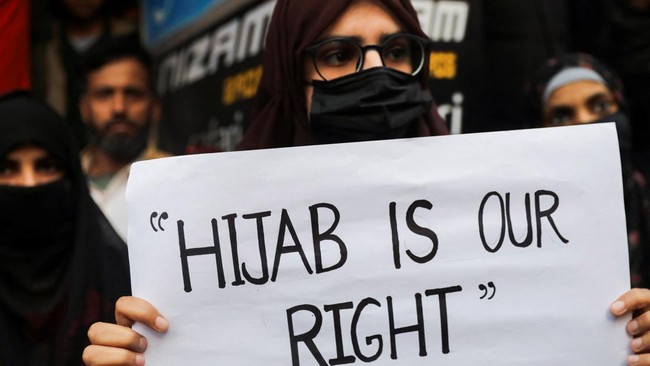
Jakarta, CNBC Indonesia — Azerbaijan’s school-uniform policy has sparked an unusual wave of protests. Several female students wearing hijabs were reportedly refused entry to classes, prompting fierce debate over religious freedom, the right to education and the application of secular principles in the Muslim-majority country.
Protests took place in several parts of Azerbaijan for nearly a week, through mid-October 2026. Other students, including boys, joined the demonstrations in solidarity with the hijab-wearing girls.
The protests, involving children, attracted widespread attention because demonstrations are relatively rare in Azerbaijan. Deutsche Welle (DW) reported that the issue had even prompted diplomatic tensions between Azerbaijani and Turkish politicians, despite the countries’ traditionally close ties.
Uniform rules spark controversy
The dispute began after the Azerbaijani government tightened clothing rules in state schools. On 7 July 2026, the general education law was amended to reinforce the principles of secular education and the requirement to comply with dress regulations.
The government then issued Resolution No. 309 on 21 September 2026, setting out school-uniform rules. The regulations restrict additional clothing deemed to disrupt uniformity or conflict with the principles of secular education.
Although the rules do not explicitly mention a hijab ban, some school administrators have interpreted them as grounds to prohibit female students from wearing headscarves.
As a result, several girls have been barred from lessons if they continue to wear hijabs. Some have chosen to remove their headscarves to enter class, while others have had to return home or consider homeschooling.
The strict rules have also affected teachers. After the government introduced dress regulations for teachers on 6 October 2026, reports emerged of female teachers wearing hijabs being prevented from teaching.
Secularism versus religious freedom
Azerbaijan is a Muslim-majority country, but its constitution expressly separates religion from the state under Article 18. Article 42, meanwhile, guarantees the right to education, and Article 48 protects freedom of belief.
The differing interpretations of the uniform rules have divided public opinion. Supporters say all students must comply with the same uniform requirements and argue that children are not mature enough to decide what religious clothing to wear.
Opponents argue that barring girls from school solely because they wear hijabs violates their right to education and freedom of religion.
The debate has produced an unusual alignment: some non-religious citizens oppose the ban, while some government critics support restrictions on the hijab.
Dozens detained as activist goes missing
The Azerbaijani government responded firmly to the protests. On 12 October 2026, the Interior Ministry announced that 37 people had been detained on suspicion of damaging school property and disrupting public order under Article 233 of the Criminal Code.
Amid the tensions, activist Ilkin Huseynov was reported missing after launching a volunteer tutoring project for affected students. Local media reported that he had been placed in administrative detention for 30 days on allegations of disobeying police orders.
Human rights organisation Amnesty International condemned the denial of access to education for girls wearing hijabs and called for detained protesters to be released.
Foreign influence concerns and Turkey-Azerbaijan tensions
Beyond the clothing issue, there is speculation that the strict policy reflects government concerns over the growing influence of foreign religious groups, particularly those from Iran.
Fazil Mustafa, chair of the Azerbaijani parliament’s Committee on Public Associations and Religious Institutions, defended the school rules, citing the need to guard against the influence of religious groups backed from abroad.
The controversy quickly took on an international dimension. On 3 October 2026, protests broke out outside Azerbaijan’s consulate in Istanbul, Turkey.
Turkish President Recep Tayyip Erdoğan’s adviser, Oktay Saral, strongly criticised the hijab restrictions, saying they obstructed children’s right to education.
The ruling New Azerbaijan Party (YAP) responded sharply, describing criticism by Turkish politicians as interference in Azerbaijan’s domestic affairs. It said the principle of “one nation, two states” did not mean either side could dictate the other’s domestic policies.
Uncertainty continues to surround the educational future of the hundreds of affected girls in Azerbaijan’s state schools.