
Musim Mas Strengthens Response to Forest and Land Fire Prevention in Central Kalimantan
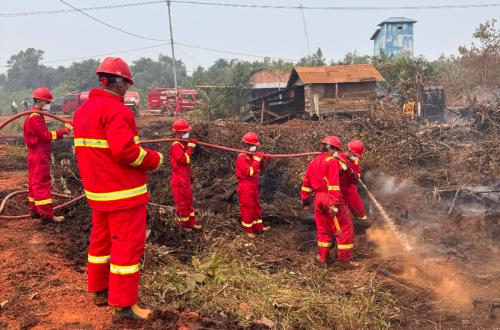
Efforts to manage and prevent forest and land fires (karhutla) in Central Kalimantan are being continuously strengthened by Musim Mas Group through the deployment of significant resources and personnel. Since 8 July 2026, the company has deployed over 1,000 firefighters supported by 16 fire engine units and one helicopter for aerial water bombing.
This fire management effort is not limited to the company’s operational areas but also reaches various villages outside its boundaries. To date, the Musim Mas firefighting team has assisted in managing fires in 13 affected villages, including Sebabi, Kenyala, Tanah Putih, Hanjalipan, Tangar, Baampah, Penyang, Camba, Soren, Bagendang Tengah, Natai Baru, Palangan, and Kandan.
These efforts are taking place amidst weather conditions that require high vigilance. The Meteorology, Climatology, and Geophysics Agency (BMKG) has noted that relatively dry atmospheric conditions persist in several regions of Indonesia, including Kalimantan. BMKG also stated that a very strong El Niño phenomenon is ongoing and is predicted to last until early 2027.
Facing these conditions, Musim Mas Group continues to strengthen its preparedness through rapid response during fires, field monitoring, and various preventive measures to help reduce the risk of forest and land fires.
Ground and Aerial Firefighting
Bangun Hapsoro, Musim Mas Group’s Survey Manager and the company’s Fire Management Coordinator for the Kalimantan region, stated that management is carried out by combining several methods to control the fire as quickly as possible.
“In the field, we cannot rely on just one method. There are teams working on the ground, there is water bombing to reach difficult points, and there is also heavy equipment to create fire breaks so that the fire does not spread further,” said Bangun.
To support aerial firefighting, Musim Mas Group operates one helicopter equipped with a ‘bambi bucket’ with a capacity of approximately 800 litres per drop. Under certain conditions, water bombing can be performed up to about 30 times a day.
According to Bangun, water bombing is used as an initial response, particularly to reach fire spots that are difficult for ground teams to access, and to help slow the spread of the fire. Subsequently, ground firefighting teams continue the process with spraying and cooling until the fire and embers are confirmed to be extinguished.
Management becomes more intensive when fires occur in peatlands. Even when surface fires appear extinguished, teams continue cooling and monitoring because fire can persist in the subsurface layers.
“In peatlands, the work is not finished when the fire is no longer visible. We continue cooling and ensuring there are no remaining embers,” said Bangun.
One of the greatest challenges faced by the field teams is water availability. Several water sources, including reservoirs and rivers, have shrunk or even dried up due to the dry weather conditions.
“The main problem in firefighting is the distance to water sources. However, we cannot face these challenges alone. Therefore, we continue to coordinate with local governments and the community so that available resources can be used together,” added Bangun.
More than 1,000 employees deployed to the field
The massive need for personnel makes human resources a vital part of the fire response. More than 1,000 personnel, comprising staff and employees of Musim Mas Group in Central Kalimantan, have been involved in firefighting squads, working in shifts for over two months.
One such individual is Suparman, Assistant Head of the Musim Mas Group Training Centre, who is also part of the firefighting team. According to him, involvement in fire management is a form of care for the environment and the communities surrounding the company’s operational areas.
“It is indeed exhausting. For over two months, we have had to be on standby and work in shifts. But our wish is simple: for the fire to be extinguished quickly, for the air to improve, and for the community to be able to resume their activities comfortably,” said Suparman.
Working amidst thick smoke also presents a significant challenge for the team. To ensure personnel safety, the company equips the firefighting squads with safety gear and health support, including supplements and vitamins.
Caring for the health of communities affected by smoke
Fire management does not stop at extinguishing the flames. The impact of smoke on public health is also a priority for Musim Ma Group. The company has opened five free health posts in various locations within the East Kotawaringin region, in collaboration with the local Health Office and community health centres (Puskesmas). These posts are intended to bring healthcare services closer to the community, especially those requiring medical examinations amidst smoke-affected air conditions.
Company doctor and Health Post Coordinator, Dr Yulin Effendi, stated that each post serves approximately 100–120 patients. Of the patients visiting the posts, about 30–40 percent suffer from respiratory complaints, including coughing and shortness of breath.
“The services we provide range from health examinations, medicines, vitamins, and masks, to oxygen for those in need,” explained Yulin.
Fire management requires cooperation
Field efforts are also conducted alongside the local government and the Regional Disaster Management Agency (BPBD) of East Kotawaringin Regency.
Acting Head of the East Kotawaringin BPBD, Rihel Magat, stated that managing forest and land fires requires the involvement of various parties.
“Managing forest and land fires must involve a working group. Not just the local government, but also the community, district authorities, and the private sector,” he said.
Source: jawawa.id (https://jawawa.id/newsitem/musim-mas-strengthens-response-to-forest-and-land-fire-prevention-in-central-kalimantan-1791190786)
Originally published by Republika (https://ekonomi.republika.co.id/berita/tmfdvz490/musim-mas-perkuat-respons-penanganan-dan-pencegahan-karhutla-di-kalimantan-tengah), translated from Indonesian