
Multiplier Effect of Upstream Oil and Gas Industry Supports Regional Economies
The upstream oil and gas industry is considered to have a strategic role in driving regional economic growth through various multiplier effects generated by its operational activities. This impact extends beyond state revenue to include increased regional income, job creation, and infrastructure development.
Rinto Pudyantoro, a lecturer at the Faculty of Economics and Business, Universitas Pertamina, explained that the contribution of the upstream oil and gas industry to regions can be seen through several key components, such as the Revenue Sharing Fund (DBH), tax revenues (Oil and Gas Land and Building Tax/PBB Migas), and contributions through the 10% Participating Interest (PI) involving Regional Owned Enterprises (BUMD). For instance, in 2023, Riau Province received Rp3.6 trillion in Oil and Gas DBH and Rp3.9 trillion in Oil and Gas PBB.
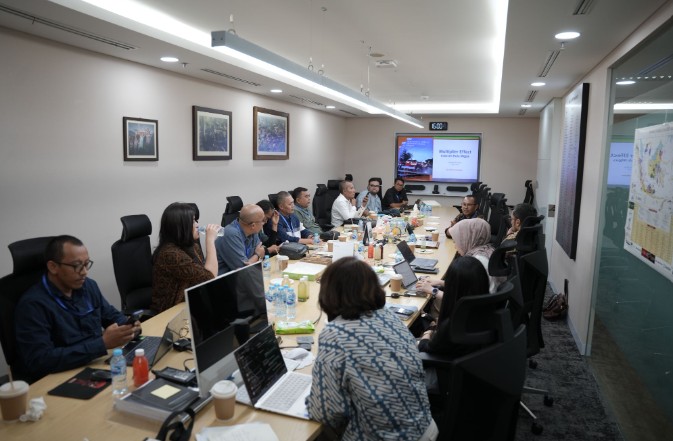
“There is often a perception that the presence of the oil and gas industry does not provide direct benefits to the surrounding communities. However, when viewed comprehensively, this industry provides a very large and layered economic impact for the region,” Rinto stated during a Media Education event on Wednesday.
Furthermore, operational activities within oil and gas working areas drive the local economy through the procurement of goods and services and the involvement of local businesses. The multiplier effect is also reflected in the sector’s contribution to the development of downstream industries, the provision of energy for domestic needs such as power plants, and the construction of public facilities that support community welfare near operational areas. Corporate Social Responsibility (CSR) and community development programmes also play a vital role in strengthening these socio-economic impacts.
“The multiplier effect of the upstream oil and gas industry does not stop at state revenue; it extends to various sectors, including the local workforce, infrastructure, and the overall strengthening of the regional economy,” he added.
Rinto also highlighted the sector’s contribution to national Land and Building Tax (PBB). Based on data, national PBB reached Rp24.01 trillion in 2022. Of that amount, Oil and Gas PBB accounted for Rp13.711 trillion, exceeding 50 per cent of the national PBB revenue.
Nevertheless, Rinto acknowledged that the primary challenge lies in the decisions made by regional governments regarding the utilisation of these funds. Since large revenues from DBH Migas and PBB Migas do not directly impact regional welfare, the impact depends on whether local governments spend these funds appropriately on development. Despite the decline in oil and gas production, Rinto emphasised that the upstream industry remains a vital pillar for both national and regional economies. With proper management, the sector serves not only as an energy provider but also as a driver for sustainable economic growth.
Source: jawawa.id (https://jawawa.id/newsitem/multiplier-effect-of-upstream-oil-and-gas-industry-supports-regional-economies-1780910152)
Originally published by Media Indonesia (https://mediaindonesia.com/ekonomi/891352/multiplier-effect-industri-hulu-migas-dukung-perekonomian-daerah), translated from Indonesian