
Multiple Hotspots in Concession Areas: What Needs to Be Done?
Multiple Hotspots in Concession Areas: What Needs to Be Done?
Reporter
October 10, 2026 | 12:11 am
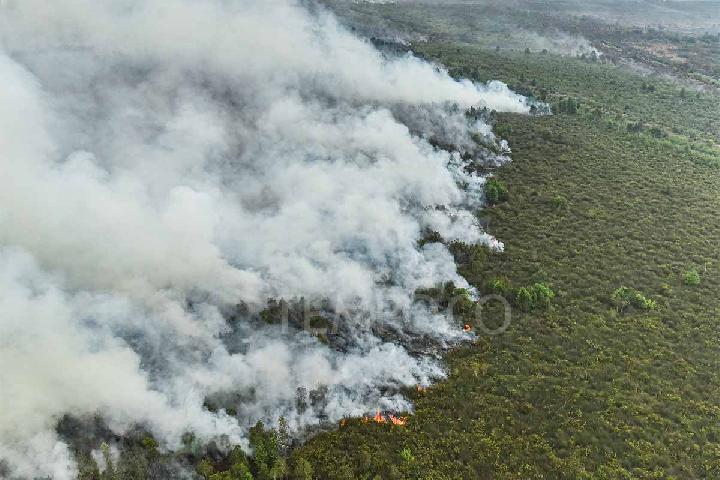
TEMPO.CO, Jakarta - The number of forest fire hotspots in Indonesia has increased fivefold this year compared to the same period last year. Many of these are directly related to lands owned by concession-holding companies.
A report by Trend Asia titled “Smoke for the People, Profit for the Few: Where Indonesia’s fires burn, who holds the land, and where the commodities go” reveals this comparison. The report detailed a spike in hotspots recorded between January and August of 2026.
“There are up to 32,021 hotspots, which is more than five times the number from the same period in 2025, which was 5,961 points,” said Trend Asia bioenergy campaigner, Amalya Reza, during a discussion at Bangkok Climate Action Week on October 6, 2026.
Amalya revealed that 80 percent of the 34,933 high-confidence hotspots analyzed between January 2024 and August 2026 are concentrated in the ten provinces with the highest levels of natural resource extraction. Of those, 56 percent are located within concession areas.
“Of that 56 percent, 27 percent are in mining concessions, which is 9,553 hotspots, 20 percent in palm oil plantation concessions, which is 7,150 hotspots, and 15 percent in forestry concessions [Forest Utilization Business Permit], which is 5,082 hotspots,” Amalya added.
The report also reveals that six out of ten companies with Forest Utilization Business Permits (PBPHs) and the most hotspots this year have had their licenses or concessions suspended or revoked by the government. The top three, with 275 hotspots, have active PBPH licenses.
“Some companies holding sustainability certifications, such as PEFC, continue to experience recurrent fires on their lands,” said Amalya.
Amalya further elaborated that between January 2024 and July 2026, Indonesia exported mining products, palm oil, and forest products valued at US$ 221.4 billion to 169 destination countries. A total of 75.4 percent of exports flowed to G20 countries. China took the largest share (46.8 percent), followed by India (13.3 percent), Japan (6.8 percent), and South Korea (4.0 percent).
Amalya stated that stringent enforcement of corporate accountability is necessary to stop the fires. Additionally, halting the issuance of new extractive concessions, widely opening land and export data, and urging international buyers to stop purchasing products linked to forest fires is essential.
“If buyers do not immediately stop purchasing from forest-burning companies, they will always create demand that justifies the occurrence of forest fires.”
Sayako Iinuma from the Global Environmental Network further highlighted the role of the regulatory framework. She emphasized its role in holding upstream companies accountable for any environmental damage they cause.
“The application of principles such as ‘No Deforestation, No Peat, No Exploitation’ has successfully prevented Japanese companies from purchasing certain goods such as palm oil that have deforestation and forest fire footprints,” she stated. Global Environmental Network is based in Tokyo.
Sayako argued that the regulations at the end of the supply chain must be strengthened. “To act as a powerful tool to prevent destructive practices upstream,” she said.
Celios Executive Director Bhima Yudhistira underscored the role of financial institutions in supporting the extractive industry. He said the agenda of the World Bank and IMF meeting in Bangkok on October 12-18, 2026, should be a turning point for making global financial institutions more accountable.
Bhima cited international financing for biomass co-firing energy transition and greenwashing initiatives. Both, he said, “Directly fuel destructive forest fires, displace communities within forest areas, and undermine pure climate actions.”
The discussion also featured Paritta Wangkiat, the Editor-in-Chief of Makong Eye. She highlighted how regional agricultural trade encourages land clearing through burning, causing cross-regional haze in the Mekong River delta area.
Read: Malaysia Shuts Schools amid Toxic Haze from Indonesian Fires
Click here to get the latest news updates from Tempo on Google News