
Mulawarman Military Commander Says Borneo Flag Raising Not a Sign of Wanting to Leave Indonesia
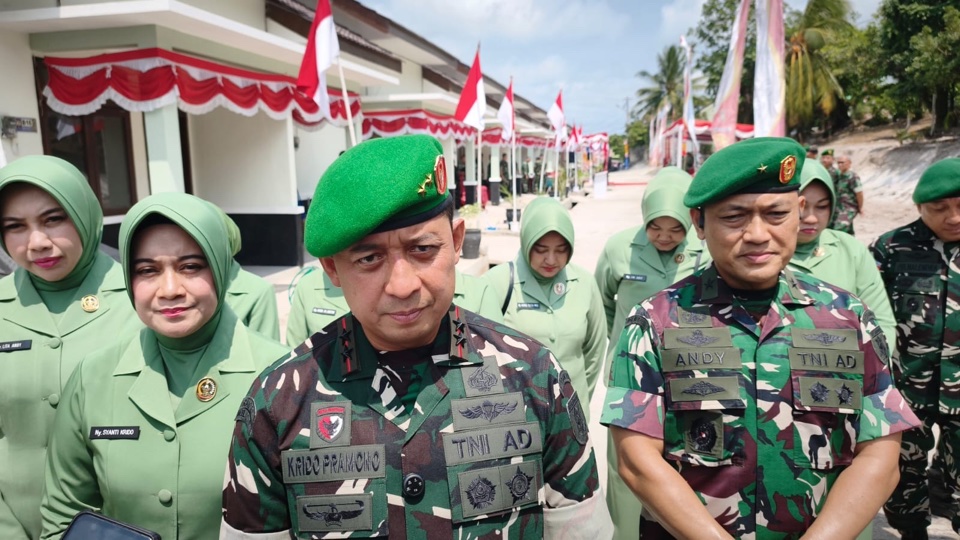
The raising of the red, yellow and blue Borneo flag by some communities in Kalimantan, including in Samarinda, East Kalimantan, does not necessarily indicate a desire to separate from the Unitary State of the Republic of Indonesia (NKRI). This was emphasised by the Commander of Military Region VI/Mulawarman, Major General TNI Krido Pramono, to journalists on Tuesday (18/8). According to him, the use of the flag is more related to community identity, as well as a means of conveying aspirations regarding development in a number of areas in Kalimantan.
“Actually, the display of that flag is an identity flag. For example, they call it the Dayak flag, Borneo. But they actually remain NKRI, they remain Red and White,” Krido asserted.
He revealed that the aspirations conveyed by the community relate to the need for infrastructure development, such as roads, bridges and other access points deemed capable of facilitating community activities. “It is not because they raise (the flag) and then they are not NKRI. No. They remain Red and White. It is just their identity, they want to obtain improvements,” he explained.
He said the TNI, together with government elements and the community, continues to take an approach to understand these aspirations. He assessed that communication with the community is carried out through various activities so that the issues raised can be resolved together. “We have also been continuously in the field with all of them, having coffee and so on, to work out how to realise what they want as part of all of us,” he said.
Krido acknowledged that there are indeed parties or individuals who have been clarified regarding the distribution and raising of the flag. The interim findings show that the action was more a form of conveying aspirations. “We have investigated. Yes, they are merely perhaps a form of protest for them to obtain actualisation of their aspirations,” he stated.
He stressed again that from the investigation conducted, there is no indication that the raising of the Borneo flag by the community was aimed at or intended to establish a separate state or to separate from Indonesia. “But that does not mean they want to leave the NKRI and want to establish their own state. No, it was done only as their internal protest regarding demands for improvements that are community aspirations,” said the Military Commander.
He assured that the government and authorities will continue to strive to pay attention to community aspirations in areas requiring development. “And they will receive the same thing or attention from us. We continue to strive together with community components to realise what they want,” he said.
Krido asked the public not to rush to draw conclusions based solely on the symbols used. He assessed that aspirations regarding development are matters that need to be conveyed and discussed through constructive communication channels. “Indeed, there is no potential yet leading towards separation,” said Krido.
He also invited the people of Kalimantan to maintain unity and jointly oversee development. And together they must be able to do their best for this nation. Krido acknowledged that development cannot be felt evenly and quickly in all regions. However, he believes the government will continue to strive to reduce development disparities.
“Indeed, we realise that not everything, not quickly, not comprehensively, that development will be felt by everyone. However, I am confident the government will continue to try to ensure that the community, the people, also receive the same as others,” he said.
The Military Commander’s statement serves as an affirmation that the issue of the Borneo flag raising needs to be viewed proportionally, by distinguishing between cultural identity symbols, the conveying of development aspirations, and actions that genuinely lead towards separatist movements.
For information, the Borneo flag with red, yellow and blue colours, which in a number of discussions is said to be related to Dajak Besar, does have a historical background in Kalimantan. Historical studies regarding the Dajak Besar Autonomous Region state that the region was once an autonomous area during the Dutch East Indies administration and later became part of the structure of the Republic of the United States of Indonesia.
In that historical context, the flag with red, yellow and blue colours is associated with Dajak Besar. Dajak Besar itself was not an independent state, but rather one of the regions that once obtained autonomous status during Indonesia’s political transition before returning to being part of the NKRI, until the region was later dissolved and became part of the administrative structure of the Republic of Indonesia.
Because of this historical background, the red-yellow-blue symbol has reappeared in various discussions regarding Dayak and Kalimantan identity. Various statements from indigenous communities explain that the flag is referred to as a cultural identity, not a symbol of rebellion. However, the context of the use of the symbol still needs to be viewed based on the situation and purpose of its use. The use of a cultural identity symbol does not automatically prove the existence of a movement to establish a new state.