
Muktamar in Tambakberas: Emulating the Devotion of Mbah Wahab Chasbullah
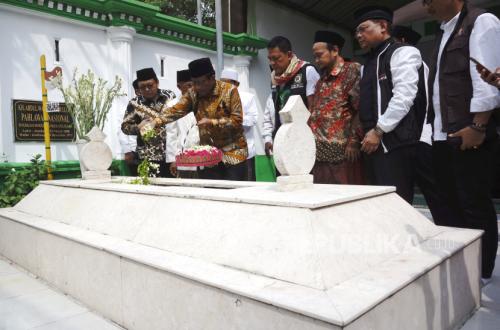
There comes a time when a place ceases to be merely a geographical space and transforms into a historical one. The Bahrul Ulum Islamic Boarding School in Tambakberas, Jombang, is one such place. Therefore, holding the 35th Nahdlatul Ulama Congress at this boarding school is not just an administrative decision by the organisation, but an endeavour to return the collective memory of the Nahdliyin community to the wellspring of its struggle. For those of us who once studied in Tambakberas, this decision brings a conviction that NU is being invited to come home: home to the adab, knowledge, fraternity, and devotion bequeathed by its founders, especially KH Abdul Wahab Chasbullah.
Returning to one’s roots does not mean walking backwards. It is precisely from strong roots that a tree can soar high. The Qur’an reminds us, ‘Wa’tashimū bi hablillāhi jamī’an wa lā tafarraqū’ (QS. Ali ’Imran [3]: 103), hold firmly to the rope of Allah all together and do not become divided. This verse is not merely a spiritual call, but a social foundation that the founders of NU later translated into a movement for the unity of scholars and the community. In the atmosphere of the Congress, this verse finds its relevance once more. Differences of opinion are a necessity, but brotherhood is an obligation.
This principle became the spirit of the Qanun Asasi Nahdlatul Ulama drafted by KH Hasyim Asy’ari in 1926. In its preamble, he reminded that the decline of the community occurs when the bonds of brotherhood are severed and the scholars are divided. Conversely, revival is only possible through unity, consultation, and loyalty to the Qur’an, Sunnah, ijma’, and qiyas. It is for this reason that NU was founded not to pursue power, but to safeguard the religion (hifzh al-din), care for the community, and bring about the common good.
Among these founders, KH Abdul Wahab Chasbullah stood out as a visionary scholar. He understood that knowledge that does not move will lose its transformative power. From this idea were born Taswirul Afkar, Nahdlatul Wathan, Nahdlatut Tujjar, and finally Nahdlatul Ulama. His widely known call, ‘Ayo obah!’ (Come on, move!), was not merely a slogan, but a methodology of civilisation. Moving means enlivening education, strengthening the community’s economy, tightening fraternity, and presenting Islam as a mercy to all the worlds.
As an alumnus of Tambakberas, I feel that the strongest message bequeathed by Mbah Wahab was not rhetoric, but exemplary conduct. At the boarding school, we learned that knowledge must give birth to service. A student is not only required to be adept at reading classical texts, but also ready to sweep the yard, serve guests, help the community, and respect teachers. All of this is a tangible practice of the Prophet’s hadith, ‘Khairunnas anfa’uhum linnas’, the best of people are those who are most beneficial to others. From here was born the character of khadim al-ummah, a servant of the community, not a seeker of honour.
This value is deepened in the Adab al-’Alim wa al-Muta’allim. KH Hasyim Asy’ari emphasised that a seeker of knowledge must purify their intentions, honour their teachers, respect knowledge, and distance themselves from arrogance. He reminded that the blessing of knowledge is determined more by adab than by intelligence. It is no wonder that for centuries, boarding schools have been able to produce scholars who are respected not because of power, but because of their character. That tradition is still palpably alive in Tambakberas.
Source: jawawa.id (https://jawawa.id/newsitem/muktamar-in-tambakberas-emulating-the-devotion-of-mbah-wahab-chasbullah-1783558286)
Originally published by Republika (https://analisis.republika.co.id/berita/thvso7451/muktamar-di-tambakberas-meneladani-khidmat-mbah-wahab-chasbullah), translated from Indonesian