
MUI Issues 3 Reminders Regarding 17 August Independence Day Celebrations
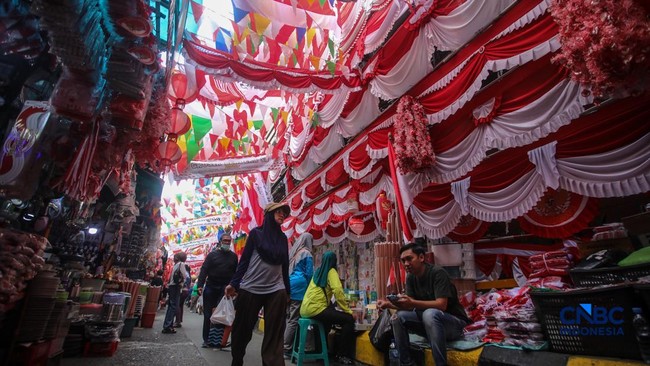
The Indonesian Ulema Council (MUI) has reminded the public not to wear clothing resembling the opposite sex or engage in tasyabbuh when participating in carnivals commemorating the Republic of Indonesia’s Independence Day. This appeal is a preventive effort to prevent the covert campaigning of the Lesbian, Gay, Sodomy and Sexual Abuse (LGSP) movement.
The Deputy Secretary of the MUI Fatwa Commission, KH Abdul Muiz Ali, stated that the August celebrations should be a momentum to strengthen unity, contribute to the nation, and increase prayer and dhikr as a form of gratitude for the blessing of independence. However, the rise of deviant actions, such as male participants wearing women’s clothing during parades, is considered to have led to violations of sharia and social norms.
“In the current context, wearing clothing of the opposite sex tends to campaign for the practice of the LGBT (LGSP) movement, which is clearly prohibited by religion and contrary to social norms,” said Kiai Muiz Ali. He stated that Islam strictly prohibits the exchange of clothing styles between men and women, as the law of resembling the opposite sex is haram and sinful, without exception, whether in private or public spaces. “The Prophet Muhammad (PBUH) cursed men who resemble women and women who resemble men,” he stressed, quoting an authentic hadith narrated by Imam Bukhari.
Not only highlighting the issue of carnival attire, Kiai Muiz Ali also requested that organisers ensure parade routes do not disturb the comfort of road users. He also issued a reminder regarding community competitions. In this regard, committees are urged not to use participant registration fees as a source of prize money, as this is classified as a gambling practice (qimar) which is also forbidden.
Ali further explained that holding August competitions is permissible. However, committees are prohibited from using participant registration fees as a source of prize funding because it constitutes gambling. According to him, Indonesia’s independence is truly a mercy and blessing from Allah SWT that must be grateful for. Celebrating it through community competitions is a positive thing to train agility, discipline, and foster a sense of togetherness.
“Islamic scholars have reached a consensus on the permissibility of competitions in general. Competitions without prizes are absolutely permissible, such as running races or other agility contests,” said Kiai Muiz Ali, quoting the view of Ibnu Qudamah in the book Al-Mughni. However, Ali provided a critical note regarding the mechanism for collecting registration fees for prize-winning competitions. Islamic jurisprudence strictly prohibits schemes where registration fees from participants are collected and then used as prize funds for the winners.
“One thing that must be avoided is the practice of gambling. This means the committee is not allowed to use participant registration fees as part of the prize money. That is incorrect according to fiqh provisions and is haram,” he explained. Quoting the book Hasyiyah al-Bajuri ’ala Fath al-Qarib, Kiai Muiz Ali added that any game placing participants in a state of uncertainty between profit and loss by risking personal funds falls into the category of prohibited gambling. Therefore, prize funds should ideally come from sponsors, committee funds, or non-binding third-party donations.