
MUI Forum Urges Sustainable Waste Management
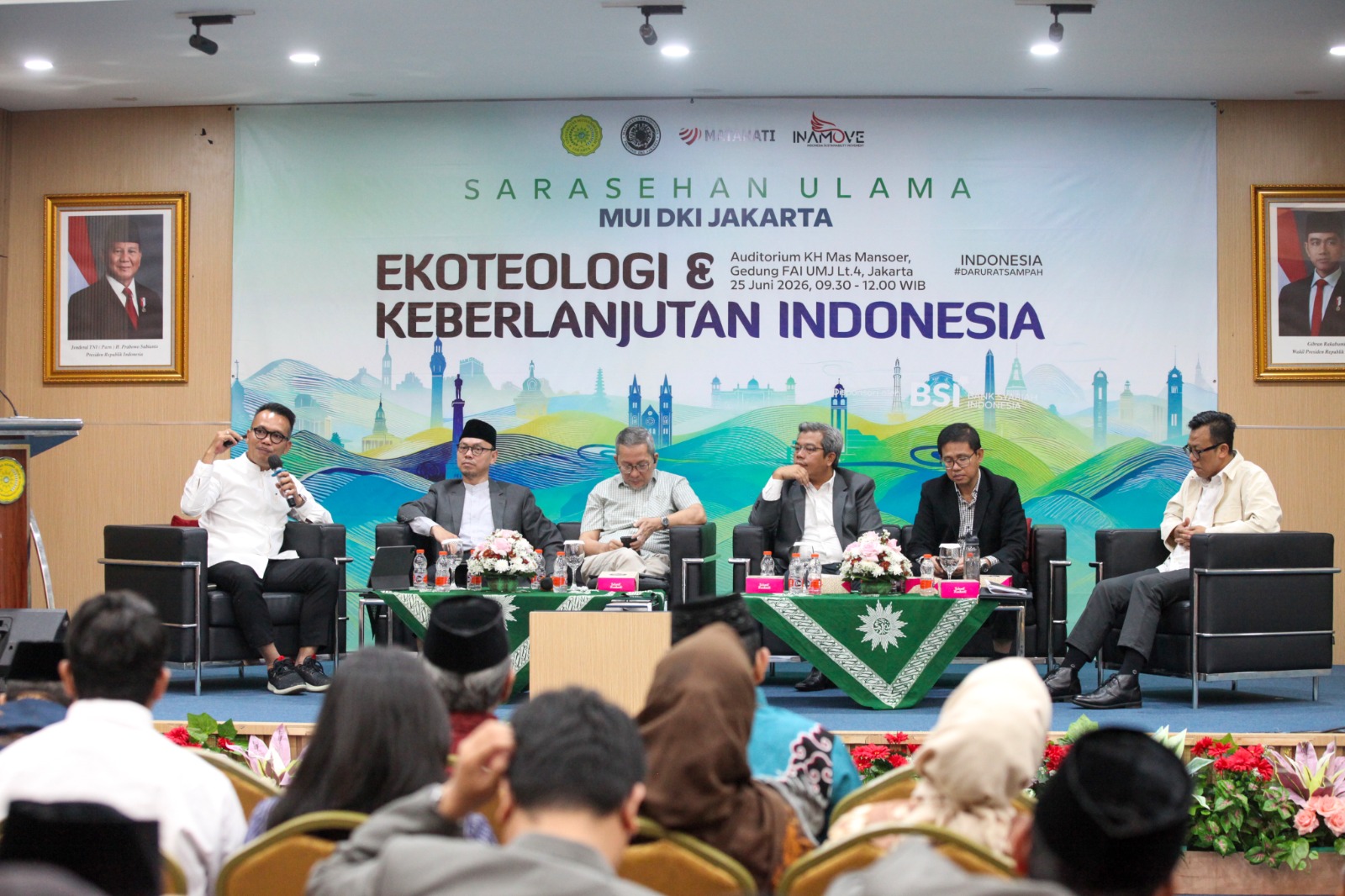
The Indonesian Ulema Council (MUI) Jakarta, together with the Indonesia Sustainability Movement (Inamove), held an Ulema Forum themed ‘Eco-theology & Sustainability in Indonesia’ at the University of Muhammadiyah Jakarta (UMJ) on Thursday (25/6/2026). The forum brought together religious scholars, academics, industry practitioners, and public policy experts to discuss solutions to the national waste crisis from various perspectives. One of the key issues raised was a warning that waste management programmes should not turn into projects that merely benefit investors by exploiting public funds. Dr. Muladi Mughni PhD, Director of the MUI DKI Jakarta PKU Executive Board and author of ‘Fikih Kota Global’, explained that in the Islamic view, waste or ‘Al-Afsah’ is discarded material that still holds value if managed properly. He highlighted the concept of ‘Fikih Ma’alat’, an approach that assesses a policy based on its long-term impact on society. ‘A good policy is not the one that manages the most waste, but the one that is most successful in reducing the generation of waste from the upstream,’ Muladi stressed. According to him, the waste management paradigm must shift from merely processing waste to preventing its generation at the source. He also reminded that the use of the state budget (APBN) in waste management projects is a public trust, so its benefits should not be enjoyed solely by investors while the risks are borne by the public. From the government’s perspective, the CEO of PT Daya Energi Bersih Nusantara (Denera), Fadli Rahman PhD, stated that Indonesia produces around 50 million tonnes of waste annually, with approximately 60 percent not being optimally handled. Consequently, the government is promoting the construction of Waste-to-Energy (PSEL) facilities through Presidential Regulation Number 109. Rahman noted that this technology can reduce emissions by up to 80 percent compared to open dumping systems. The initial phase of the project is planned for Bali, Bekasi, and Solo, and will involve informal sector workers such as scavengers. However, several speakers assessed that the implementation of PSEL still faces challenges. Industrial design practitioner Ir. Edy Sutrisno MM stated that the public’s habit of not sorting waste is a major obstacle, as mixed wet food waste and plastic can damage the incinerator machinery used for power generation. He also questioned the economic viability of the project, given that the electricity systems in Java, Bali, and Madura are currently experiencing a supply surplus, while the investment required for PSEL facilities is very large. Former Indonesian Ombudsman Commissioner Ahmad Alamsyah Saragih also stressed the importance of good governance. He argued that Indonesia has been too quick to adopt waste-to-energy technology without first building a culture of waste sorting, a process that took countries like Japan and China decades. He also highlighted the lack of public consultation in the formulation of Presidential Regulation Number 109, which he believes could lead to maladministration and fiscal burdens if there is excessive reliance on foreign investment. Meanwhile, senior environmental researcher from IPB University, Dr. Ir. Kiman Siregar, assessed that waste management policies should use a Life Cycle Assessment approach, with an orientation towards reducing carbon emissions rather than simply incinerating waste. The forum concluded that solving the national waste problem cannot rely solely on technology. It requires synergy between public education and literacy, the application of appropriate technology, and transparent, accountable, and public-oriented government policies to ensure that waste management truly supports sustainable development.