
Muhammadiyah’s Da’wah Must Remain Firm in Faith and Flexible in Approach
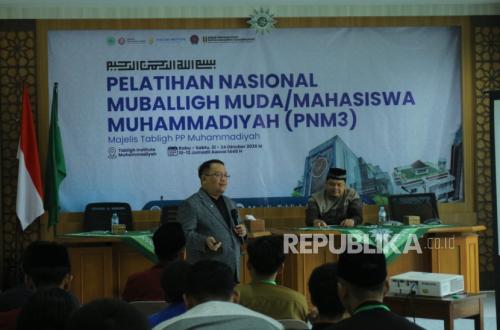
JAKARTA — Fahmi Salim, head of Global Tabligh at the Central Board of Muhammadiyah’s Tabligh Council, has reminded preachers not to sacrifice the principles of faith in response to social change and contemporary intellectual challenges. However, firmness in religious belief must be accompanied by flexibility in choosing da’wah methods so that Islamic messages can be accepted by the public.
Fahmi made the remarks at the National Training for Young Muhammadiyah Preachers and Students (PNM3) in Bantul on Thursday (22 October 2026). Addressing a forum attended by students from several universities in Java and Sumatra, he stressed the importance of strengthening tawhid and tajdid as the foundations of Muhammadiyah’s da’wah movement.
“Tawhid and tajdid are ideological antibodies for all Muhammadiyah cadres, members and leaders at every level, in facing challenges to Islamic thought,” Fahmi said in his presentation.
The lecturer at the Faculty of Islamic Studies at Muhammadiyah University Prof Dr Hamka (Uhamka) in Jakarta said the challenges facing da’wah today were not limited to theological issues, but also included the development of ideologies and ideas he considers contrary to Islamic teachings.
In a session titled “The Muhammadiyah Da’wah Method versus Deviant Movements”, Fahmi raised a range of issues, from syncretism, religious pluralism, liberalism and radical feminism to the LGBTQ movement. He also discussed Ahmadiyya, the Baháʼí faith, Twelver Shi’ism, neo-Sufism, atheism, communism and Christianisation.
Fahmi said these developments required preachers to have a strong understanding of religion as well as the ability to interpret social change. He cited debates over freedom of sexual orientation as one contemporary issue that needed to be addressed through an appropriate da’wah approach.
Fahmi stressed that Islam should not be understood merely as an identity or lifestyle. It should, he said, serve as a guide shaping how people think, behave and act in their daily lives.
“Islam as a way of life,” Fahmi said.
He therefore cautioned that Muhammadiyah’s da’wah should not be limited to sermons. It should also take practical form through education, healthcare, economic empowerment and social activities that bring direct benefits to the public.
Fahmi cited schools, hospitals, orphanages and Muhammadiyah’s various charitable enterprises as examples of da’wah in practice. All such institutions, he said, must remain grounded in the values of tawhid.
At the same time, Fahmi warned preachers against approaches that could create new problems in society. Firmness in defending the faith, he said, must not be interpreted as justification for treating every difference harshly.
“The practice of forbidding wrongdoing must not bring about new wrongdoing,” was one of the principles Fahmi emphasised in his presentation.
Source: jawawa.id (https://jawawa.id/newsitem/muhammadiyahs-dawah-must-remain-firm-in-faith-and-flexible-in-approach-1792695045)
Originally published by Republika (https://news.republika.co.id/berita/tnbc5j451/dakwah-muhammadiyah-harus-teguh-dalam-akidah-luwes-dalam-pendekatan), translated from Indonesian