
Muhammadiyah’s Community Empowerment Council Holds 2026 National Consolidation, Reviews Grassroots Programmes
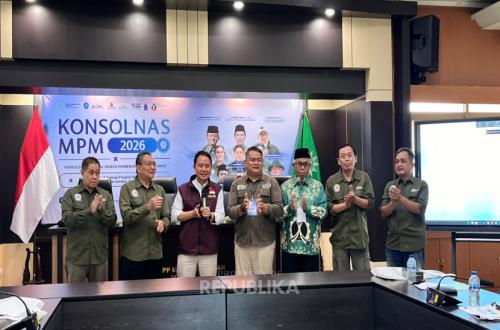
Muhammadiyah’s Community Empowerment Council (MPM) Chair M. Nurul Yamin said the national consolidation meeting was the second of its kind, following the first in 2024. It continued the work of the MPM’s 2023 national working meeting at Muhammadiyah University of Purwokerto.
The MPM reviewed programme progress, identified obstacles and outlined strategic steps to strengthen its community empowerment movement.
“This morning’s forum is not simply a reflection; it also provides a picture of the Community Empowerment Council’s activities up to 2026,” he said in his opening remarks on Saturday (31 October 2026).
Yamin said the MPM had established two broad empowerment strategies: national programmes and flagship programmes. National programmes are intended to address community empowerment challenges comprehensively through an integrated movement from the central level to local branches. Flagship programmes, meanwhile, are developed around local potential and the strengths of communities in each area.
At the forum, Yamin outlined progress on several national programmes. In terms of institutional development, 230 MPM councils had been established at district or municipal level and 122 at branch level. The establishment and expansion of MPM bodies at provincial level still required further work.
He acknowledged that data collection remained a challenge in assessing the movement’s nationwide progress. Not all activities and reports from provincial and local bodies had been consolidated, making it necessary to strengthen the organisation’s reporting practices.
“Data is our weakness, even though we want to make decisions based on data. Many may already be active, but have not entered their data,” he said.
In cadre development, the MPM has consolidated 760 certified participants through its Community Empowerment Cadre School (SEKAM), against a target of 1,000. Strengthening this cadre was considered important to sustaining empowerment work at district and branch levels.
In agriculture, the Muhammadiyah Farmers’ Association (JATAM) had gathered 6,695 members towards a target of 10,000. The Muhammadiyah Fishers’ Association (JALAMU) had exceeded its initial target of fewer than 500 members.
To strengthen the movement, the MPM is also preparing the second JATAM National Jamboree as a forum for bringing Muhammadiyah farmers together nationally. At the consolidation meeting, it launched the logo, jingle and theme song for the event, which is planned for Lampung on 23–25 July 2027.
“The Farmers’ Association Jamboree is one way to make the agricultural movement more than just farming activity, turning it into a broad-based movement,” he said.
The MPM is also developing Sahabat Migran Berkemajuan (Saranmu), a community that has gathered 5,362 members, most of them Indonesian migrant workers in Malaysia. Support is provided from the outset through to reintegration, including legal assistance, protection and religious guidance through the Jendela Migran forum.
Alongside these national programmes, Yamin said the MPM ran various community-based flagship initiatives targeting marginalised groups. These include the Martikop waste-picker community, an egg-farming community in Bangka Belitung, the Bank Vivabel savings and loan cooperative, small and medium-sized business communities, and residents of underdeveloped, frontier and outermost (3T) regions.
Empowerment work in 3T areas has taken place in Papua, East Nusa Tenggara (NTT) and Berau. In Sorong Regency, Papua, one supported community has developed its institutions to the point of becoming a village-level settlement and gaining access to village funds. In NTT, the MPM is developing dryland agriculture, helping improve access to water and initiating construction of a bridge connecting villages.
Yamin stressed that these programmes form part of a process of social and cultural transformation through community empowerment. Their purpose is not merely to carry out activities, but to help communities become more socially and economically self-reliant.
“All of this is part of a process of cultural and social transformation carried out by Muhammadiyah through the MPM,” he said.
The MPM is also using the national consolidation meeting to strengthen coordination and programme evaluation across all levels of the organisation. It hopes the findings will guide improvements to programme delivery and ensure the continuity of Muhammadiyah’s community empowerment work.
“These are some of the achievements that have been recorded, and I am sure many more have not. We need to keep strengthening the organisation’s practices and regulations. This consolidation meeting is therefore focused largely on internal issues for us to discuss,” he said.
At the same event, Muhammadiyah Treasurer Hilman Latief praised the MPM’s empowerment work. Muhammadiyah’s central leadership considers the MPM, alongside the Muhammadiyah Disaster Management Centre (MDMC) and Lazismu, to be among the organisation’s most visible councils and bodies.
“I dream of and hope that the MPM will truly become a means of education—education about what we mean when we speak of Islam Berkemajuan, or Progressive Islam,” he said.
Latief urged the MPM to take the next step by measuring its programmes’ impact through social return on investment and their contribution to the Sustainable Development Goals (SDGs). He said this could involve young people, or Gen Z, so that fieldwork is complemented by technology-enabled, more effective methods. With clear documentation, he added, the MPM could seek recognition from national and international institutions.
“If we prepare properly, before or at the next Congress, we can put the MPM forward to national and international institutions, as well as the government and private sector, for recognition. I want to raise its profile, and God willing, I will help,” he said.
Latief also offered several recommendations for strengthening the MPM’s movement. He said field-based empowerment work needed to be matched by sound reporting systems, the use of digital technology and programme impact assessments.
“The MPM’s hard work strategy must be matched by smart work. Smart work means digital reporting technology. We need good data on our community empowerment work,” he said.
According to Latief, the results of empowerment programmes should be examined further to establish their effect on the welfare of farmers, fishers, migrant workers and other supported communities.
He also encouraged the MPM to develop social impact and social return on investment (SROI) assessments, and to link its empowerment programmes to progress towards the SDGs.
The aim is for the MPM’s empowerment work not only to be properly documented, but also to have clearly measured impacts and receive wider recognition from national and international institutions.
“This is what we hope for: that the MPM will truly become a national movement with impact,” he said.
At the meeting, the MPM also launched the logo, jingle and theme song for the second Muhammadiyah Farmers’ Association (JATAM) National Jamboree, planned for Lampung on 23–25 July 2027.
Source: jawawa.id (https://jawawa.id/newsitem/muhammadiyahs-community-empowerment-council-holds-2026-national-consolidation-reviews-grassroots-programmes-1793436697)
Originally published by Republika (https://rejogja.republika.co.id/berita/tnrha6291/mpm-pp-muhammadiyah-gelar-konsolidasi-nasional-2026-evaluasi-programpemberdayaan-akar-rumput), translated from Indonesian