
Muhammadiyah Kicks Off 'Rojolele Reborn' to Revive Klaten's Legendary Rice
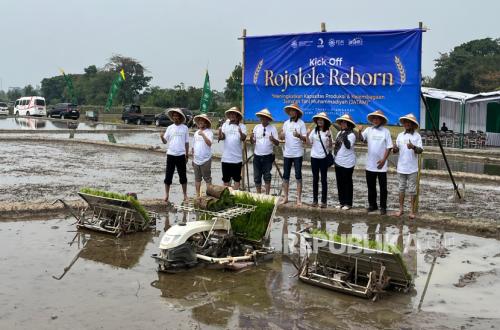
The Rojolele rice variety, once a flagship product of Klaten Regency, is being revived. The Community Empowerment Council (MPM) of the Central Board (PP) of Muhammadiyah, in collaboration with PT Danone Indonesia and JATAM MPM PDM Klaten, launched the Rojolele Reborn Kick Off programme: Increasing Production Capacity and Institutional Capacity of Muhammadiyah Farmers’ Congregations (JATAM) through the planting of the Rojolele-104 rice variety in Gempol Village, Karanganom District, Klaten Regency, on Thursday (20/8/2026).
The kick-off marks the first step towards restoring Rojolele’s former glory while strengthening the agricultural ecosystem from upstream to downstream. MPM PP Muhammadiyah Chairman M. Nurul Yamin said Rojolele was chosen because of its strong historical ties to Klaten. The variety has long been known as an icon of regional rice and has a fluffy texture favoured by the public.
“Rojolele is a fairly legendary variety and Klaten is one of the icons of Rojolele rice products. We want to build this Rojolele innovation to continue developing it as a rice variety that is favoured by the public,” Yamin said during an interview in Gempol Village, Karanganom District, Klaten Regency, on Thursday (20/8/2026).
According to him, the movement is not merely a symbolic mass planting activity. MPM PP Muhammadiyah wants to build an agricultural ecosystem by ensuring that the harvest has a market.
In this initial phase, Yamin said the development of Rojolele-104 will be carried out in three locations: Gempol covering 8,000 square metres, Ceper 5,500 square metres, and Prambanan 3,000 square metres. Overall, the trial area is targeted to reach approximately five hectares.
From that land, Yamin estimates production can reach 6-7 tonnes of unhusked rice per hectare. This means that from five hectares, it is projected to produce around 30-35 tonnes of unhusked rice, or around 20-25 tonnes of rice after milling.
“We are targeting five hectares in this initial phase. If the average is 6 to 7 tonnes per hectare, it will produce 30 to 35 tonnes of unhusked rice. If that unhusked rice yields about 60 per cent rice, then it will produce approximately 20 to 25 tonnes of rice,” he said.
Muhammadiyah, he continued, has long had an interest in the agricultural sector. Farmer empowerment is carried out from improving human resource capacity, institutional capacity, and productivity, to market preparation. For this reason, the organisation is also preparing an offtaker, or a party that will absorb the harvest. The Rojolele product planted this time is even being offered through a pre-order scheme to Muhammadiyah charitable enterprises, such as universities and hospitals, as well as members of the organisation.
“We have already thought about when it will be harvested and who will consume or buy the production,” he said.
“Farmers must not suffer losses because at planting time prices rise, and later at harvest time prices fall. Hopefully this will not happen to the Muhammadiyah Farmers’ Congregation,” Yamin added.
Yamin hopes this pattern can form a sustainable agricultural chain. Once the five-hectare model is running, the Rojolele Reborn development will be expanded to other Muhammadiyah branches in Klaten Regency.
“What we are planting today already has a clear offtaker. Tomorrow we will expand to other branches throughout Klaten Regency, so that the expansion of the Rojolele Reborn model can spread,” he said.
Meanwhile, the Chairman of the Muhammadiyah Regional Board (PWM) of Central Java, Tafsir, appreciated the steps taken by MPM PP Muhammadiyah to revive Rojolele in Klaten. According to him, Klaten holds an important position as one of Central Java’s rice barn regions, while Rojolele already has strong branding as a rice distinctive to the area.
“Appreciation to MPM PP Muhammadiyah for carrying out the planting of Rojolele rice in Central Java today, especially in Klaten. We know Klaten is part of Central Java’s rice barn. Rojolele is an extraordinary branding for rice,” Tafsir said.
Tafsir noted that Rojolele has so far been identified with consumption by certain segments of society because its price is relatively higher. He hopes that increased production will make the rice more accessible to the wider public, including people in rural areas.
“So far, Rojolele’s branding has been for people of a certain class. Who knows, with more production, those who consume Rojolele will not only be certain people but can be more massive. People in villages will also not only enjoy C4, but also Rojolele,” he said.
Furthermore, Tafsir encouraged the development of Rojolele not to stop at meeting domestic needs. According to him, Indonesia as an agrarian country should not continue to depend on food imports, but should begin increasing production to penetrate foreign markets.
“So perhaps it is time for us to think not only about importing, but also exporting. Not only to meet our own needs, but it is time for us to export to other countries,” he said.
One farmer from the Dewi Ratih 2 Farmers’ Group, Junaidi, recounted that Rojolele production in Gempol had indeed once thrived. In fact, before the Covid-19 pandemic, organic Rojolele rice from the area had obtained certification and was known to the public.
However, the pandemic affected the sustainability of production. After Covid-19, the number of farmers returning to plant Rojolele decreased drastically. This condition, Junaidi said, was not primarily due to seed or pest problems, but related to price certainty and the economic condition of farmers.
“After Covid, it was not a seed problem. The farmers’ condition had become less enthusiastic. Farmers expect price certainty. Prices plummeted at that time, so capital did not return,” Junaidi revealed.
He hopes the Rojolele Reborn programme can re-energise the spirit of Gempol farmers to plant the variety.
“The hope is that farmers, especially in Gempol, can rise again as before,” he said.