
Muhammadiyah Chairman: Eid al-Adha Opportunity to Revive Taqwa Spirituality
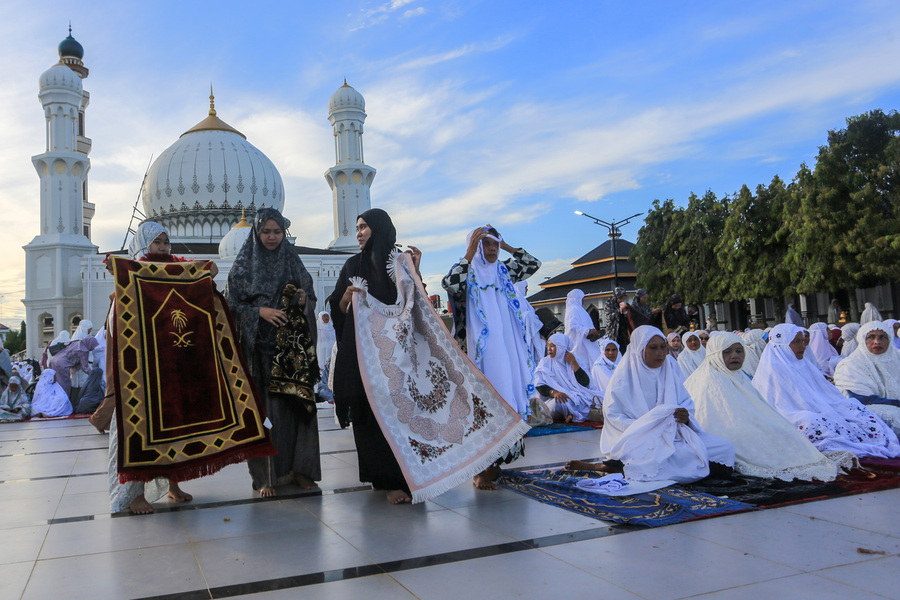
Muhammadiyah General Chairman Haedar Nashir has urged Muslims to seize Eid al-Adha as an opportunity to cultivate grounded spiritual taqwa in personal, social, national, and universal human life. “Eid al-Adha should not be seen merely as a formal ritual involving Eid prayers and animal sacrifice. Beyond these acts lies a deeper purpose: shaping individuals who are pious towards Allah SWT,” he said on Tuesday (26 May). According to Haedar, all Islamic rituals, including Eid prayers and sacrifice, ultimately aim to cultivate individuals who submit to Allah, follow His commands, and avoid His prohibitions. “Allah states that it is not the meat and blood of the sacrificial animal that reaches Him, but the piety of those who perform it. Therefore, the essence of Eid al-Adha is the strengthening of spirituality and morality,” he said in a press release on Tuesday (26 May). Haedar explained that the examples of Prophet Ibrahim, Siti Hajar, and Prophet Ismail embody a revolutionary spiritual taqwa. They demonstrated total submission to Allah’s will through extraordinary sacrifices. “Prophet Ibrahim was willing to sacrifice his beloved son upon Allah’s command. Siti Hajar displayed unwavering faith, while Prophet Ismail showed profound obedience. They serve as exemplary models of how taqwa gives rise to a spirit of sacrifice and virtue,” he added. He added that spiritual taqwa enables individuals to free themselves from the chains of base desires, worldly greed, and personal egoism, fostering a spirit of ihsan (excellence in goodness) that transcends everyday life. Haedar noted that if the values of Eid al-Adha are truly internalised by Muslims, socially righteous individuals will emerge in society. Whether ordinary citizens or leaders, the pious will fear Allah and thus avoid wrongdoing and corruption. “Those with spiritual taqwa will live with honesty, simplicity, sincerity, patience, humility, and compassion for others,” he said. They also possess a strong work ethic, positive thinking, diligence, and view worldly life as a field of deeds for the hereafter. Conversely, Haedar warned that those who lose the value of taqwa are prone to corruption, abuse of power, economic greed, systemic manipulation, and actions that damage the environment and social life. “Spiritual taqwa prevents corruption, arbitrary use of power, rejection of criticism, greed, and environmental destruction for short-term gains,” he stressed. In the context of modern life, Haedar also highlighted the importance of upholding noble ethics in public spaces and social media. He said pious individuals will guard their speech, avoid hate speech, slander, misinformation, and other digital behaviours that undermine unity and civilisation. “Taqwa must be reflected in social media use, in preserving unity, respecting differences, and actively building brotherhood,” he said. Haedar also addressed national challenges still faced by Indonesia, such as social inequality, corruption, social conflicts, and opportunistic behaviour that continues to erode communal life. He stated these issues stem from human greed that has lost moral and spiritual direction. When wealth is concentrated in a few hands while many struggle, justice and taqwa are in crisis. “The desire to possess everything without limit drives people to harm others and damage the environment. Therefore, this nation needs a revival of spiritual taqwa that produces tangible virtue,” he said. Haedar hoped Eid al-Adha would not remain an annual ceremony but become a moral transformative force for the Muslim community and nation. Spiritual taqwa, he added, must create a more just, civilised, and beneficial way of life. “Taqwa is not merely beautiful words and rhetoric; it must manifest in actions, policies, and daily life. If spiritual taqwa flourishes in reality, a culture of righteousness will spread virtue to families, society, the nation, and the universe,” Haedar stressed. Specifically, Haedar urged millennial, Gen Z, and Gen Alpha generations to use Eid al-Adha as a means to build strong and progressive character. He hopes young people will grow into religiously devout individuals who love reading, embrace knowledge, master technology and skills, have a strong work ethic, are independent, frugal, and uphold ethics and morality. “Young generations must avoid instant culture, laziness, hedonism, and showing off wealth. Spiritual taqwa must produce generations that are intelligent, integrity-driven, and beneficial to life,” Haedar concluded.