
Muhammadiyah Begins Construction of Infusion Factory in Malang
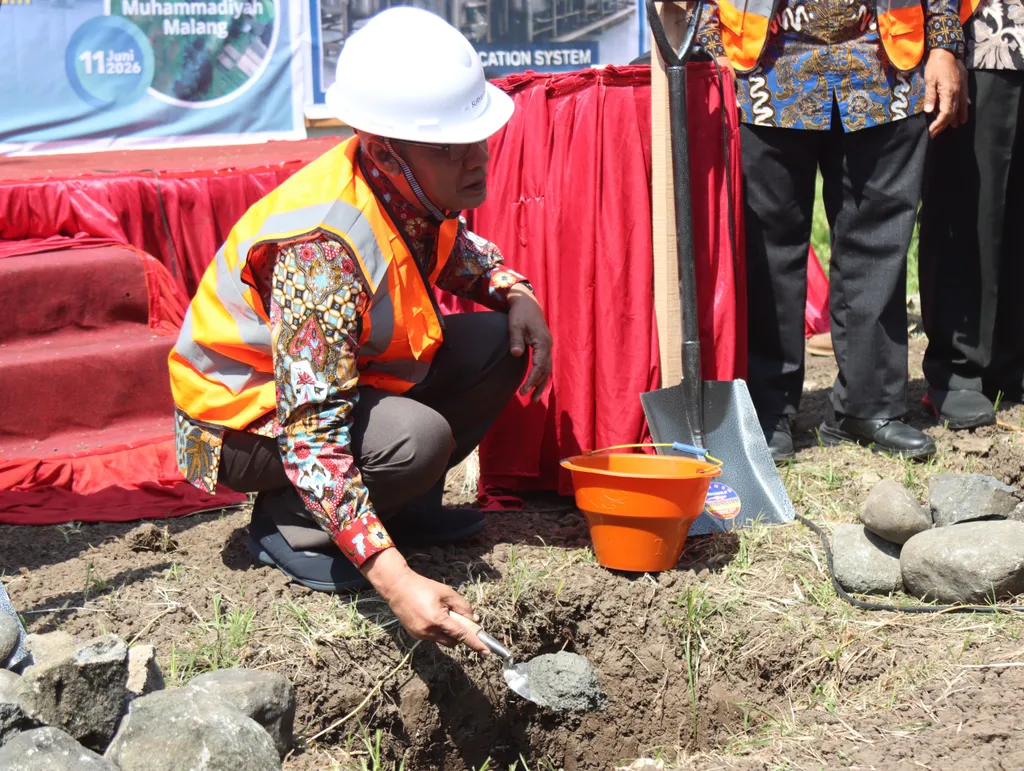
Muhammadiyah’s role in the health sector continues to expand, with the organisation commencing construction of an infusion factory in Karangploso, Malang Regency, East Java, utilising land owned by the University of Muhammadiyah Malang. Of a total 14 hectares available, approximately 3 hectares have been specifically allocated for an integrated industrial zone. The factory’s construction, through PT Suryavena Farma Indonesia—a pharmaceutical company owned by Muhammadiyah’s Central Board—involves an investment of around Rp 800 billion and is targeted to begin operations in 2027. Its production is projected to support the supply chain for Muhammadiyah’s network of hospitals and health facilities, as well as other healthcare providers.
Muhammadiyah’s General Chairman, Haedar Nashir, present at the groundbreaking ceremony on Thursday, stated that the spirit behind building the infusion factory is rooted in a desire to strengthen both the ummah’s economy and the people’s economy. Haedar noted that Muhammadiyah has continuously strengthened the micro, small, and medium enterprise sector, but the time has come for the organisation to move up a level and enter a larger industrial sector. He cited the organisation’s hundreds of hospitals and health facilities requiring a sustainable supply of infusions as the primary reason for choosing this product, arguing that without self-sufficiency, the demand would persistently rely on external parties. Haedar described the step as the most feasible entry point into Muhammadiyah’s hospital business ecosystem, expressing confidence that the organisation will eventually move into the production of pharmaceuticals.
The establishment of the infusion factory is a manifestation of the socioreligious corporation concept developed by Muhammadiyah. Haedar disclosed that the initiative proves a religious organisation can build economic and health self-reliance through professionally managed business activities, with the primary orientation towards public benefit and contribution to the state, rather than solely pursuing financial profit. Meanwhile, Muhammadiyah Central Board Chairman Muhadjir Effendy explained that the organisation has actually been producing infusions through a toll manufacturing scheme for the past two years. Owning its own plant will make the production process more efficient and allow for stricter product quality control. Furthermore, if product prices can be driven lower, the infusions produced will not only be utilised by Muhammadiyah hospitals but also reach a broader consumer base. Regarding employment, Muhadjir added that besides the core business of infusion production, growth will extend to the supply chain, including distribution, which currently collaborates with Kimia Farma. The University of Muhammadiyah Malang’s Vice Rector II, Ahmad Juanda, stated that the university’s contribution does not stop at providing land. The area will be integrated into a laboratory ecosystem for the university’s Directorate of Science and Technology, bridging industrial activity with higher education’s tri-dharma functions of education, research, and human resource development.