
MSME Law Must Be Revised to Strengthen Protection and Competitiveness
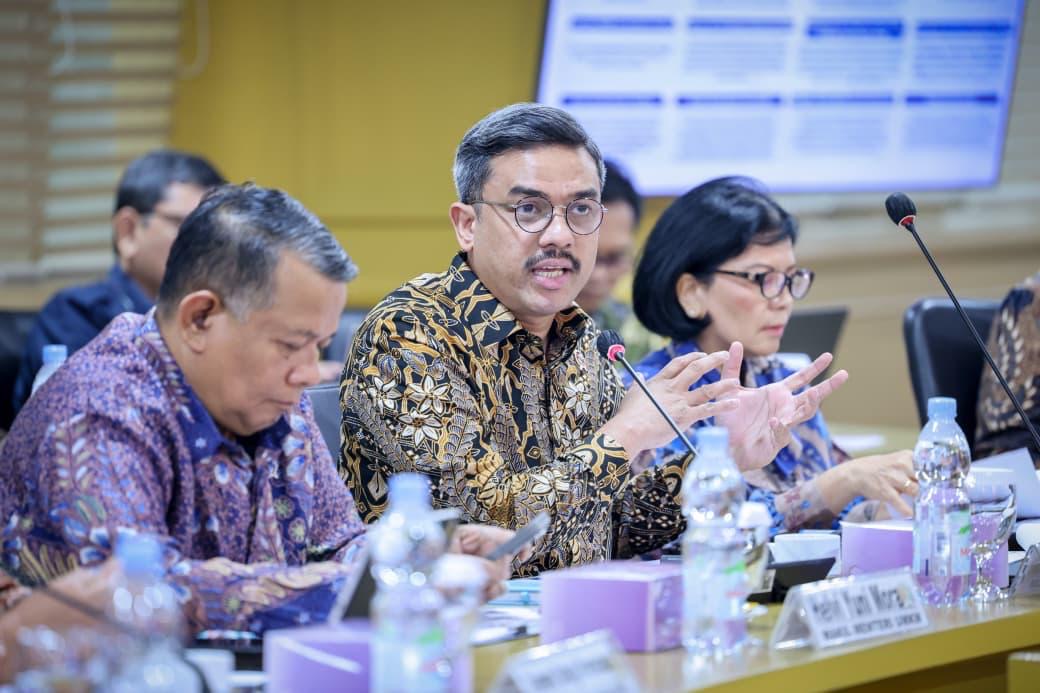
Minister of Micro, Small, and Medium Enterprises (MSMEs) Maman Abdurrahman stated that MSME empowerment over nearly two decades has continued to refer to Law Number 20 of 2008. This situation is no longer relevant as MSMEs now face economic and technological transformation. “The MSME Law has not kept pace with technological developments. The Ministry of MSMEs cannot possibly manage 57 million MSMEs using a conventional approach. Therefore, a revision of the MSME Law is necessary as a step to protect, empower, and enhance the competitiveness of MSMEs,” Maman said during a working meeting with Committee IV of the Regional Representative Council (DPD RI) on Tuesday (9/6). He explained that various provisions concerning MSMEs are currently scattered across numerous regulations and policies implemented by central and regional governments. This often leads to differing approaches in MSME development and empowerment. Hence, the revision of the MSME Law is expected to strengthen policy coordination and synchronisation to make them more effective and integrated. Maman revealed that his ministry is preparing a revision of the MSME Law that will cover various strategic aspects, including strengthening the MSME empowerment system, developing a one-data system and programme coordination, improving technology literacy and infrastructure, regulating the digital economy and marketplace platforms, legal aid and protection, and reinforcing the business mentoring system. According to him, the protection aspect is also a critical concern because millions of MSME entrepreneurs spread across various regions remain vulnerable to practices that harm their businesses. “Millions of MSMEs are spread throughout Indonesia. They face various challenges, including illegal levies and thuggery, yet often lack adequate complaint channels. Therefore, we are preparing a stronger protection strategy,” he stated. In addition, the government is also highlighting the challenges faced by MSME entrepreneurs in the digital trade ecosystem. The increasing business activity through e-commerce platforms needs to be balanced with regulations capable of creating fairer and more sustainable relationships for MSME entrepreneurs. The revision of the MSME Law will also regulate the strengthening of strategic partnerships and the integration of MSMEs into supply chains, protection from unfair business competition practices and the influx of cheap imported products, business recovery mechanisms during crises or disasters, the development of modern financing systems and new forms of collateral, expansion of market access and business internationalisation, as well as strengthened oversight and the application of sanctions. “The current MSME Law does not yet regulate binding sanctions. Going forward, there needs to be an instrument capable of ensuring all parties carry out their responsibilities in protecting, empowering, and increasing the competitiveness of MSMEs,” said Maman. In an effort to strengthen the effectiveness of empowerment policies, the Ministry of MSMEs has also issued Minister of MSMEs Regulation Number 2 of 2026 concerning MSME classification. This regulation serves as a guideline for grouping MSMEs based on specific parameters so that the programmes and policies provided can be more targeted. Furthermore, the Ministry is currently drafting a number of other strategic regulations, including those related to applications for mining business permit areas for MSMEs, MSME protection in electronic trading systems, and national MSME development policies. According to Maman, these various policies will later be integrated through the SAPA UMKM platform, which serves as a national service and data collection system for MSME entrepreneurs. “All these policies will be implemented for MSME entrepreneurs who have completed onboarding through the SAPA UMKM system,” said Maman. On the same occasion, Maman also stated that the government is targeting the distribution of People’s Business Credit (KUR) in 2026 amounting to Rp295 trillion. “This distribution is directed with a portion of 65 percent for the production sector and is targeted to reach 1,372,311 new debtors and produce 1,105,793 graduating debtors,” he added. Meanwhile, throughout 2025, KUR distribution realisation reached Rp270 trillion to 4.58 million debtors. Of that amount, approximately 2.7 million were new debtors and another 1.5 million successfully upgraded their status to become graduating debtors. Efforts by the Ministry of MSMEs to strengthen governance and accelerate business empowerment received appreciation from Committee IV of the DPD RI. Deputy Chair of Committee IV DPD RI Elviana assessed the launch of SAPA UMKM as a strategic step that can strengthen the synergy of various MSME empowerment and marketing programmes within a single integrated ecosystem. “The existence of SAPA UMKM is very visionary. If it runs optimally, this platform has the potential to simplify the marketing chain while strengthening MSME empowerment more effectively,” said Elviana.