
MSME Development Helps Dragon Fruit Farmers Access National and Global Markets
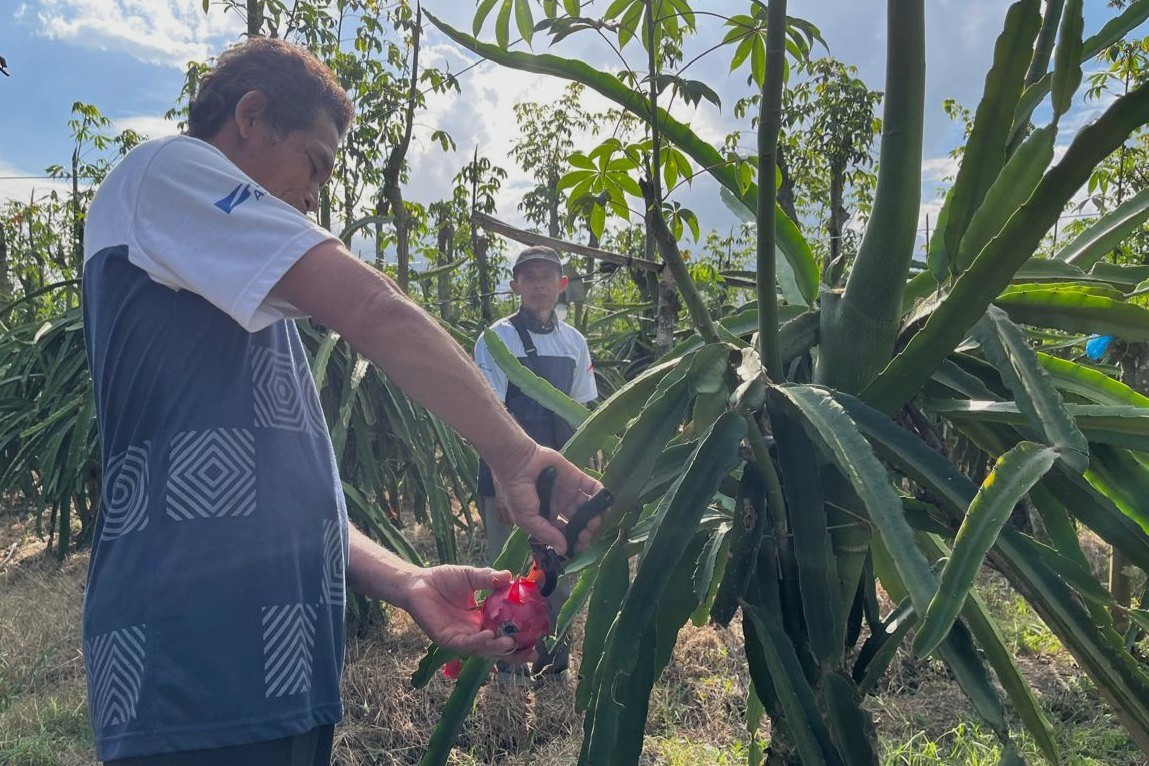
The price of dragon fruit, which once plummeted to Rp1,000 per kilogram, had left farmers in Banyuwangi without hope. Some of the harvest even had to be discarded because the market could not absorb it. However, that situation has now reversed. Through the adoption of organic farming, processing of the harvest, and business mentoring, dragon fruit farmers in Sumbermulyo Village, Banyuwangi, have succeeded in expanding their market overseas.
One such story comes from Sumartini, a dragon fruit farmer who began developing the commodity in 2013. A major challenge came in 2017 when the price of dragon fruit fell drastically. The best quality dragon fruit, or grade A, was priced at only around Rp1,000 to Rp2,000 per kilogram. Meanwhile, grade B and C fruit had almost no market value. This situation meant that much of the harvest was not absorbed by the market, with some even ending up as waste.
“At that time, a lot of fruit went unsold. Some was even thrown away because the market could not absorb it,” she said.
This situation prompted the Sinar Cabe Farmers Group, of which Sumartini is a member, to find a solution so that unsold harvests could still have economic value. One of the steps taken was to process dragon fruit waste into liquid organic fertiliser, which was then reused for cultivation purposes.
The farmers group’s journey developed further after receiving mentoring from Astra through the Dharma Bhakti Astra Foundation (YDBA) in 2020. Through this MSME development programme, the farmers received training in cultivation, harvest processing, and marketing strategies to reach a wider market.
According to Sumartini, one of the important materials provided was an understanding of market access, including exports. The mentoring opened the farmers’ insights into the importance of market diversification so as not to rely solely on local market absorption.
“We were given training related to exports because when production is high, the local market cannot always absorb it all,” she said.
In addition to training, the farmers group also received support for production facilities, including equipment and drums for making liquid organic fertiliser.
A new challenge emerged in early 2021 when a fruit fly infestation threatened garden productivity. Through the mentoring received, the farmers group obtained pest control support, enabling them to maintain the quality of their harvest.
These various efforts have begun to show results. Dragon fruit products that were previously only marketed locally can now enter modern retail markets, hotels, and restaurants. In fact, the farmers group succeeded in supplying dragon fruit for export to Singapore and Hong Kong during the 2022 to 2023 period. In 2025, product samples were again sent to the Netherlands as part of export market exploration.
In addition to selling fresh fruit, the Sinar Cabe Farmers Group has also started developing processed products so that all harvests have economic value. Through collaboration with culinary MSME PT Oreng Osing, dragon fruit that does not meet premium market standards is processed into dried dragon fruit sweets. Under this scheme, the farmers group is responsible for the drying process, while the subsequent processing stages are carried out by the business partner. This collaborative model helps reduce potential waste while increasing the added value of agricultural products.
“Farmers really need mentoring, especially in the early stages. Our biggest challenges used to be cultivation and marketing,” said Sumartini.
Currently, the Sinar Cabe Farmers Group, led by Sumartini, has 30 members with a total cultivation area of around 9.2 hectares. From this land, in 2025, the group was able to produce approximately 595 tonnes of dragon fruit with a turnover reaching Rp11.9 billion.