
MSCI May Downgrade Indonesia’s Stock Market Status, Analyst Warns of Risks
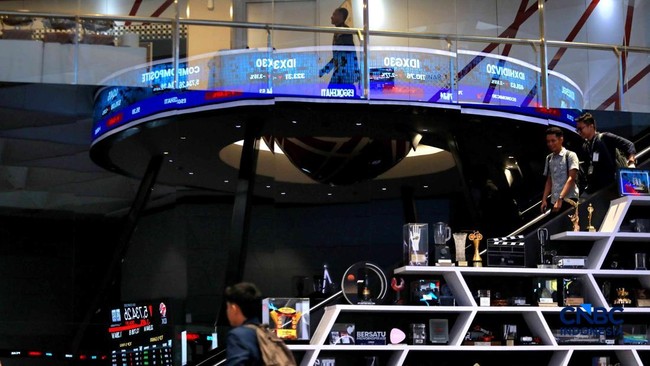
Jakarta, CNBC Indonesia – Analysts have weighed in on Morgan Stanley Capital International’s (MSCI) proposal to downgrade Indonesia’s stock-market classification to standalone status. They broadly agree that the move could have a significant impact on the domestic capital market.
Nafan Aji Gusta, senior investment information analyst at Mirae Asset Sekuritas, said that if MSCI does downgrade Indonesia from emerging market to standalone market, the impact on the domestic capital market would be substantial, affecting foreign fund flows, trading liquidity, share-price volatility and global investors’ perception of Indonesia’s investment risk.
“The change could reduce the exposure of Indonesian shares in the portfolios of international institutional investors that use the MSCI Emerging Markets index as a benchmark,” Nafan told CNBC Indonesia on Friday (16 October 2026).
He added that if portfolio adjustments take place simultaneously, selling pressure could be concentrated in large-cap shares with significant index weightings and high foreign ownership, including several major banking stocks. This could increase volatility and heighten the risk of a correction in the Jakarta Composite Index (IHSG), particularly if accompanied by a weaker rupiah and sustained foreign capital outflows.
“However, the scale of the impact will depend on MSCI’s final decision, the implementation timetable and the ability of domestic investors to absorb the selling pressure,” Nafan said.
He also highlighted fundamental issues behind MSCI’s view that Indonesia may not even qualify for frontier-market status.
“This indicates that the concerns are not simply about market capitalisation or the depth of the stock market, but about the quality of governance and the market’s investability,” he said.
Nafan said MSCI had flagged opaque share-ownership structures, highly concentrated ownership, suspected co-ordinated trading that could disrupt price formation, and a lack of evidence of adequate law enforcement. MSCI also considers that announced reforms, including greater disclosure of shareholders and plans to raise the minimum free float to 15%, have yet to demonstrate consistent and significant effects across the market.
“For this reason, MSCI considers that a downgrade to frontier-market status would not adequately reflect the scale of the issues, and has proposed a standalone-market classification,” he said.
He added that the situation was a serious warning that Indonesia’s capital-market reforms had not yet convinced global institutional investors in terms of implementation and tangible results.
“This does not mean that all reform efforts have failed, but policy announcements and regulatory changes alone are not enough to maintain market confidence. Global investors need evidence that ownership structures are becoming more transparent, that free float genuinely reflects shares available for trading, that market manipulation is consistently acted against when proven, and that price formation is fair. Indonesia’s challenge is therefore to narrow the gap between announced reforms and improvements that market participants can actually see,” he said.
Capital-market observer and Republik Investor founder Hendra Wardana said the IHSG faced extremely heavy selling pressure on Friday (16 October 2026), opening down by around 8%. This showed that the market was dealing with pressure far more serious than a routine technical correction. He said MSCI’s proposal to reclassify Indonesia from an emerging market to a standalone market had heightened investor concerns about the credibility, transparency and governance of Indonesia’s capital market.
“In my view, this sharp fall reflects a crisis of confidence that could trigger a chain reaction of selling, particularly as foreign investors choose to reduce risk before there is clarity about policy direction and the results of reforms,” he told CNBC Indonesia on Friday (16 October 2026).
In such circumstances, Hendra said, selling pressure is determined not only by whether shares are cheap or expensive, but also by the higher risk premium investors demand to invest in Indonesia.
He said the IHSG could continue falling towards 5,200, with its subsequent movement depending heavily on investors’ response after the trading halt, the scale of selling once trading resumes and the index’s ability to hold above support levels.
“If selling intensifies again and the index fails to recover, the risk of further declines will rise. Conversely, if buying emerges in large-cap shares and the index manages to hold above 5,318, a technical recovery is possible, although that would not be enough to conclude that market pressure has ended,” he said.
Hendra said the main risk to watch was a potential outflow of foreign funds if Indonesia’s status in the MSCI index is actually downgraded to standalone market. A change in classification could force passive funds tracking the index to adjust their portfolios, while active fund managers might also reduce their exposure to Indonesia.
Nevertheless, Hendra cautioned that MSCI’s reclassification proposal was not yet a final decision. He said the market needed evidence of implementation and consistent enforcement, rather than policy announcements alone.
“In my view, the priority now is to protect capital and portfolio liquidity while waiting for more convincing signs of stabilisation. Ultimately, an IHSG recovery cannot rely solely on short-term intervention; it requires confidence to be rebuilt through transparency, credible governance and demonstrable enforcement of the rules,” he concluded.
Source: jawawa.id (https://jawawa.id/newsitem/msci-may-downgrade-indonesias-stock-market-status-analyst-warns-of-risks-1792126252)
Originally published by CNBC Indonesia (https://www.cnbcindonesia.com/market/20261016095956-17-776738/msci-mau-turunkan-status-pasar-saham-ri-analis-ungkap-risikonya), translated from Indonesian