
MSCI Effect Intensifies as JCI Plummets 4.31%
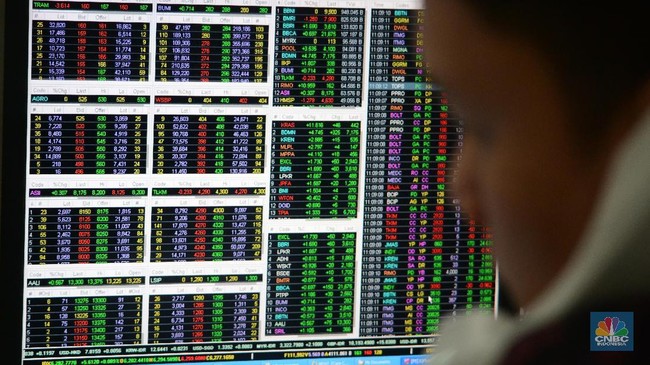
The Indonesia Composite Index (IHSG) opened with a sharp decline in trading today, Monday (18/5/2026). The index began the session down 94.34 points or 1.40% to the 6,447.97 level. However, just two minutes after the market opened, the IHSG slumped further by 2.59%, and the decline worsened 60 minutes later, with the index dropping 4.3% to the 6,428 level.
A total of 707 stocks declined, 87 stocks gained, and 167 stocks remained stagnant. Transaction value was recorded at Rp7.79 trillion, with a trading volume of 13.67 billion shares across 1.15 million transactions.
Prajogo Pangestu’s stocks remain the primary drivers of the IHSG’s weakness, alongside several other issuers, including DSSA, which have drawn the attention of international index providers MSCI and FTSE. The greatest pressure on the IHSG since the weekend has originated from stocks removed from the MSCI Global Standard Index and the MSCI Global Small Cap Index.
MSCI has officially removed six Indonesian stocks from the MSCI Global Standard Index, namely: PT Amman Mineral Internasional Tbk (AMMN), PT Barito Renewables Energy Tbk (BREN), PT Chandra Asri Pacific Tbk (TPIA), PT Dian Swastatika Sentosa Tbk (DSSA), PT Petrindo Jaya Kreasi Tbk (CUAN), and PT Sumber Alfaria Trijaya Tbk (AMRT). Additionally, MSCI removed 13 Indonesian stocks from the MSCI Global Small Cap Index.
Shortly after the MSCI announcement, another global index provider, FTSE, also addressed the future of Indonesian stocks included in its indices. In a recent announcement titled “Index Treatment for the June 2026 Index Review” released on Wednesday (13/5/2026), FTSE issued a stern signal regarding the potential removal of stocks with High Shareholding Concentration (HSC) on the Indonesia Stock Exchange (BEI).
The new FTSE rule was issued following efforts by Indonesian capital market authorities to increase transparency, including the publication of the High Shareholding Concentration (HSC) list. In the document, FTSE Russell emphasised that if a company becomes subject to a shareholding concentration warning from exchange and financial authorities—where floating shares are controlled by only a few parties—the stock will be removed from the index during the next review.
“To ensure the integrity and replicability of the index, FTSE Russell will remove securities affected by a zero price during the June 2026 review, effective from the market opening on Monday, 22 June 2026,” the official announcement stated. This “zero price” policy is adopted because FTSE assesses that the liquidity of HSC stocks tends to deteriorate materially. There are concerns that institutional passive fund managers may not find sufficient counterparties if they are forced to exit such stocks suddenly.
While FTSE has not yet released a specific list of threatened issuers, several stocks appear likely to be significantly impacted. Two major issuers, often associated with free float and ownership concentration issues—PT Barito Renewables Energy Tbk (BREN), owned by tycoon Prajogo Pangestu, and PT Dian Swastatika Sentosa Tbk (DSSA) from the Sinarmas group—are under scrutiny as both are on the BEI’s HSC list.
According to Refinitiv data, all trading sectors weakened today, with the deepest pressure felt in the infrastructure, basic materials, energy, and technology sectors. The primary contributors to the IHSG’s decline this morning included Bank Central Asia (BBCA), which fell 2.5% and contributed 14.05 index points, and Dian Swastatika Sentosa (DSSA), which hit the lower auto rejection (ARB) limit, dropping 15% to Rp 880 per share, contributing 13.67 index points.
Chandra Asri Pacific (TPIA) also hit the ARB limit, falling 14.88% to Rp 3,660 per share, contributing 13 index points. Furthermore, Barito Renewables Energy (BREN) dropped to the 2,880 level and is no longer the largest market cap issuer in Indonesia, with its contraction contributing 10 index points. AMMN, which was removed from the MSCI index last week, also contributed 9.12 index points to the decline.
After more than one hour of trading, the IHSG began to resist, gradually narrowing its losses to 3.91%. However, volatility in the Indonesian stock market remains extremely high and difficult to predict.