
MSCI Considers Removing Indonesia from Global Index, Putting Foreign Funds at Risk
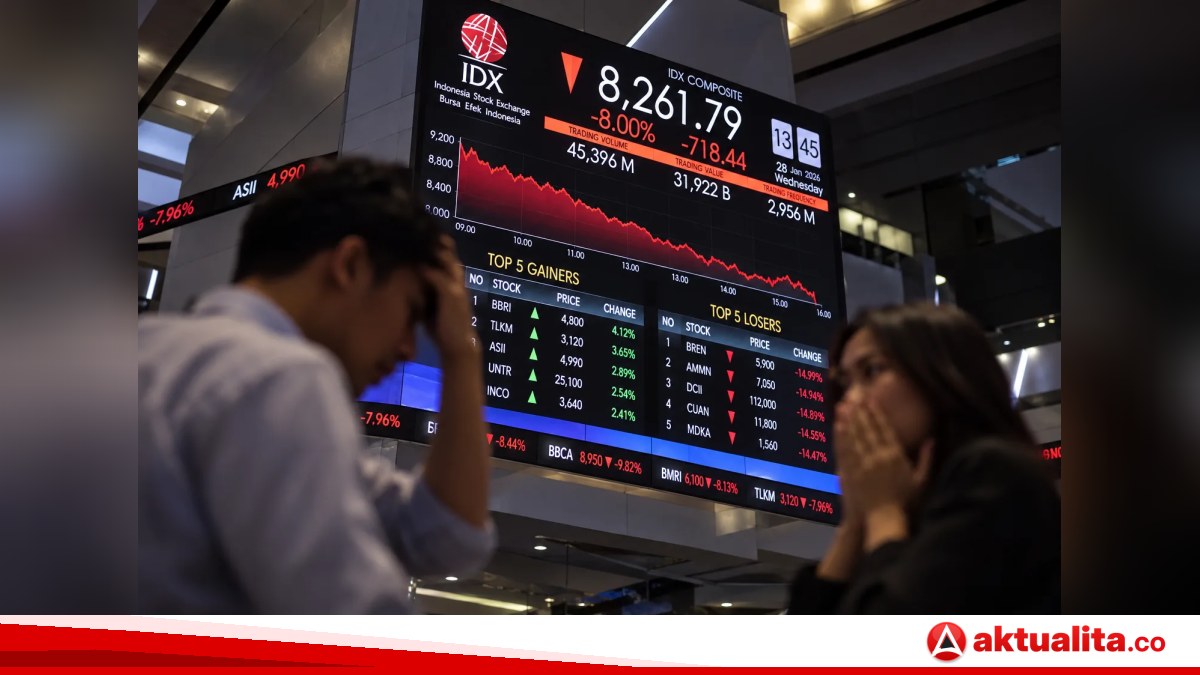
Jakarta, Aktualita.co — The Indonesian capital market is facing a serious threat after global index provider Morgan Stanley Capital International (MSCI) considered removing Indonesian stocks from its emerging market index group. If the plan is realized, billions of US dollars in foreign investment funds could potentially leave the Indonesia Stock Exchange (IDX).
The concern arose after MSCI announced a proposal to change Indonesia’s classification from Emerging Market to Standalone Market on Thursday (10/15/2026) US time.
The impact was immediately felt during trading on Friday (10/16/2026). The Composite Stock Price Index (IHSG) plunged 11.57 percent and closed at the 5,185.10 level. The decline was one of the worst daily drops for the Indonesian stock market since the 1998 Asian financial crisis.
However, Indonesia has not been officially removed from the MSCI global index. The proposal is still in the consultation stage, with a final decision scheduled for no later than June 2027.
Up to US$19 Billion in Foreign Funds Potentially at Risk
The biggest threat from Indonesia’s status change is not merely a drop in market classification. The MSCI decision could affect the placement of international investment funds that have long used the index as a benchmark.
Several investment banks estimate that potential outflows from passive funds could reach US$3 billion to US$6 billion if Indonesia truly loses its emerging market status.
JPMorgan estimates that potential passive fund outflows could be around US$4.8 billion.
Meanwhile, UBS estimates that active funds could also potentially withdraw up to US$15 billion. If using the UBS estimate for both groups of investors, the total potential outflow could approach US$19 billion.
This figure is a projection based on the classification change scenario, not funds that have already left the Indonesian stock market.
Passive investors generally manage portfolios by following the composition of a specific index. When a country is removed from the benchmark index, fund managers must adjust their holdings.
Unlike passive investors, active investment managers have the flexibility to determine fund allocation. However, increasing market risk and regulatory uncertainty could prompt them to reduce exposure to Indonesian stocks.
Why is MSCI Considering Removing Indonesia from the Global Index?
MSCI stated that the assessment of the Indonesian capital market is influenced by a number of issues that are considered not to have shown adequate improvement.
One of the main concerns is the transparency of share ownership structures. MSCI also highlighted alleged coordinated trading activities and the effectiveness of capital market supervision and enforcement.
These issues relate to the ability of international investors to know the number of shares that are truly available for free trading, or free float.
Lack of clarity in ownership and high concentration of shares are considered to make it difficult for investors to determine the fair value of shares and measure market liquidity.
Previously, MSCI had warned of the possibility of downgrading Indonesia to Frontier Market status. However, in the latest announcement, the institution assessed that this category did not sufficiently reflect the issues found.
Therefore, MSCI proposed a lower classification, namely Standalone Market.
If the change is implemented, Indonesia risks losing access to investment fund flows that follow emerging market or frontier market indices.
IHSG Plummets, Stock Market Value Shrinks
Investor concern over the MSCI decision immediately shook the domestic financial market.
On Friday (10/16/2026), selling pressure caused the IHSG to drop sharply from the opening of trading. The IDX even temporarily halted transaction activities through a trading halt mechanism.
The index decline continued until the close of trading, with a number of large-cap stocks experiencing significant selling pressure.
The fall is estimated to have wiped out approximately US$65 billion in Indonesian stock market capitalization. This value reflects the shrinkage in stock valuation, not the total foreign cash withdrawn by investors.
Pressure also spread to the foreign exchange market. The Rupiah weakened to around Rp18,070 per US dollar before trimming some of its losses.
This situation shows that concerns over capital market integrity have the potential to affect investor confidence in Indonesian financial assets more broadly.
OJK Prepares Capital Market Improvement Steps
The Financial Services Authority (OJK) stated that it respects the MSCI assessment and will continue reforms to strengthen the transparency and integrity of the national capital market.
Chairman of the OJK Board of Commissioners, Friderica Widyasari Dewi, emphasized that the Indonesian stock market remains attractive to investors.
“We believe the domestic capital market remains prospective and attractive,” said Friderica in her official statement, Friday (10/16/2026).
According to the OJK, a number of improvement steps have been taken, including increasing the disclosure of share ownership above 1 percent, strengthening investor classification, and implementing supervision of share ownership concentration.
The regulator is also preparing to increase the minimum public float requirement to 15 percent.
On the same Friday, the OJK announced administrative sanctions with a total fine of Rp2.1 trillion related to the investigation of capital market violations involving DSSA, BREN, and CUAN shares.
These sanctions are part of the law enforcement steps that are of concern to global investors.
The IDX also plans to request further clarification from MSCI regarding the basis for the proposal to change Indonesia’s status.
However, the announcement of reforms and the imposition of sanctions does not automatically guarantee that MSCI will cancel the classification downgrade plan.
What is the Impact on Investors and the Indonesian Economy?
If Indonesia is truly designated as a Standalone Market, the impact could potentially extend beyond a decline in stock prices.
Public companies could face greater challenges in attracting international investors. Reduced demand for shares could potentially pressure company valuations while increasing the cost of raising capital.
This condition could also affect state-owned companies that require large funding for expansion or long-term investment.
For retail investors, increased market volatility is a risk that needs to be considered. However, an MSCI classification change does not mean that all Indonesian stocks automatically lose value or that all foreign investors are required to leave the market.
The final impact depends on the MSCI decision, the policies of individual investment managers, and the response of the government and regulators.
Currently, MSCI is still accepting input from market participants until April 30, 2027. The final decision will be announced no later than June 30, 2027.
This period is an opportunity for Indonesia to prove that transparency, governance, and law enforcement reforms are being implemented consistently.
For the Indonesian capital market, the issue now is not just maintaining Emerging Market status, but restoring global investor confidence in the quality and integrity of domestic stock trading.
Source: jawawa.id (https://jawawa.id/newsitem/msci-considers-removing-indonesia-from-global-index-putting-foreign-funds-at-risk-1792245010)
Originally published by aktualita.co (https://aktualita.co/en/economy/msci-considers-removing-indonesia-from-global-index-billions-in)