
MSCI and the Warning Bell for Indonesia’s Capital Market
A healthy market is not one in which the index chart is constantly green. A healthy market is one that allows investors to assess risk rationally, access accurate information and operate free from transaction manipulation.
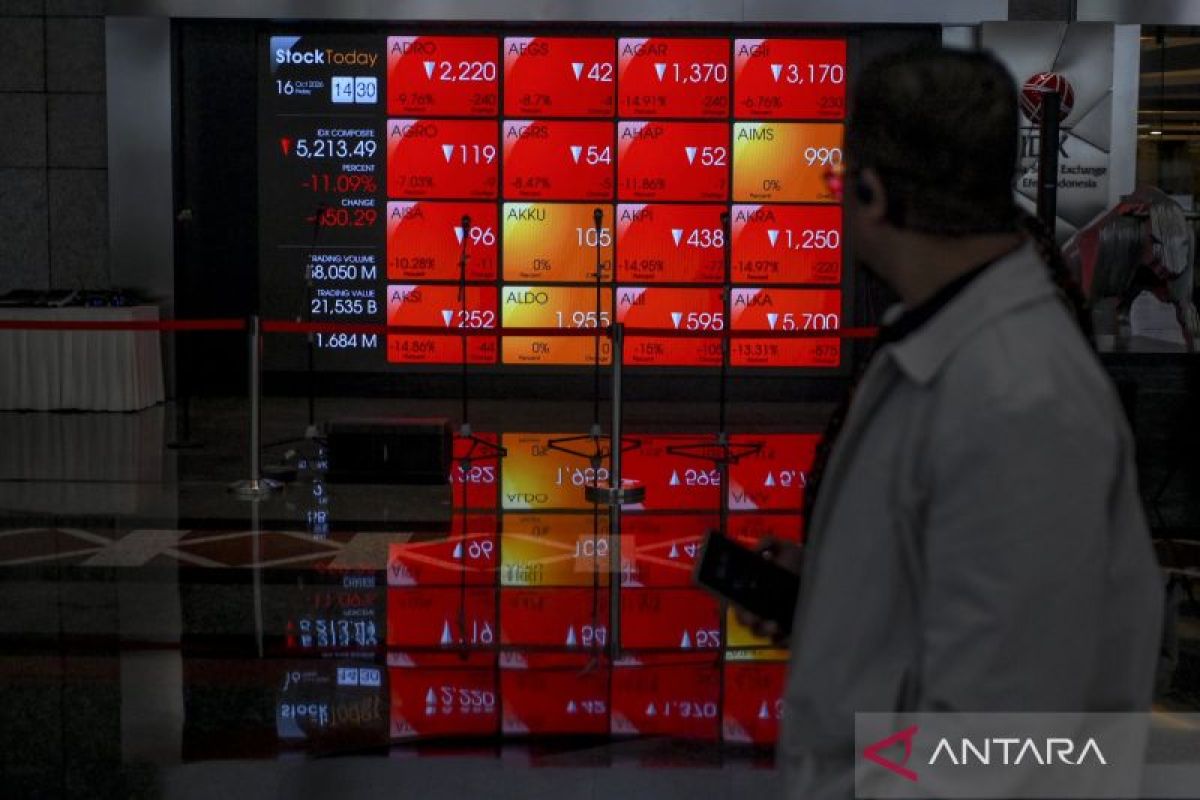
Jakarta (ANTARA) – On Friday afternoon (16 October), my family WhatsApp group suddenly sprang to life. The topic was not holiday plans, but news that the Jakarta Composite Index (JCI) had plunged by as much as 11 per cent in a single day.
My younger sibling, who was just about to start investing in mutual funds, was curious and asked: “What’s going on?”
The answer lies in 15 October 2026. Morgan Stanley Capital International (MSCI), a New York-based global index provider, announced that it was reviewing the status of Indonesia’s capital market, from emerging market to standalone market.
For most people, the term may sound unfamiliar. But for investment managers in London, Singapore and Tokyo, MSCI’s classification is a key reference in determining whether their funds may be invested in Indonesia or must be withdrawn.
Put simply, if Indonesia is removed from the emerging-market category, funds that investors have placed in the country could automatically be redirected to other markets. Not because they dislike Indonesia, but because their portfolio rules require it.
This is a matter of trust. MSCI is essentially signalling that Indonesia’s financial market is not yet sufficiently transparent or fully reliable.
MSCI’s warning
MSCI has not accused Indonesia of doing nothing. It has acknowledged reforms including disclosure of share ownership above one per cent, improvements to investor classification data, disclosure of High Shareholding Concentration, and new rules to raise the minimum public shareholding, or free float, to 15 per cent.
But MSCI’s concern is not limited to whether the requested policies have been introduced. It is also about how they are implemented.
In response to concerns about market integrity, the Financial Services Authority (OJK) has so far imposed administrative sanctions and fines totalling Rp2.1 trillion on three listed companies: PT Dian Swastatika Sentosa Tbk (DSSA), PT Barito Renewables Energy Tbk (BREN) and PT Petrindo Jaya Kreasi Tbk (CUAN).
The sanctions followed findings of indications of trading manipulation in DSSA shares, as well as violations in the initial public offering (IPO) processes of BREN and CUAN.
Hasan Fawzi, OJK’s Chief Executive for Capital Markets, Derivatives Finance and Carbon Exchanges, said MSCI’s feedback was in fact in line with the Action Plan to Accelerate Reform of the Integrity of Indonesia’s Capital Market.
He stressed that the OJK was fully committed to strengthening law enforcement to safeguard capital-market integrity, including through close coordination and cooperation with various stakeholders.
Echoing the OJK, Coordinating Minister for Economic Affairs Airlangga Hartarto said capital-market reform must demonstrate concrete progress to both domestic and foreign investors.
This underscores that Indonesia’s task following MSCI’s announcement is not merely to retain its emerging-market label, but to ensure that the reforms bring substantive change to the country’s capital-market industry.
Source: jawawa.id (https://jawawa.id/newsitem/msci-and-the-warning-bell-for-indonesias-capital-market-1792165986)
Originally published by Antara (Indonesian) (https://www.antaranews.com/berita/5792345/msci-dan-alarm-pasar-modal-indonesia), translated from Indonesian