
MPs Join Forces to Urge Indonesian Vice-President to Abandon Resignation Plan
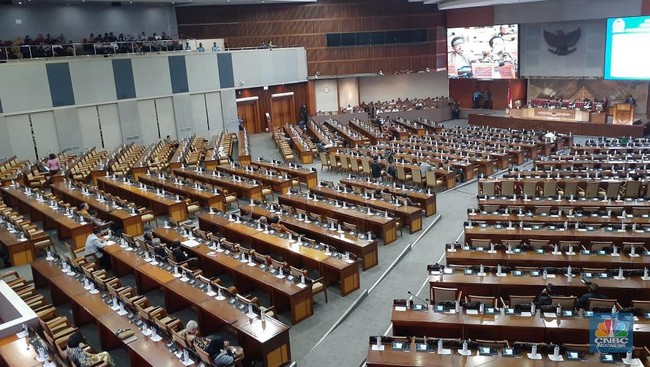
Jakarta, CNBC Indonesia — History shows that an Indonesian vice-president’s decision to resign has not always been accepted without question. One example was Vice-President Mohammad Hatta’s resignation on 1 December 1956, when a number of members of the House of Representatives (DPR) tried to persuade him to reconsider leaving the country’s second-highest office.
Hatta had previously written to the Speaker of the DPR on 20 July and 23 November 1956 to inform him of his resignation. In letter No. 47/56, Hatta confirmed his decision.
“Further to my letter to you dated 20 July 1956, No. 35/56, I hereby respectfully inform you that on 1 December 1956 I will resign from my post as Vice-President,” Hatta wrote in the letter, quoted by the newspaper Indonesia Raya on 28 November 1956.
The decision immediately became a subject of debate in Parliament. One faction that reacted by urging Hatta not to resign was the Indonesian National Party (PNI), which won the 1955 election and secured 57 seats.
In a statement, the PNI’s central executive board said the Indonesian people’s struggle still required Hatta’s involvement in national leadership.
“The PNI strongly disagrees with Bung Hatta’s intention. The PNI believes that, at this stage, the Indonesian people’s struggle to complete the national revolution and carry out state development still requires the participation of the political figure Bung Hatta in the country’s leadership,” Indonesia Raya reported on 28 November 1956.
The PNI hoped Hatta would abandon his plan or at least postpone his resignation until the Constituent Assembly had completed drafting a new constitution. Even if Hatta remained determined to resign, the party suggested that “he be given the opportunity to lead the Cabinet to overcome the turmoil in the country and continue the development of our nation”.
Parliament’s seriousness was also evident in its decision to send a five-member delegation to meet Hatta. Its members were Arudji Kartawinata (PSII), Djokrosujoso (Masyumi), K.H. Masjkur (NU), Mr Hardi (PNI) and Peris Pardede (PKI). As 1 December approached, they were asked to meet the second Vice-President in person and seek an explanation for his resignation.
The delegation was scheduled to report the results of its visit to the DPR leadership that evening. The report would then be forwarded to a plenary session of the DPR, which was to reach a decision that same night.
After meeting the delegation, however, Hatta remained firm in his decision to resign. The DPR then held a session at 9pm and expressed its gratitude and highest appreciation to the West Sumatra-born statesman for his 11 years as Indonesia’s second-highest office-holder.
“The DPR expresses its most sincere gratitude and highest appreciation for his service to the nation and state,” the Speaker of the DPR said, as quoted by Indonesia Raya on 1 December 1956.
After Hatta’s resignation, the vice-presidency remained vacant until 1973. In his biography Mohammad Hatta: Political Biography (1990), Hatta later explained that he resigned because he was no longer in agreement with President Soekarno’s policies.
Source: jawawa.id (https://jawawa.id/newsitem/mps-join-forces-to-urge-indonesian-vice-president-to-abandon-resignation-plan-1794376246)
Originally published by CNBC Indonesia (https://www.cnbcindonesia.com/entrepreneur/20261111070759-25-784080/anggota-dpr-ramai-ramai-minta-wapres-ri-ini-batalkan-niat-mundur), translated from Indonesian