
MPs Back Bahlil’s Plan for a Moratorium on Nickel Smelter Projects
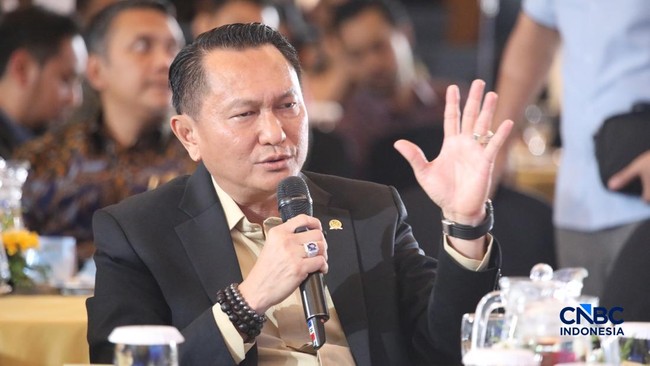
Jakarta, CNBC Indonesia — The House of Representatives’ Commission XII has weighed in on the Energy and Mineral Resources Ministry’s proposal to temporarily halt construction of nickel smelters that produce only semi-finished goods.
The proposal is considered appropriate because domestic capacity for Nickel Pig Iron (NPI) smelting has become excessive, or overloaded.
Bambang Patijaya, deputy chairman of the Golkar Party faction in the House and Golkar’s Commission XII group leader, said his party supported the government considering a moratorium, as nickel supplies exceed market requirements and put downward pressure on prices.
He said the policy could provide an important opportunity to redirect investment towards further-processing industries.
“Indonesia has been quite successful in the first stage of downstreaming. In nickel, for example, we have NPI and ferronickel, but most NPI products are sold overseas. What we need now is further downstreaming, rather than stopping at the construction of first-stage plants or semi-finished-product smelters,” he said in a written statement on Thursday (8 October 2026).
He said most nickel smelters currently operating process ore with a nickel content of about 50% to 60%. Most of the resulting semi-finished NPI and ferronickel is sold directly overseas, meaning the economic added value for Indonesia remains below its potential.
“What we hope for is investment in industries that process these semi-finished materials into other derivative products,” he added.
The plan to stop issuing permits for semi-finished nickel smelters will be discussed at ministerial level before being reported to President Prabowo Subianto. Patijaya urged the government to ensure new investment is genuinely directed towards facilities that make more advanced nickel derivative products.
“We are open to all ideas and suggestions, including the Energy and Mineral Resources Minister’s proposal for a moratorium on semi-finished nickel smelters. NPI smelter capacity in Indonesia is already overloaded. What we need are further-processing smelters that process NPI,” he said.
Energy and Mineral Resources Minister Bahlil Lahadalia, who is also Coordinating Minister for Downstreaming and Energy Transition, previously said his ministry was studying a moratorium or restrictions on the construction of nickel refining and processing facilities that still produce semi-finished goods. The review takes into account the global nickel oversupply, which has caused prices to fall sharply.
He said most operating nickel smelters still produce semi-finished materials with a nickel content of around 50% to 60%. Supply currently exceeds market demand by as much as 2.5 million tonnes, directly affecting international nickel prices.
“There is an oversupply, which is why prices are falling. We can consider beginning to limit semi-finished-product industries, perhaps even imposing a moratorium, while encouraging industries whose products are further downstream,” he said on the sidelines of the 2026 Investor Daily Summit in Jakarta on Wednesday (7 October 2026).
Bahlil said the government would regulate national production volumes so that Indonesian mining commodities are not sold cheaply when markets are saturated. Although installed smelter capacity is theoretically high, actual operating levels will be adjusted in a measured way to reflect global supply and demand.
“Even if installed capacity is, say, 10, production may not reach 10 while there is still an oversupply. That is what we will regulate. If we keep meeting every smelter’s demand, our prices will certainly fall,” he added.
As well as stabilising prices and optimising state revenue, production controls are intended to ensure the sustainability of national natural resources. Bahlil noted that minerals such as nickel are finite and cannot grow back like agricultural or plantation crops.
“If prices are plunging, we should not flood the market and make our goods cheap. We do not want to sell our goods cheaply. Nickel and coal do not grow back once extracted. We must also protect these resources sustainably for the nation’s future,” he said.