
MPR's Constitutional Commission Evaluates Regional Autonomy and Natural Resource Governance
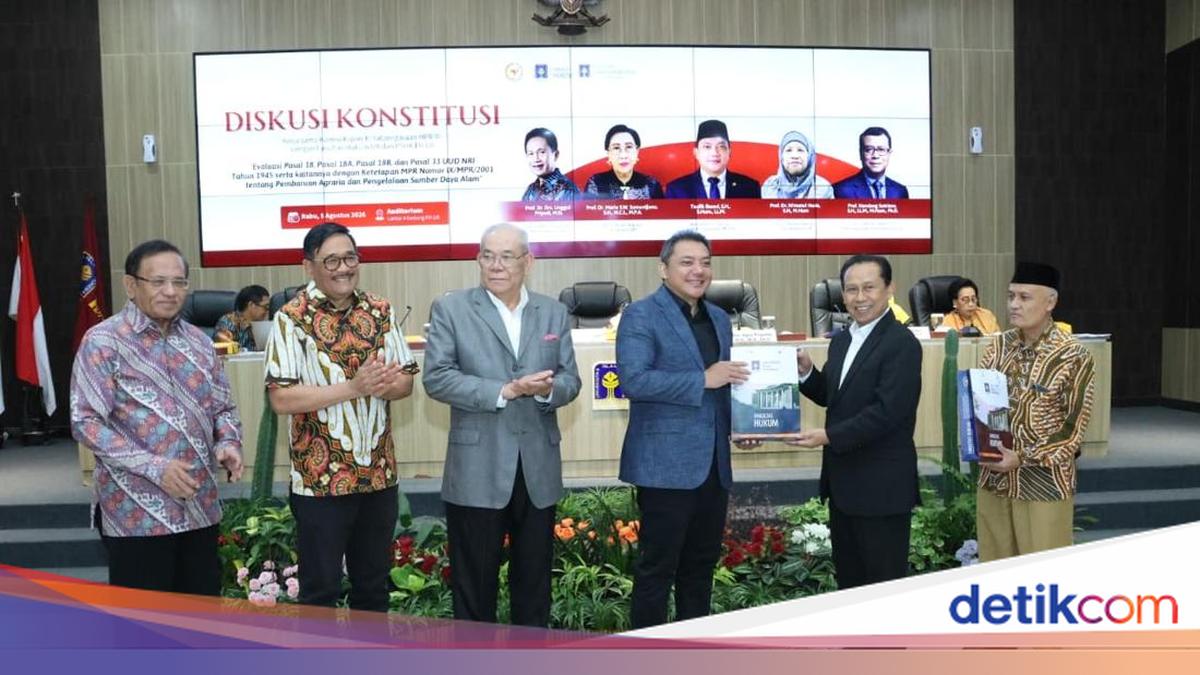
The Constitutional Studies Commission (K3) of the People’s Consultative Assembly (MPR) is preparing strategic recommendations for the MPR leadership regarding the evaluation of constitutional mandates on regional autonomy, economic democracy, agrarian reform, and natural resource management. The recommendations are based on an academic study gathering views from experts across various universities to strengthen constitutional policy.
As part of this process, K3 MPR held a Constitutional Discussion in collaboration with the Faculty of Law at the Islamic University of Indonesia (UII) and the UII Faculty of Law’s Center for Constitutional Studies in Yogyakarta on Wednesday (5/8/2026). The discussion focused on evaluating the implementation of Articles 18, 18A, 18B, and 33 of the 1945 Constitution, along with related MPR Decrees, including TAP MPR No. XV/MPR/1998 on Regional Autonomy, TAP MPR No. XVI/MPR/1998 on Economic Politics in the Framework of Economic Democracy, and TAP MPR No. IX/MPR/2001 on Agrarian Reform and Natural Resource Management.
K3 MPR Chairman Taufik Basari explained that the commission, comprising 65 figures including drafters of the 1945 Constitution amendments from 1999-2002, is mandated to review constitutional implementation. He stated that in 2026, the commission is focusing on evaluating how the reform mandates regarding regional autonomy, economic democracy, and natural resource management have been implemented in state administration. “We want to ensure the recommendations are based on scientific studies and reflect the reality of constitutional implementation on the ground,” Basari said on Monday (10/8/2026).
UII Rector Prof. Hari Purnomo welcomed the collaboration, stating that evaluating regional autonomy and natural resource management is a strategic issue directly linked to realizing the people’s prosperity as mandated by the constitution. He noted that universities have a moral and academic responsibility to contribute thought to state policy formulation.
Prof. Maria S.W. Sumardjono, Professor of Agrarian Law at Gadjah Mada University, assessed that TAP MPR No. IX/MPR/2001 remains relevant more than two decades after its enactment. She noted that the underlying issues, such as agrarian conflict, environmental degradation, regulatory overlap, and inequality in natural resource management, have become increasingly complex. Sumardjono highlighted the slow implementation of agrarian reform, rising land conflicts, and the lack of optimal regulatory harmonization in the natural resource sector. “The constitutional direction is available, but it is not yet supported by political commitment, strong conflict resolution institutions, or effective accountability mechanisms,” she said.
Prof. Nandang Sutrisno, Professor of International Trade Law at UII, reviewed the implementation of Article 33 of the 1945 Constitution from an international trade perspective. He emphasized that state control over natural resources should not be measured solely by the extent of state ownership but must be realized through policies that deliver the greatest prosperity for the people, guided by democratic, accountable, proportional, and sustainable principles aligned with international commitments.
Prof. Unggul Priyadi, Professor of Institutional Economics at UII, stressed the importance of strengthening institutions in natural resource management. He argued that weak institutions trigger moral hazard, opportunistic practices, corruption, and economic inequality, necessitating inclusive institutions to ensure the benefits of resource management are felt fairly by all citizens.
Prof. Ni’matul Huda, Professor of Constitutional Law at UII, assessed that the implementation of Articles 18, 18A, and 18B of the 1945 Constitution still faces challenges, including a tendency toward recentralization of authority, fiscal imbalances between central and regional governments, and the suboptimal regulation of customary law communities and special autonomy regions. He emphasized the need for regulatory reform to ensure constitutional recognition of regions and customary law communities is effectively implemented.
Closing the discussion, Taufik Basari confirmed that all views and input from academics gathered during the series of discussions at various universities will be compiled into a comprehensive study by K3 MPR. The study will then be submitted to the MPR leadership as a strategic recommendation to strengthen constitutional implementation.