
MPR-UNS explores PPHN proposals to strengthen development continuity
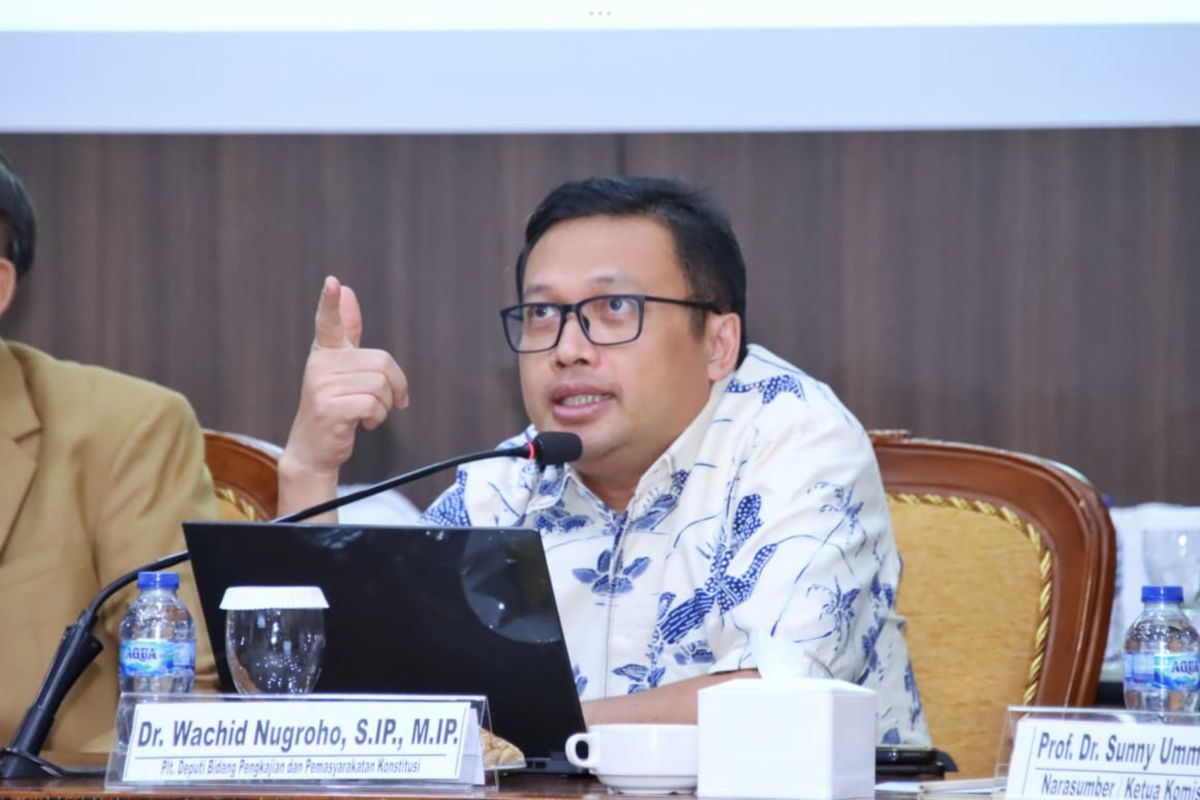
Jakarta (ANTARA) – Acting Deputy for Constitutional Studies and Dissemination at the People’s Consultative Assembly (MPR RI), Wachid Nugroho, said the MPR was continuing to examine the idea of State Policy Guidelines (Pokok-Pokok Haluan Negara, or PPHN) to clarify the direction of national development and address unresolved constitutional issues following amendments to the 1945 Constitution of the Republic of Indonesia.
The MPR considers that the substance of state guidelines can still be found in the Preamble and articles of the 1945 Constitution, MPR decrees that remain in force, and court rulings. However, these instruments have not yet been fully connected within a coherent and continuous framework.
“The problem now is that we still have state guidelines, but their links are scattered,” Wachid said in a statement in Jakarta on Wednesday.
Wachid made the remarks at a focus group discussion organised by the MPR Secretariat-General in partnership with the Professors’ Council of Sebelas Maret University (UNS), in the university rectorate’s Meeting Room IV in Surakarta, Central Java.
The discussion, themed “Upholding National Identity and the Direction of the Nation’s Civilisation: Reactualising Pancasila Values and the Status of MPR Decrees in Indonesia’s Constitutional System”, was part of the MPR’s effort to gather academic views and input as it examines the possible development of PPHN.
Wachid said the MPR had been studying the PPHN proposal since 2009. One fundamental issue under consideration is the status of state guidelines after the amendments to the 1945 Constitution, including whether they have disappeared or remain dispersed across various legal instruments.
He said the development of PPHN should be considered within a framework of three complementary basic consensuses: Pancasila as the foundation and source of values, the 1945 Constitution as the rules governing the state, and state guidelines as the direction for national development.
“Pancasila answers the question of what values underpin our state; the 1945 Constitution sets out the rules governing the state; and state guidelines answer where and how we should proceed. All three are centred on the goals of the state,” he said.
The MPR is also considering how well the public understands and internalises the constitution and state institutions. Wachid cited a 2025 Kompas Research and Development survey, which found that public knowledge of the MPR scored 3.42 out of four, while internalisation of its values scored 2.98. Knowledge of the 1945 Constitution scored 2.78.
The MPR is also monitoring follow-up action on several decrees that remain in force. Such action may involve assigning responsibilities directly to the president, passing tasks to other institutions, or providing for further measures through legislation.
Beyond the substance of the proposal, the MPR is examining PPHN’s position within the national legal system, including where it might sit in the hierarchy of legislation and how it could be subject to judicial review. These discussions must take into account the powers of each state institution and the constitutional consequences of each option.
Wachid said these issues required further examination and input from various parties. The discussion with UNS’s Professors’ Council was expected to enrich the MPR’s study, particularly by helping to identify the key questions that must be answered before the PPHN proposal is developed further.
“The principle is that this is a discussion forum. Some of the issues raised have been included in the outline of the paper, but many questions have yet to be developed further in the MPR’s draft,” he said.
Sunny Ummul Firdaus, chair of Commission II of the UNS Professors’ Council, said the legal form of PPHN should be determined only once its constitutional function is clear.
“The legal form must not be decided before its constitutional function is clear. The principle is simple: function before form,” she said.
She said PPHN was intended as a guide linking Pancasila and the 1945 Constitution with the planning, implementation and evaluation of national development. Its substance should therefore focus on the nation’s fundamental direction, rather than regulating government programmes in technical detail.
She said continuity in development was important to prevent priorities changing whenever leadership changed every five years. However, PPHN must still leave room for a president who has received a direct mandate from the people to determine policy.
Sunny outlined three possible legal forms for PPHN: an amendment to the 1945 Constitution, an MPR decree, or a law. Each option has different consequences and should be assessed in light of state institutions’ powers and its compatibility with the current constitutional system.
As a basis for consideration, Sunny proposed eight constitutional principles for PPHN: upholding the supremacy of the constitution; respecting the president’s democratic mandate; preventing a return to a system in which the president is an MPR delegate; preserving checks and balances; protecting the independence of the judiciary and independent institutions; limiting the guidelines to fundamental direction rather than technical policy; clarifying review and accountability mechanisms; and balancing continuity with the ability to adapt.
“If these eight safeguards are met, we can discuss PPHN within the framework of constitutionalism, rather than simply reviving a model from the past,” she said.
Professor Siswandari said PPHN was needed to keep development on a consistent course despite changes in presidents, ministers and government policies. This would allow education development to continue without interruption when leadership changed.
“When the president changes, the direction remains the same. PPHN is therefore needed to provide a direction and roadmap that binds all state institutions,” she said.
Siswandari said education was a long-term investment, but faced a number of challenges, including unequal access in remote, frontier and outermost regions, the quality of learning, the relevance of graduates to labour-market needs, and the governance and welfare of educators.
“Character education must be strengthened through a continuous process, from teaching and training to habituation and cultural practice. The example set by leaders and educators is also vital to building the character of the younger generation,” she said.
Quality education, Siswandari added, should help advance the Sustainable Development Goals (SDGs), particularly by promoting decent work, reducing inequality and strengthening institutions.
“PPHN must serve as a consistent development guide, with education as the foundation for building a workforce with strong character and achieving a sustainable Indonesia,” she said.
Professor Akhmad Arif Musadad said a lack of continuity in development could waste public funds and state resources, while poverty, unemployment, education and healthcare required long-term attention.
“Every country needs strategic guidelines and direction. With a strategic direction, development can be carried out continuously, without being fragmented by sector or determined solely by the priorities of a particular administration,” he said.
Arif said Pancasila should not remain merely a symbol of national identity or a subject taught in schools, but should serve as a practical guide for every political decision and public policy. Applying its values required political commitment and ethical leadership from public officials.
“The most important thing is to make Pancasila a real guide for every political decision made by our state,” he said.
Arif said PPHN should provide strategic guidance for the central government, ministries, institutions and regional governments, so that development remained on course across successive administrations. Development should also focus on improving people’s quality of life, alleviating poverty, reducing inequality and protecting people’s rights.
All the principles of Pancasila, he said, formed a unified system of values and must be applied as a whole. Development should not prioritise one value at the expense of another, such as promoting unity while disregarding deliberation or social justice.
“Strengthening PPHN is therefore expected to translate Pancasila’s values into a consistent, fair and long-term development direction focused on the welfare of all Indonesians,” he said.
Source: jawawa.id (https://jawawa.id/newsitem/mpr-uns-explores-pphn-proposals-to-strengthen-development-continuity-1793789683)
Originally published by Antara (Indonesian) (https://www.antaranews.com/berita/5831663/mpr-uns-dalami-gagasan-pphn-perkuat-kesinambungan-pembangunan), translated from Indonesian