
MPR Targets Climate Change Bill for Discussion Before End of 2026
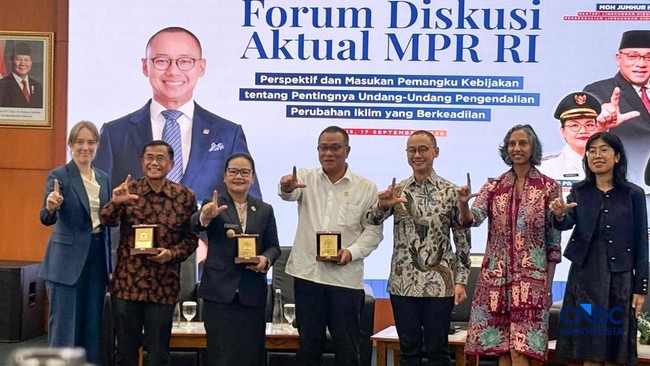
The People’s Consultative Assembly (MPR) of the Republic of Indonesia aims to discuss the Just Climate Change Control Bill (RUU PPIB) at the parliamentary level at least before the end of 2026.
The proposed regulation is designed to be integrated, covering carbon emission reductions, climate crisis mitigation and adaptation, incentive and sanction schemes, and the strengthening of carbon economic value.
Currently, the core substantive drafts of the RUU PPIB are being discussed and developed through problem-solving processes involving public participation, academics, and local governments.
Deputy Speaker of the MPR, Eddy Soep_arno, revealed that the initial substance of the RUU PPIB draft has been discussed in parliament alongside the Ministry of Environment (KLH). “We have discussed the initial substance of the Just Climate Change Control Bill in Commission XII together with the Ministry of Environment. The core substances of the draft have been discussed. However, to develop the draft, we are conducting various programmes involving public participation, including today’s discussion,” said Eddy following the MPR’s Actual Discussion Forum (FDA) in Jakarta on Thursday (17/9/2026).
Eddy explained that the acceleration of the Bill’s preparation is driven by the increasing climate crisis, which threatens vital sectors such as health, food security, and environmental sustainability. Furthermore, all parliamentary factions have welcomed the proposal to discuss the RUU PPIB as a standalone piece of legislation rather than merging it with other regulations.
He emphasised that an agreement has been reached between Commission XII of the DPR RI and the Ministry of Environment to follow up on the legislative formation process as soon as possible. “We target that this law can be discussed, hopefully, before the end of this year for official deliberation. The sooner we can discuss it, the better,” he added.
He expressed hope that future climate action in Indonesia would have a strong and impactful legal foundation. “The aspect of justice will also be a key substance in the RUL PPIB, ensuring that climate crisis control provides affirmation and intervention for those directly affected, particularly coastal communities, the economically disadvantaged, farmers, fishermen, women, infants, the elderly, and also Global South nations,” he concluded.
Minister of Environment Mohamad Jumhur Hidayat also spoke on the urgency of regulations for handling the environmental crisis in Indonesia. One proposed regulatory path is through the Just Climate Change Control Bill (RUU PPIB).
Essentially, the issue of handling the climate crisis involves two potential schemes: integrating climate change rules into the revision of the 2009 Environmental Law or creating it as a separate, independent legal product.
According to Jumhur, the climate change law should be discussed separately from existing environmental regulations. He believes this separation is crucial so that the governance of climate crisis management has its own specificity and a focused, flexible approach. “I was asked this because I am considered the one who will implement the law. I said the most ideal way is to keep it separate so there is specificity, as this is a new theme and a new issue that requires new ways of management,” he explained during the FDA event.
Furthermore, the government and parliament have agreed to emphasise the aspect of justice, hence the name ‘Just Climate Change Control Bill’. “It was eventually agreed by the Special Envoy to the President for Climate Change and Energy, Mr Hashim, that there was a proposal from the Ministry of Environment to add the word ‘justice’. Thus, it became the RUU PPIB,” said Jumhur.
In formulating the substance of the RUU PPIB, the Ministry of Environment is encouraging public consultation with various universities and non-governmental organisations, and has even sent a team to the United Kingdom to study the governance of the Climate Change Commission.
Jumhur emphasised that handling the climate crisis and reducing emissions cannot be borne by the government budget alone; it requires the involvement of businesses and philanthropy. However, he warned that the economic value generated from carbon must not only benefit investors but must be shared fairly with indigenous communities and local residents through cooperative-based management units.
“Therefore, we want to ensure that any profit or benefit from these activities is shared with the ground people, indigenous communities, and local residents. I want to ensure that carbon units in various places are owned or managed by cooperatives of those who actually manage the site or the environment there,” said Jumhur.
Consequently, Jumhur proposed that Indonesia add a new pillar to climate action: ‘prosperity action’, to complement the existing pillars of mitigation and adaptation. Additionally, the government is highlighting the aspect of a ‘just transition’ to protect workers and vulnerable groups from being left behind.