
MPR Study Body Reviews Regional Government Design and Administration under the 1945 Constitution
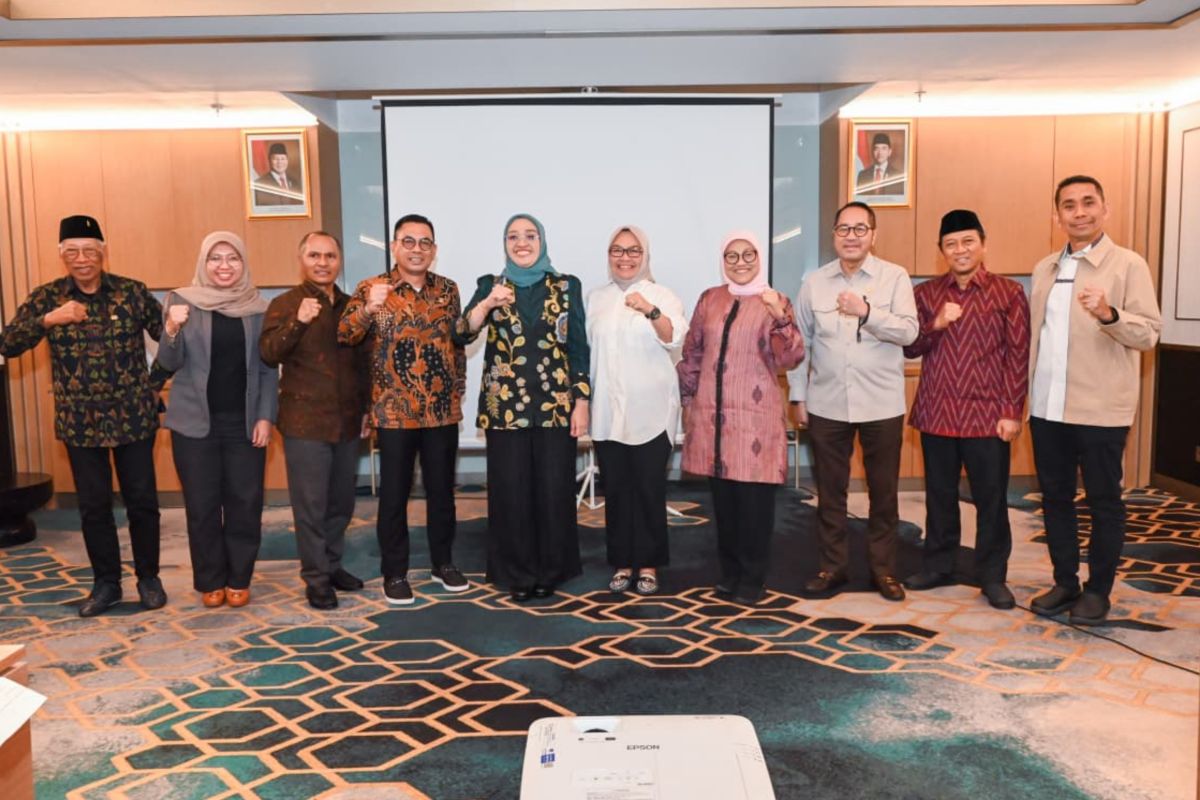
Jakarta (ANTARA) – The MPR’s Study Body is conducting a comprehensive review of the design and administration of regional government under the 1945 Constitution of the Republic of Indonesia through a focus group discussion (FGD).
The FGD, held in Solo, Central Java, focused in particular on asymmetric decentralisation and the local democratic system.
Hindun Anisah, deputy chair of the MPR’s Study Body, said in a statement received in Jakarta on Friday that asymmetric decentralisation and local democracy are closely linked to regional government and the realisation of popular sovereignty at the local level.
“Various forms of asymmetric decentralisation have different foundations, objectives and characteristics, but there is still a need to clarify the conceptual framework. This includes the criteria for granting asymmetric arrangements, the division of powers, fiscal relations, the capacity to exercise autonomy, and the relationship between national interests and the need for regional differentiation,” Hindun said.
Hindun highlighted developments in local democracy, including regional elections, which have raised challenges such as high political costs, vote-buying, the dominance of financial power, pragmatism and social polarisation.
She said the discussion was designed as an academic forum to gather experts’ input on how the system should be reconstructed, while also considering whether improvements could be made through regulation or required fundamental constitutional changes.
“Would strengthening asymmetric decentralisation and the local democratic system be sufficient through improvements to legislation and policy, or is there a fundamental need for change at the constitutional level?” Hindun said.
The FGD, held on Thursday (5 November), featured three main speakers: Agus Riwanto, professor at the Faculty of Law at Sebelas Maret University (UNS) in Surakarta; Gabriel Lele, dean of the Faculty of Social and Political Sciences at Gadjah Mada University (UGM); and Emmy Latifah, professor at UNS’s Faculty of Law.
In her presentation, Emmy Latifah stressed that a unitary state does not require uniform systems of government, as demonstrated by the arrangements in Aceh, Jakarta, Yogyakarta and Papua. She said constitutional change should be a last resort.
“Problems need to be properly diagnosed and identified so that the right instruments can be selected and decentralisation can be effective,” Emmy said.
Gabriel Lele said Articles 18A and 18B of the 1945 Constitution already provide an adequate basis for decentralisation, but that the framework needs strengthening to ensure effective autonomy.
As a reference for an ideal model of asymmetric decentralisation, Gabriel cited Macedonia’s cluster system, which divides regions into high, medium and low levels of asymmetry.
Agus proposed three models for selecting regional heads, based on local conditions. The first is direct regional elections, for areas with high human-resource capacity, political literacy, Human Development Index (HDI) scores and locally generated revenue (PAD), as well as low dependence on central government transfers, such as Java and Bali.
The second model is selection through regional legislative councils (DPRD), for areas with medium levels of those indicators and medium dependence on central transfers, such as Sumatra, Kalimantan and Sulawesi.
The third model is appointment by the central government, intended for areas with low human-resource capacity, political literacy, HDI scores and PAD, but high dependence on central transfers, such as West Nusa Tenggara, East Nusa Tenggara, Maluku and Papua.
Source: jawawa.id (https://jawawa.id/newsitem/mpr-study-body-reviews-regional-government-design-and-administration-under-the-1945-constitution-1793937084)
Originally published by Antara (Indonesian) (https://www.antaranews.com/berita/5835787/bp-mpr-telaah-desain-dan-penyelenggaraan-pemda-dalam-kerangka-uud-1945), translated from Indonesian