
MPR RI Constitutional Study Committee Reviews Implementation of Article 33 of the 1945 Constitution
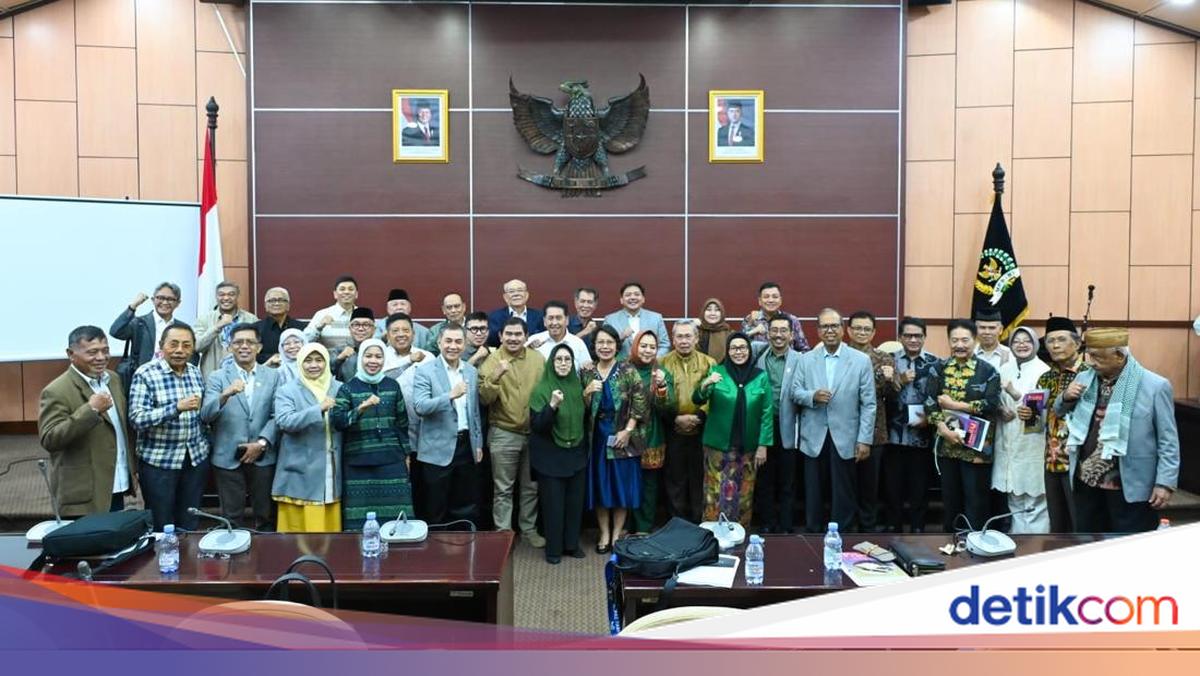
The 1945 Constitution of the Republic of Indonesia is directly linked to efforts to realise a national economic system that adheres to constitutional mandates. “We want to ensure that the national economy is run within the constitutional corridor, where all Indonesian people are involved in the economic process so that prosperity can be felt more evenly,” stated Tobas in a statement on Thursday (4/6/2026).
This was emphasised following a Plenary Meeting of the Constitutional Study Committee (K3) of the MPR RI held at the Nusantara V Building, Parliament Complex, Jakarta, on Wednesday (3/6). The study of Article 33 of the 1945 Constitution is being conducted by the K3 as part of an effort to strengthen the national economic system based on Pancasila and the constitution, while addressing national challenges such as development inequality, the strengthening of the people’s economy, digital transformation, and increasingly dynamic global economic changes.
According to Tobas, the various views presented by resource persons will serve as study material for the K3, which will subsequently be compiled into recommendations for the Leadership of the MPR RI. “The points presented by the resource persons will be used for further study, which we will later submit in the form of recommendations to the MPR Leadership to serve as a guide in managing the national economy to achieve national prosperity in accordance with the constitutional mandate,” said Tobas.
Responding to questions regarding the possibility of an increased state role in the economy leading towards a socialist economic system, Tobas asserted that the discussion aims to find the best format that complies with the Indonesian constitution. “We want to find the best format within the constitutional corridor. We can also see to what extent the state plays a role and to what extent the people can be activated to participate in running the economic wheels,” said Tobas, adding that concerns regarding such shifts need to be discussed to find solutions.
Tobas added that the primary principles must be people’s sovereignty, the principle of kinship, equality, and social justice as mandated by the 1945 Constitution. “The most important thing is how we refer to the constitution in running the state economy. There must not be too wide a gap between the richest and the poorest. Equality and justice must be the main corridors,” he emphasised.
Meanwhile, economic expert Dr Revrisond Baswir assessed that Article 3lar 33 of the 1945 Constitution remains highly relevant and active in Indonesia’s national discourse. According to Dr Revrisond, Article 33 contains the concept of economic democracy, which places people’s participation at the core of national economic development. “Economic democracy is a systematic process to democratise the ownership of the means of production to all members of society. Therefore, Article 33 contains an anti-concentration of wealth spirit and rejects economic dominance by a small group of parties,” said Dr Revrisond.
Dr Revrisond also highlighted the lack of academic attention towards the concept of economic democracy explicitly stated in the constitution. “The question is simple: is economic democracy studied seriously in economics or social-political science faculties? Yet, this is a constitutional mandate that should be the foundation for the development of science and public policy,” said Dr Revrisund.
In Dr Revrisond’s view, strengthening human resources is a primary requirement for realising economic democracy. Therefore, access to education must be a priority in the implementation of Article 33. “If Indonesia’s economy wants to be knowledge-based, then the quality of education is key. Education is the most important means of production because it determines the community’s ability to be subjects in economic democracy,” he explained.
Similarly, the Rector of Universitas Paramadina, Prof Didik Junaidi Rachbini, PhD, assessed that the debate regarding Indonesia’s economic system should not stop at the dichotomy of capitalism and socialism, but should be directed towards finding the most effective model to achieve the constitutional goal of people’s prosperity. “The main goal of Article 33 and the Preamble of the 1945 Constitution is to advance general welfare. The issue is not the goal, but how to achieve it. That is where the debate on implementation becomes important,” said Prof Didik.
In his presentation, Prof Didik compared Indonesia’s experience with South Korea, which successfully underwent significant economic transformation over several decades. “In 1965, the per capita income of Indonesia and South Korea were both around 200 USD. Now, Indonesia is in the range of 4,800 USD, while South Korea is approaching 40,000 USD. This shows that the implementation of economic policy and institutional development is decisive,” said Prof Didik.
According to Prof Didik, the success of economic development is determined by the quality of institutions and the effectiveness of public policy implementation. “In my opinion, 70% of our attention should be on institutions and programmes. Ideas and the constitution are important, but without strong institutions, policy implementation will not run optimally,” said Prof Didik.
Prof Didik cited the successful implementation of Article 28H of the 1945 Constitution, which guarantees the right to health through the implementation of the national health insurance programme. “Constitutional articles must be translated into working institutions. Therefore, the more important debate is how constitutional mandates are realised in concrete policies that are felt by the community,” he asserted.
Source: jawawa.id (https://jawawa.id/newsitem/mpr-ri-constitutional-study-committee-reviews-implementation-of-article-33-of-the-1945-constitution-1780834328)
Originally published by detikcom (https://news.detik.com/berita/d-8517081/k3-mpr-ri-kaji-implementasi-pasal-33-uud-nri-tahun-1945), translated from Indonesian