
MPR Reveals Potential for Energy Transition Development in Indonesia
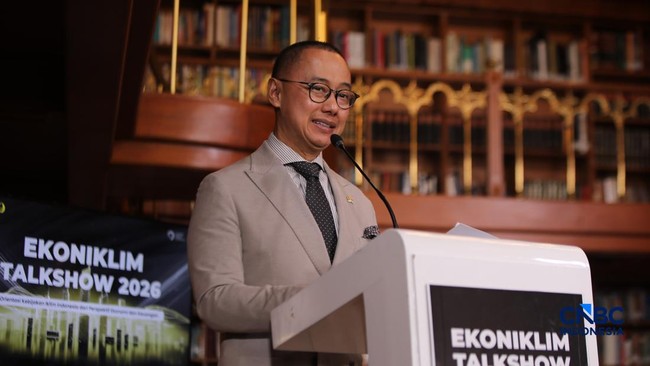
Indonesia has a major opportunity to become one of the centres for energy transition development. Moreover, with abundant tropical forests and mangroves, the government can also establish a carbon trading ecosystem as primary capital to attract sustainable investment.
Deputy Speaker of the MPR, Eddy Soeparno, stated that Indonesia requires investment of around US$230 billion to carry out the energy transition, including accelerating the construction of Solar Power Plants (PLTS). In detail, Indonesia needs around US$130 billion for the development of 70 gigawatts (GW) of new power plants, of which 52 GW comes from renewable energy.
“But because Indonesia has just announced its intention to build 100 gigawatts of solar power plants, we need an additional US$100 billion. Because solar power plants are accompanied by battery backup. So this is the US$230 billion that we need in investment and financing,” he said at the Ekoniklim Talkshow 2026 with the theme “Orientation of Indonesia’s Climate Policy from an Economic and Financial Perspective” at Wisma Habibie Ainun some time ago.
He said that funding of that scale cannot rely solely on the state, PLN, or state-owned enterprises. Therefore, investment support from the private sector, both domestic and foreign, is needed.
In addition, Eddy recounted that he had just returned from London Climate Action Week and met with several representatives of international financial institutions, where they expressed interest in financing renewable energy projects in the country. This is because there is a renewable energy project with a capacity of 1 GW that is ready to be funded once the regulations and cooperation schemes are completed.
“But our friends from financial institutions also said, Mr Eddy, we have various problems that we must address. What are the problems, I asked. One, legal certainty is a problem. Two, policy consistency is a problem. Three, the long, multi-layered licensing process is also a problem. The last is the problem of incentives provided,” he explained.
Eddy continued that fundamentally, jumbo investment in the clean energy sector must provide direct benefits for national industry and labour in Indonesia. In this context, the concept of green jobs and green industries must not merely be a slogan, but a tangible manifestation of the energy transition.
“In other words, the energy transition party must belong to the nation’s children. Something like that. The energy transition gives birth to benefits that we did not expect before. What is it called? The carbon economy. We have just issued Presidential Regulation Number 110 of 2025, where the rules regarding carbon trading are strengthened there,” he explained.
Furthermore, with abundant tropical forests and mangroves, Indonesia is believed to be capable of producing high-integrity carbon credits. These carbon credits can later be traded on the global market along with the launch of the Carbon Unit Registration System (SRUK).
“So there is a great opportunity and potential, and I want to broadcast it to international investors that Indonesia is ready for business and we have the ecosystem in place,” he said.
Not only that, Eddy also explained that there are three national energy transition priorities. In the short term, the government needs to increase electrification, especially in the public transport, industrial, and household sectors, including encouraging the replacement of 3-kilogram LPG with electric stoves to reduce imports and energy subsidies.
In the medium term, Indonesia is encouraged to strengthen bioenergy development through increasing the biodiesel and bioethanol blend by utilising degraded, unproductive land.
Meanwhile, in the long term, Eddy assessed that Indonesia needs to begin developing new energy sources such as hydrogen and nuclear power plants as large-capacity clean electricity sources capable of supporting national energy needs.
“Perhaps the energy transition is an inevitability. We cannot deny the energy transition. Earlier there was bad news, now here is the good news: the energy transition is a global movement, it has become a worldwide movement today. Investment costs in the energy sector are much cheaper now than 5-10 years ago, and Indonesia’s commitment to implementing the energy transition is very strong,” he concluded.