
MPR Gathers Input from Unhas Professors for Constitutional Review
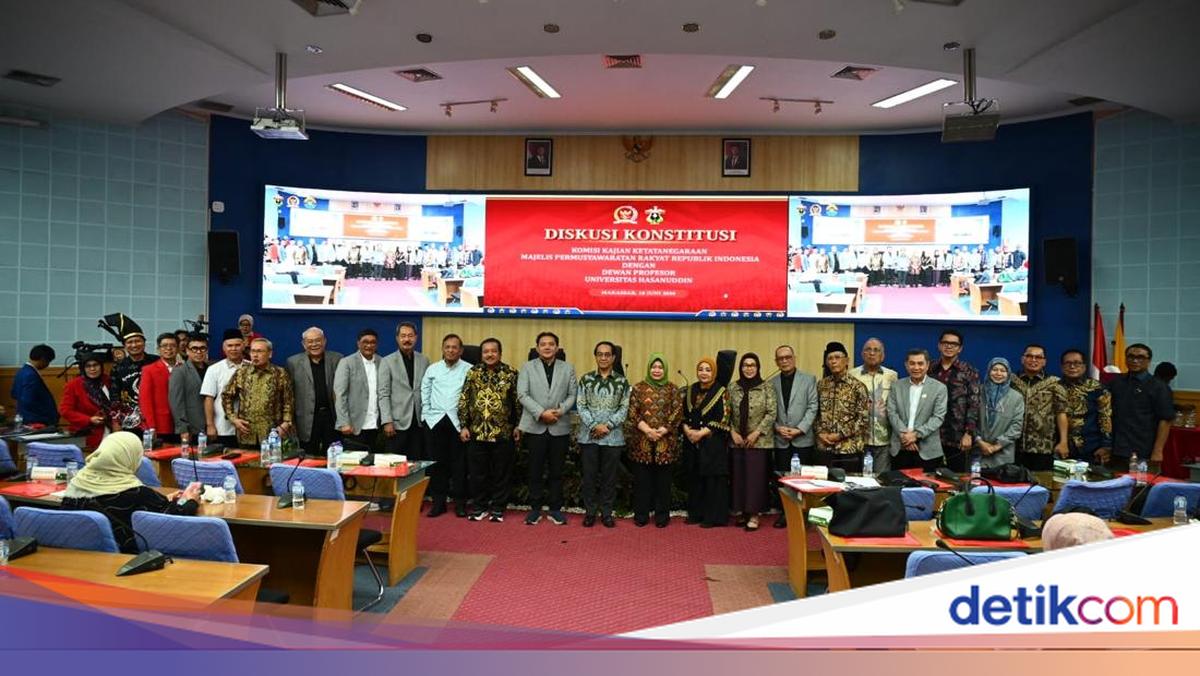
Acting Secretary General of the People’s Consultative Assembly (MPR RI) Siti Fauziah stated that the 1945 Constitution of the Republic of Indonesia (UUD NRI Tahun 1945) remains a compelling subject for discussion. She noted that many issues can serve as topics for debate regarding the constitution.
The statement was made during a Constitutional Discussion event followed by the signing of a Memorandum of Understanding between the Secretariat General of the MPR RI and Hasanuddin University (Unhas) in Makassar. The event took place in the Senate Meeting Room on the 2nd floor of the Hasanuddin University Rectorate on Wednesday (8/6).
In her presentation, Siti Fauziah highlighted the constitutional foundation in the economic sector. According to her, the 1945 Constitution obliges the state to regulate the economic system for the prosperity of the people while also organising social welfare for all Indonesian citizens. The constitution rejects a liberal-capitalist economic system and replaces it with economic democracy.
"This is enshrined in Article 33 paragraphs (1), (2), and (3): The economy shall be organised as a common endeavour based upon the principle of familyhood. Branches of production that are important to the state and affect the livelihood of many people shall be controlled by the state, and the land, waters, and natural resources shall be controlled by the state and used for the greatest possible prosperity of the people," Siti stated in a written release on Saturday (20/6/2026).
She considered the evaluation of articles within the 1945 Constitution to be a reasonable exercise, especially since the constitution has undergone four stages of amendment over the past 20 years. Therefore, input from the academic community is crucial. One such avenue is through discussions evaluating Article 33 of the 1945 Constitution in relation to MPR Decree No. IX/MPR/2001 on Agrarian Reform and Natural Resource Management.
"The discussions with Unhas professors will be compiled to serve as further material for the Constitutional Studies Commission and the MPR Assessment Body. It could potentially produce recommendations for the refinement of the 1945 Constitution," she said.
Siti mentioned that the MPR continues to record various public aspirations. Some desire a comprehensive evaluation of the constitution, while others believe the 1945 Constitution remains relevant to the times. The latter group argues that current problems are not caused by the fundamental rules, but rather by the level of implementation.
"We hope that discussions with universities will find answers to whether the problems that arise lie in the constitution or its implementation. This is where we see the importance of cooperation with campuses that always think objectively," Siti concluded.