
MPR Gathers Input from UNDIP Academics to Refine PPHN
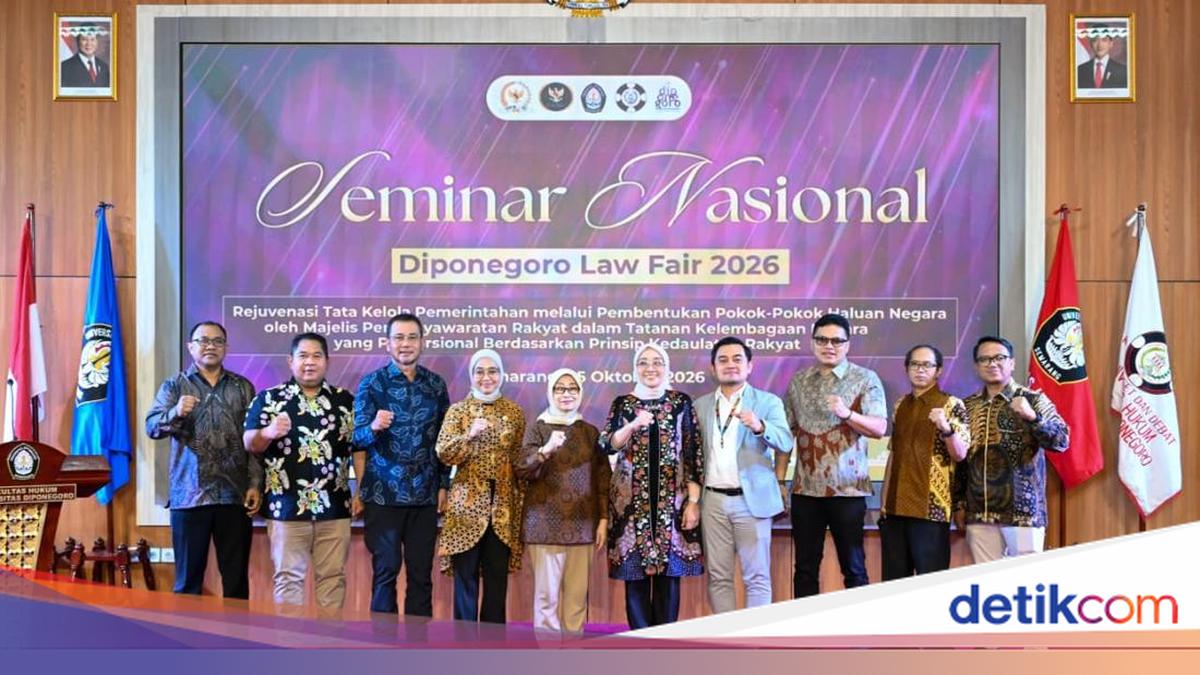
The Study Agency of the People’s Consultative Assembly (MPR) has gathered input from academics and students at Diponegoro University (UNDIP) to deepen its study of the State Policy Guidelines (Pokok-Pokok Haluan Negara, or PPHN). Discussions covered the need for the guidelines, their substance and possible legal forms at the 2026 Diponegoro Law Fair National Seminar, held at UNDIP’s Faculty of Law in Semarang.
“The PPHN is expected to serve as a shared guide that strengthens continuity in development, synergy between central and regional governments, and the achievement of national objectives,” MPR Study Agency Chair Yasonna H. Laoly was quoted as saying on Monday (26 October 2026).
The seminar took place at UNDIP’s Faculty of Law in Semarang on Sunday (25 October). Its theme was “Rejuvenating Governance through the Establishment of State Policy Guidelines by the People’s Consultative Assembly within a Proportionate State Institutional Framework Based on the Principle of Popular Sovereignty”.
Yasonna said the PPHN was not intended to abolish or replace the existing development planning system. Its design must continue to respect the people’s mandate through elections, the presidential system and regional autonomy.
He said amendments to the 1945 Constitution of the Republic of Indonesia, an MPR Decree and legislation were among the legal options being studied. Each option should be assessed in terms of its constitutional basis, binding force and effectiveness, while leaving room for public input.
Hindun Anisah, deputy chair of the MPR Study Agency and a seminar speaker, said the PPHN was expected to provide a common direction for national development. The proposal was also intended to improve coordination in government and reduce overlapping authority among institutions.
Hindun said she hoped contributions from universities would enrich the study being conducted by the Study Agency together with the MPR’s Constitutional Affairs Study Commission. She also encouraged stronger collaboration with UNDIP’s Faculty of Law and greater student involvement in constitutional discussions.
“We need a younger generation that not only understands the Constitution, but can also bring its values to life through reasoned thinking, integrity and concern for issues affecting society,” Hindun said.
During the discussion, Fajar Laksono Suroso, head of the Constitutional Court’s Bureau of Law and Registrar Administration, stressed the need to test the PPHN’s necessity and added value in light of the development planning system already in place.
Fajar said concerns that policies change whenever a new government takes office needed to be examined in depth. He also cautioned that any choice of legal form for the PPHN should be consistent with the division of powers among state institutions following the constitutional amendments.
He added that the reasoning in Constitutional Court Decision No. 66/PUU-XXI/2023 should also be considered when discussing the option of an MPR Decree.
Lita Tyesta Addy Listya Wardhani, a professor at UNDIP’s Faculty of Law, emphasised the importance of making use of the powers available to institutions within the constitutional system. She said the enactment of legislation was one option that could be considered, while ensuring clarity on implementation and oversight.
Lita also highlighted the importance of public understanding of the direction of development, so people can assess government policies. In her view, continuity in development requires both government commitment and public involvement in monitoring progress towards national objectives.
Meanwhile, Aditya Yuli Sulistyawan, UNDIP Faculty of Law’s vice-dean for academic and student affairs, representing the dean, said the 2026 Diponegoro Law Fair had drawn delegations from 19 universities. The programme included a legal debate, a contract drafting and negotiation competition, and a scientific paper competition.
Through the seminar, the MPR Study Agency gathered academic views on how the PPHN would relate to national and regional development planning, including arrangements for implementation, oversight and evaluation. Speakers’ contributions will inform further study aimed at refining the PPHN proposal.