
MPR Forum Highlights Education Crisis, Urges Revision of National Education System Law to Meet Modern Challenges
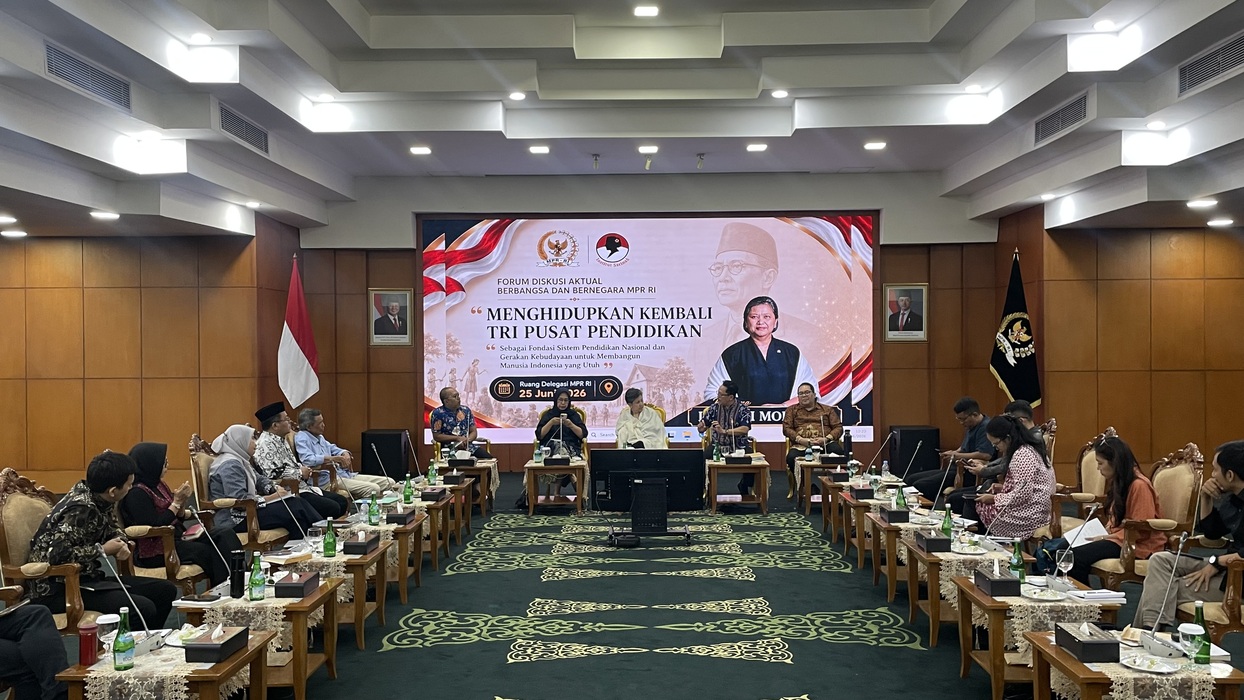
The People’s Consultative Assembly (MPR) of the Republic of Indonesia has held a Forum on Contemporary National and State Discourse with the theme ‘Reviving the Tri Pusat Pendidikan (Three Centres of Education)’. The event was organised in response to various issues currently afflicting the national education sector. The forum highlighted the importance of reforming the education system to tackle challenges on the road to Indonesia Emas 2045.
Eva Kusuma Sundari, Special Staff to the Deputy Speaker of the MPR and Director of the Sarinah Institute, stated that the current crises indicate the national education system is facing serious problems that must be addressed immediately. ‘When we are confronted with various crises such as bullying, violence, and low literacy skills among children, we see a fundamental problem in our education system. Many children can read but do not understand what they are reading. This phenomenon occurs almost everywhere, from Eastern Indonesia to Jakarta,’ she said on Thursday (25/6).
She noted that this situation raises concerns about the quality of human resources that will support Indonesia in 2045. ‘We need to question whether the younger generation is truly ready to become the backbone of Indonesia Emas 2045 if these educational issues are not resolved immediately,’ she remarked.
During the discussion, Eva explained that the Tri Pusat Pendidikan concept introduced by Ki Hadjar Dewantara—comprising family, school, and community—needs to be reinterpreted in line with current developments. She said a new ecosystem now has a significant influence on the educational process: the internet. ‘The changing times mean the centres of education are no longer just three. The internet has directly entered family life and become a highly influential part of the educational ecosystem,’ she said.
She assessed that the rapid flow of digital information also affects the quality of education within the family. Various issues such as domestic violence, mental health problems among children and parents, and weak family resilience directly impact the development of students at school. ‘Families experiencing various social and psychological pressures will affect the quality of children’s education. Ultimately, this condition is also reflected in national educational achievements,’ she said.
Eva added that these various problems contribute to the nation’s low competitiveness. Therefore, education must be able to bridge all ecosystems that influence child development, from family, school, and community to the state and the digital environment. On that occasion, she also expressed high hopes for the planned revision of the National Education System Law (UU Sisdiknas), which is currently under the attention of the House of Representatives (DPR).
According to Eva, the revision of the UU Sisdiknas must be able to answer the fundamental problems faced by the education sector, including low literacy, weak character development, and the suboptimal achievement of holistic national education goals. ‘The revision of the UU Sisdiknas must not merely be an administrative codification. The regulation must address cultural issues, character building, and the comprehensive strengthening of the quality of Indonesian people,’ she stressed.
Furthermore, Eva emphasised the importance of civil society involvement in the administration of education. She cautioned that the space for public participation should not be narrowed in the process of shaping national education policy. ‘We are gathering to build a kind of civil society coalition because there is concern that the space for public involvement in education administration is shrinking. In fact, ideal education must involve families, schools, communities, the state, and even international networks and the digital space,’ she revealed.
Through the forum, it is hoped that the Tri Pusat Pendidikan concept, adapted to the challenges of the digital era, can become an important foundation in creating a superior, character-driven Indonesian generation ready to embrace Indonesia Emas 2045.