
MPR Finalises Legal Formulation of State Policy Guidelines (PPHN)
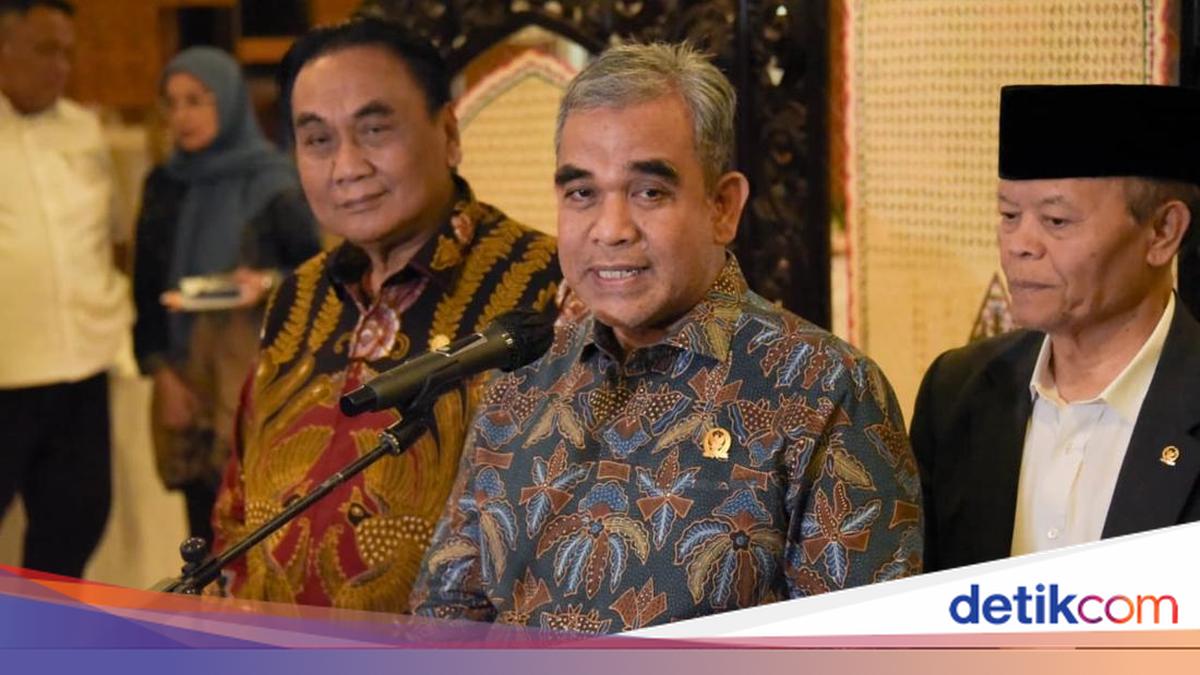
The People’s Consultative Assembly (MPR) is continuing to mature the legal formulation of the Broad Outlines of State Policy (PPHN) to ensure it has binding power and serves as a national guideline in realising the state’s objectives as mandated by the 1945 Constitution of the Republic of Indonesia. MPR Chairman Ahmad Muzani stated that the PPHN concept was directly presented to the President of the Republic of Indonesia on 3 August 2026, as a follow-up to the mandate of the 2019-2024 MPR.
The discussion became one of the main agendas of the Joint Meeting of MPR Leaders with faction leaders, the Regional Representative Council (DPD) group, and MPR Complementary Organs, led by Ahmad Muzani at the Parliament Complex, Senayan, Jakarta, on Wednesday (5/8).
“In principle, the President received the PPHN concept very well and hopes that the PPHN can soon become a legal product. In the joint meeting earlier, we discussed various alternative legal formulations so that the PPHN can be established as a legal product with binding force,” said Ahmad Muzani on Thursday (6/8/2026).
According to him, the discussion on the legal form of the PPHN has become increasingly important following the 2023 Constitutional Court ruling, which affirmed that MPR Decrees no longer have external binding force on state institutions outside the MPR. Therefore, the MPR is reviewing various alternative legal formulations that remain in line with the constitution, so that the PPHN can serve as a binding national guideline for all state administrators.
Ahmad Muzani emphasised that the PPHN is not intended as a technical guide for government administration, but rather as a philosophical direction and guideline for national development that serves as a common reference for all state institutions.
“The PPHN is the nation’s philosophical direction in achieving the state’s goals. Therefore, the PPHN is not a technical guide for government administration. That is where it differs from the National Long-Term Development Plan (RPJPN),” he explained.
He added that the formulation of the PPHN must be built through a national consensus involving all stakeholders so that it has strong legitimacy.
The MPR will continue the process of dialogue and substantive deepening of the PPHN with various elements of society as part of the effort to present a sustainable and constitutional national development direction, which can serve as a common reference in achieving Indonesia’s ideals as mandated by the Preamble to the 1945 Constitution.
“We will involve all stakeholders. Not only the factions in the MPR, but also academics, experts, community organisations, professional organisations, and various elements of society so that the PPHN truly becomes a national consensus that can be accepted by all elements of the nation,” concluded Ahmad Muzani.