
MPR Emphasises 1945 Constitution Amendment Minutes as Constitutional Reference
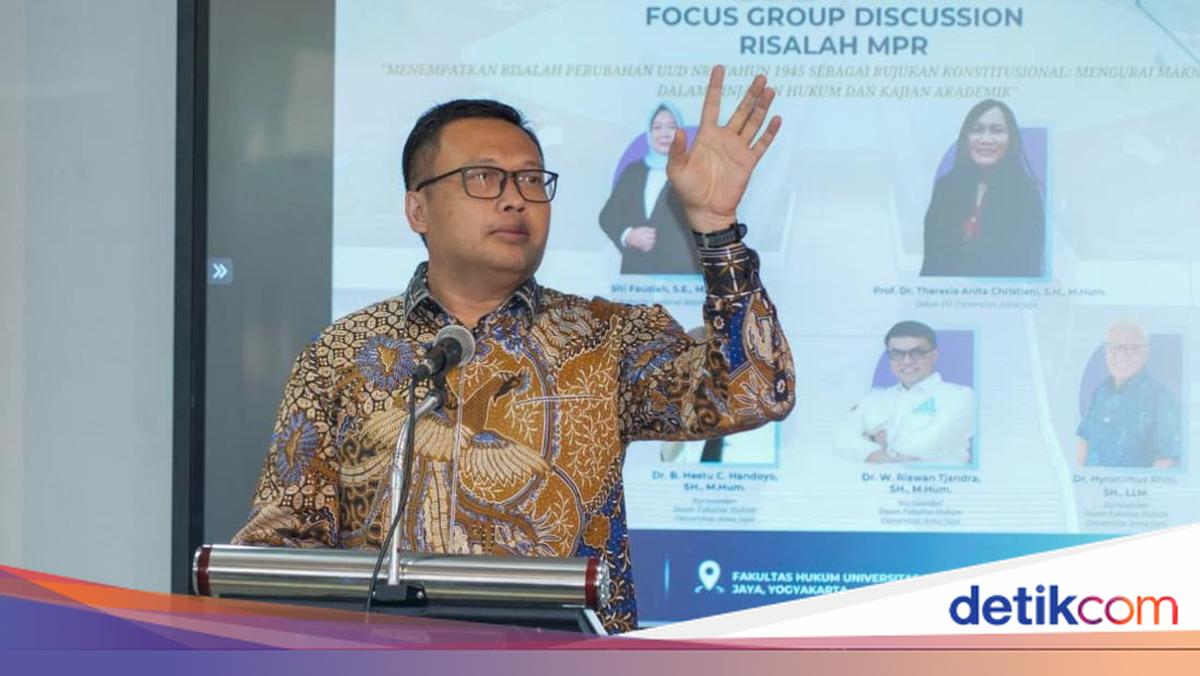
The Head of the MPR RI’s Bureau for Session and Constitutional Dissemination, Wachid Nugroho, has stressed the importance of strengthening the function of the minutes (risalah) of the amendments to the 1945 Constitution of the Republic of Indonesia (UUD NRI) as a reference source for understanding and interpreting the constitution. He conveyed this during a Forum Group Discussion (FGD) on the MPR RI Minutes titled ‘Positioning the Minutes of the 1945 Constitution Amendments as a Constitutional Reference: Unravelling Constitutional Meaning in Legal Review and Academic Study’ at the RKF Conference Room, Faculty of Law, Atma Jaya University Yogyakarta (UAJY), on Monday (15/6).
Wachid explained that constitutional minutes must not be viewed merely as administrative documents that only record the course of sessions. According to him, the minutes possess substantive value because they record the ideas, arguments, and intentions of the constitution’s framers, which can serve as an important reference in the process of interpreting constitutional law. ‘The minutes are actually not just administrative documents recording discussions in a session. The minutes are part of the historical record of the constitution that can help understand the intent and direction of constitutional change,’ Wachid stated.
He noted that in various countries, parliamentary minutes and constitutional drafting records have long been used as consideration material in judicial review processes and public policy formulation. This practice can be found in the United States, Germany, and South Africa. ‘In the United States, congressional records are one of the important references in the decision-making process. Similarly, in Germany and South Africa, minutes are used to seek argumentative support in understanding constitutional principles,’ he said.
According to Wachid, Indonesia needs to position the minutes of the 1945 Constitution amendments as the ultimate historic record accompanying constitutional development. The presence of the minutes becomes crucial, especially when debates arise between the original intent approach and the living constitution approach. Wachid also revealed the MPR RI’s efforts to develop the concept of a Constitutional Lab as a digital centre that not only functions as a document repository but also as a centre for analysis and visualisation of Indonesia’s constitutional development. ‘We imagine the Constitutional Lab not merely as a digital library. It must become a centre for analysis and visualisation capable of bridging the needs of constitutional studies with policy-making requirements,’ he explained.
As part of its digital transformation, the MPR RI has digitised various state administration minutes, from the Constituent Assembly minutes and MPRS minutes to the minutes of the 1945 Constitution amendments. This digitisation is expected to broaden access for academics, students, researchers, and the public wishing to delve into the history of Indonesia’s constitutional development. Wachid added that the future challenge lies in managing the minutes more systematically and thematically so they are easier to use in research and constitutional interpretation processes. ‘The minutes must be able to answer the challenges of evolving constitutional interpretation. Therefore, their management needs to be continuously strengthened to become a living source of knowledge relevant to the needs of the times,’ he said.
He further emphasised the importance of collaboration between the MPR RI, academics, and researchers in formulating a model for managing constitutional minutes that is adaptive to the development of modern constitutional law. The discussion forum is expected to produce various academic recommendations serving as a foundation for strengthening the function of constitutional minutes as a supporting instrument in building Indonesia’s democratic and constitutional state system.
The discussion also featured academic perspectives on the urgency of constitutional minutes in the development of Indonesian constitutional law. Dr. B. Hestu Cipto Handoyo, a lecturer at UAJY’s Faculty of Law, assessed that the minutes of the 1945 Constitution amendments cannot be viewed merely as historical archives. According to him, the minutes are an important instrument for understanding the process of the birth of constitutional norms, including the values, political compromises, and objectives behind each constitutional change. ‘A constitution never exists as a standalone text. It is born from a struggle of ideas, political compromises, and historical dynamics. Therefore, the minutes of the 1945 Constitution amendments are truly a means for this nation to understand its own constitution,’ he stated.
He explained that from a modern hermeneutics perspective, the meaning of a constitution arises not only from the text but also from the dialogue between the text, history, and the interpreter. Hence, the minutes hold an important position as a bridge to understand the original intent of the constitution’s framers while maintaining constitutional morality in state administrative practice. ‘Within the minutes are stored the original intent, constitutional morality, and the philosophical direction of Indonesia’s constitutional reform. Therefore, the minutes must not be positioned merely as supplementary historical documents,’ he said.
Hestu also cautioned that while artificial intelligence (AI) technology can assist in data processing and legal information compilation, it cannot fully replace the process of constitutional interpretation, which is laden with political context, history, and national values. ‘In the context of constitutional interpretation, we cannot only speak in machine language. Within it lies history, political struggle, and values that require human understanding,’ he asserted.
Meanwhile, Dr. W. Riawan Tjandra, a lecturer at UAJY’s Faculty of Law, affirmed that the minutes hold a strategic position as an official record capturing the entire process of policy formation and constitutional amendment. Riawan added that the minutes can serve as a basis for understanding the direction of national policy.