
MPR Develops Constitutional Lab to Strengthen Constitutional Studies
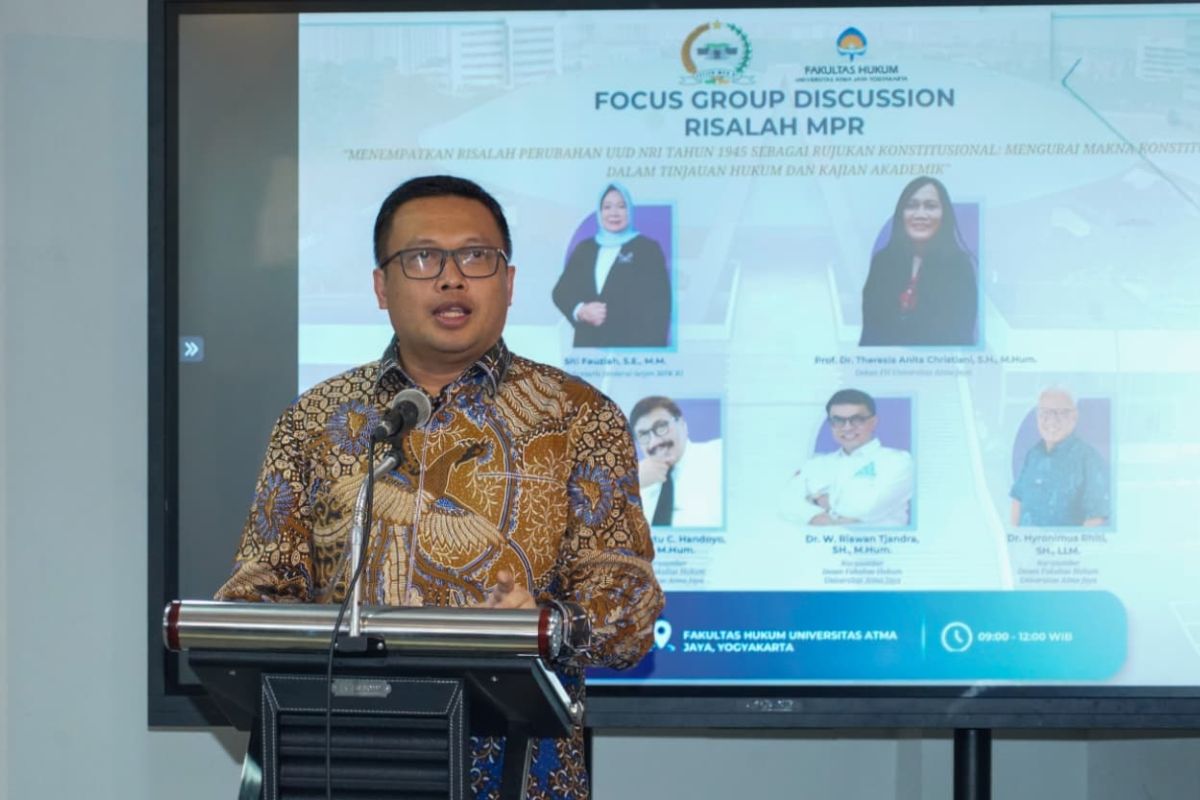
Jakarta (ANTARA) - The MPR RI is developing the concept of a Constitutional Lab as a centre for constitutional analysis and visualisation. This initiative aims to strengthen the use of the minutes from the amendments to the 1945 Constitution of the Republic of Indonesia (UUD NRI 1945) as a primary reference for enhancing constitutional studies and interpretation.
The Head of the Bureau of Session and Constitutional Oversight of the MPR RI, Wachid Nugroho, stated in Jakarta on Monday that the minutes of the 1945 Constitution amendments hold strategic importance. They do not merely record the proceedings of sessions but also preserve the ideas, arguments, and intentions of the constitutional drafters, which can serve as a reference for understanding constitutional norms.
“The minutes are not merely administrative documents recording discussions in sessions. They are part of the historical record of the constitution that can help in understanding the intent and direction of constitutional amendments,” said Wachro during a Focus Group Discussion (FGD) on MPR RI Minutes at the Faculty of Law, Atma Jaya University Yogyakarta, on Monday.
According to him, several countries, such as the United States, Germany, and South Africa, have utilised parliamentary and constitutional drafting minutes as considerations in judicial review processes and the formulation of public policy. Therefore, Indonesia needs to position the minutes of the 1945 Constitution amendments as the ultimate historic record to accompany the development of the national constitution.
To support this utilisation, the MPR RI has digitised various state documents, ranging from the minutes of the Constituent Assembly and the MPRS to the minutes of the 1945 Constitution amendments. This effort will be strengthened through the development of the Constitutional Lab, which will function not only as a document repository but also as a data-based constitutional analysis centre.
“We envision our Constitutional Lab not merely as a digital library. It must be a centre for analysis and visualisation capable of bridging the needs of constitutional studies with the requirements of policymaking,” he added.
During the discussion, academics from the Faculty of Law at Atma Jaya University Yogyakarta assessed that constitutional minutes are vital for maintaining continuity between the history of norm formation and current constitutional practices.
B. Hestu Cipto Handoyo, a lecturer at the UAJY Faculty of Law, stated that the minutes contain the original intent, constitutional morality, and the philosophical direction of Indonesia’s constitutional reform. “The constitution never exists as a standalone text. It is born from a struggle of ideas, political compromises, and historical dynamics. Therefore, the minutes of the 1945 Constitution amendments are essentially a means for this nation to understand its own constitution,” he said.
Meanwhile, UAJY academic W. Riawan Tjandra noted that the minutes can serve as a reference for judges, academics, and policymakers when facing debates regarding the meaning of open-ended constitutional norms. According to him, the minutes of the 1945 Constitution amendments can be positioned as a constitutional blueprint that records the design of Indonesia’s constitutional governance post-reform.