
MPR Deputy Speaker Lestari Moerdijat Urges National Priority Status for Demak Tidal Flood Crisis
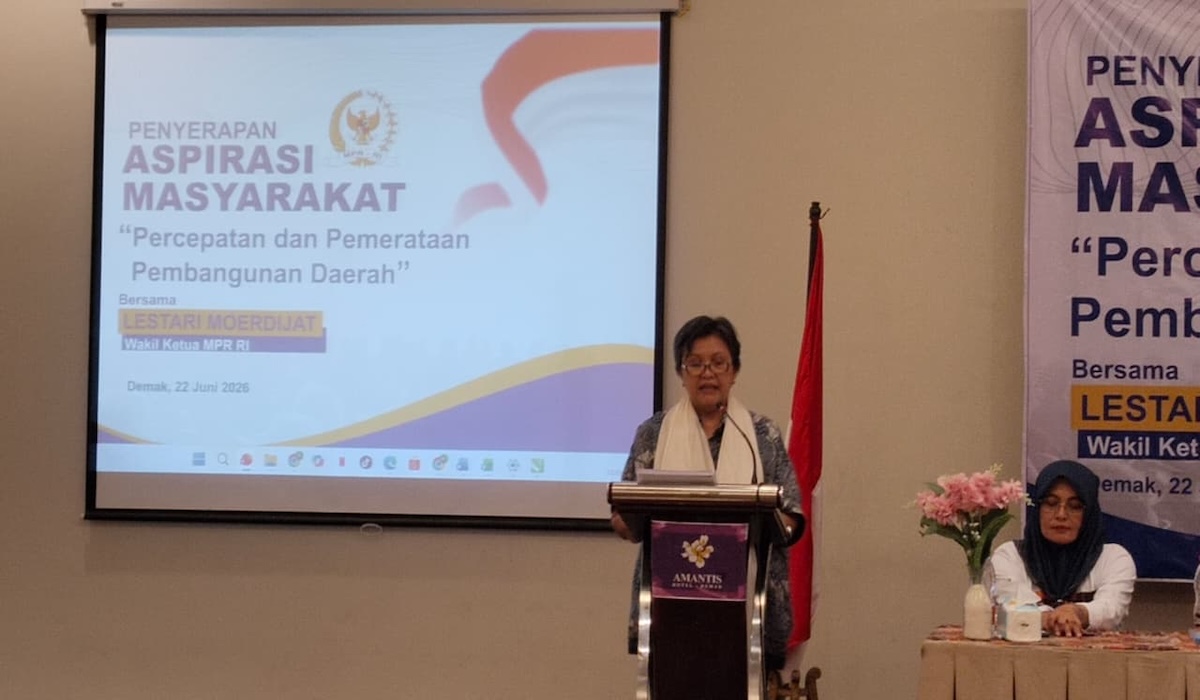
Deputy Speaker of the People’s Consultative Assembly (MPR RI) Lestari Moerdijat has stressed that the tidal flood disaster and permanent inundation affecting Sayung District, Demak Regency, Central Java, must be addressed comprehensively without delay. She urged that this ecological crisis be designated a national priority due to its already massive impact on the community’s living space.
Lestari conveyed this during an MPR RI public aspiration event themed ‘Acceleration and Equitable Regional Development: Ecological and Infrastructure Challenges’ at the Amantis Hotel in Demak on Monday (22/6). The event was attended by community leaders, members of the Demak Regency Regional House of Representatives (DPRD) from the NasDem Party faction, and representatives of residents from various affected sub-districts.
Lestari, affectionately known as Rerie, highlighted that infrastructure development such as the Semarang-Sayung toll road has caused significant environmental impacts. Historically, the Sayung area was a strait that had been avoided for development since the colonial era due to geological considerations.
‘When we talk about the Demak context, the Sayung area and its surrounding villages have already entered the category of a permanent disaster, no longer just tidal flooding,’ asserted the legislator from Central Java’s Electoral District II.
Data indicates this disaster has inundated approximately 6,600 hectares of Demak’s territory and affected 15,000 families. This condition has forced the majority of residents to lose agricultural land and switch to fish farming without adequate knowledge, resulting in unstable incomes.
Addressing this complex situation, Rerie offered two solution options. The first is relocation, which she acknowledged is extremely difficult to implement at present. The second option is to promote adaptation efforts for affected residents through strategic programmes.
‘For example, for agricultural land that can no longer be planted, we discuss with the government to pursue biosaline rice varieties. Or, rice fields that have turned into waterlogged areas can be converted into fish ponds. However, the licensing process for this land-use change is also not straightforward,’ explained the member of House Commission X.
Rerie also criticised the policy of raising road surfaces, which she deemed only a short-term solution that merely shifts the problem, as water continues to submerge residential areas. She urged the Regional Government and DPRD to adopt more progressive administrative policies.
Beyond infrastructure, Rerie advocated for nature-based ecological restoration, such as mangrove planting to withstand coastal erosion, as well as improvements in waste management. She emphasised the importance of environmental education for the younger generation to prevent the crisis from worsening.
‘This is already a disaster and we cannot ignore it. If the approach is always normative, this problem will never be resolved. What is being lost in Sayung is not just land, but living space, certainty, and the future,’ concluded the member of the NasDem Party High Council.