
MPR and UNHAS Discuss Article 33 of the 1945 Constitution, Focusing on People's Economy
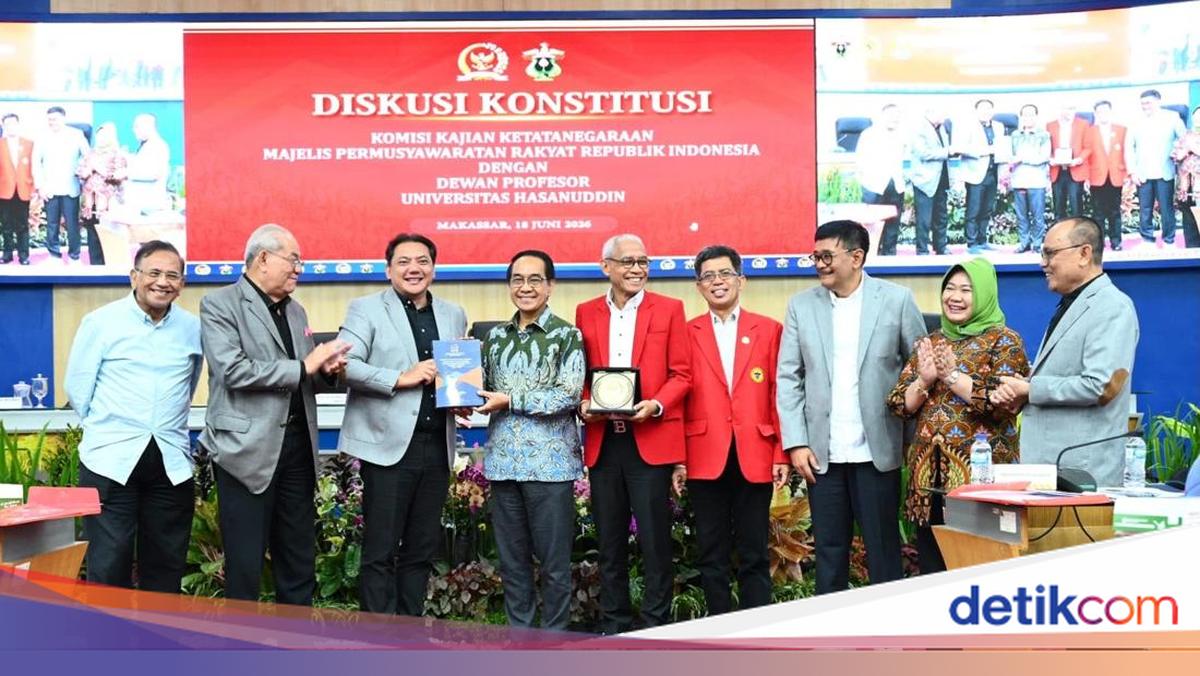
The Constitutional Studies Commission (K-3) of the MPR RI, together with Hasanuddin University (UNHAS), held a Constitutional Discussion titled ‘Evaluation of the Implementation of Article 33 of the 1945 Constitution of the Republic of Indonesia and its Relation to MPR Decree Number XVI/MPR/1998’. Article 33 of the 1945 Constitution regulates the national economic system based on economic democracy, the principle of kinship, and state control over important branches of production and natural resources for the greatest prosperity of the people.
The event, which took place in the Senate Meeting Room on the 2nd Floor of the UNHAS Rectorate on Thursday (18/6), served as a forum for exchanging ideas between the MPR RI and academics in examining the direction of national economic development based on the constitution and the principles of economic democracy. During the series of activities, a Memorandum of Understanding (MoU) was also signed between the MPR RI Secretariat General and UNHAS. The MoU was signed by Acting Secretary General of the MPR RI Siti Fauziah and UNHAS Rector Prof Dr Ir Jamaluddin Jompa, symbolising the strengthening of institutional collaboration in developing constitutional studies, education, and community service.
Dean of the Faculty of Law (FH) UNHAS Prof Dr Hamzah Halim asserted that the evaluation of Article 33 cannot be separated from the history of the birth of Indonesia’s economic system, which was designed to realise economic sovereignty after political independence. “Article 33 is the main characteristic of Indonesia’s national economic system, born from the nation’s long experience facing colonialism and resource exploitation. Therefore, people’s welfare is the main goal of national economic development,” said Prof Hamzah. He stressed that from the beginning, the nation’s founders placed the people as the axis of economic development, unlike the colonial system which was oriented towards profit extraction.
Meanwhile, UNHAS FH Professor Prof Dr Achmad Ruslan highlighted that the implementation of Article 33 paragraphs (1) to (5) still requires more comprehensive regulation, particularly regarding the objects, subjects, and management mechanisms of production branches that are the state’s responsibility. “There is a need to strengthen the norms in Article 33 by clarifying the business branches that must be managed by the state along with their management principles so that they are truly aimed at the greatest prosperity of the people,” Prof Achmad emphasised. He added that strategic sectors must have clear boundaries so that their benefits are well-targeted and not subject to multiple interpretations.
UNHAS FH Professor Prof Dr Abdul Razak delved deeper into the meaning of ‘controlling the livelihoods of many people’ in Article 33 paragraph (2). According to Prof Abdul, the constitution’s framers provided clear guidelines that vital sectors must be under state control, but this must be balanced with the protection of rights already inherent in society. “The state’s right to control must not be used to override the people’s rights. The state’s presence must be an instrument to guarantee welfare and protect citizens’ human rights, not the opposite,” Prof Abdul explained.
The perspective of a people’s economy was presented by the Faculty of Economics and Business (FEB) UNHAS Prof Dr Mursalim. Prof Mursalim stressed that the national economy must not stop at discussion but must be realised in policies that genuinely side with the people. “There needs to be a reconstruction of norms in Article 33 that increasingly affirms that the national economy is organised as a joint effort based on the principle of kinship. The state is obliged to provide facilitation and protection to cooperatives as the backbone of the Indonesian economy,” said Prof Mursalim.
UNHAS Rector Prof Dr Ir Jamaluddin Jompa affirmed that the university is ready to contribute fully to formulating a national development direction that favours the people’s interests. “If we are already discussing Article 33 at UNHAS, there is no turning back; it must be completed. We set aside all differences and unite our thoughts for better change,” Prof Jamaluddin asserted. “This is part of the university’s contribution to the nation’s progress,” he continued.
Chairman of K-3 MPR RI Taufik Basari expressed appreciation for the depth of analysis from UNHAS academics. Taufik affirmed that all recommendations would become valuable input for the ongoing constitutional review process. “The ideas from this forum enrich the MPR’s perspective in viewing the implementation of Article 33, so that we can answer the challenges of national economic development and realise the welfare of the Indonesian people,” Taufik said. Acting Secretary General of the MPR RI Siti Fauziah added that the signing of the MoU serves as a foundation for more concrete follow-up actions between the MPR and UNHAS, such as joint research, community service, and constitutional studies. “Input from various regions, including from UNHAS, will be compiled as enrichment material for the study. This collaboration is a form of real synergy between state institutions and universities in strengthening the national economic system based on social justice and people’s prosperity,” Siti said.
Through this discussion and institutional cooperation, the MPR RI and UNHAS hope to produce constructive recommendations for strengthening the national economic system oriented towards the values of economic democracy, social justice, and the greatest prosperity for the people as mandated by Article 33 of the 1945 Constitution.
Source: jawawa.id (https://jawawa.id/newsitem/mpr-and-unhas-discuss-article-33-of-the-1945-constitution-focusing-on-peoples-economy-1781927488)
Originally published by detikcom (https://news.detik.com/berita/d-8539562/mpr-dan-unhas-bahas-pasal-33-uud-1945-fokus-pada-ekonomi-kerakyatan), translated from Indonesian