
MPR and UNAIR Discuss Strengthening the Role of Constitutional Amendment Minutes
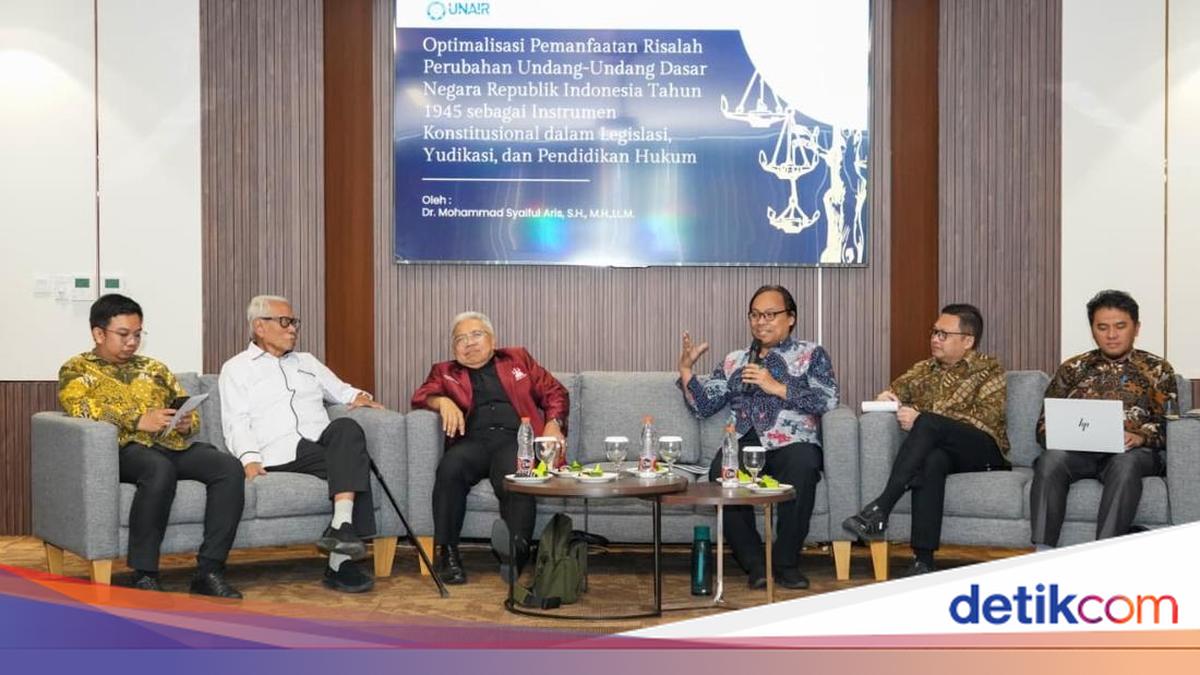
The People’s Consultative Assembly (MPR RI) held a Focus Group Discussion (FGD) in collaboration with the Faculty of Law at Universitas Airlangga (UNAIR) in Surabaya on Wednesday (22/7). Themed ‘Positioning the Minutes of the 1945 Constitution Amendments as a Constitutional Reference: Unravelling Constitutional Meaning in Legal and Academic Review’, the discussion aimed to strengthen the status of the minutes as an important reference in constitutional interpretation.
Wachid Nugroho, Head of the MPR’s Bureau for Session Affairs and Constitutional Dissemination, stated that the minutes of the 1945 Constitution amendments should not be viewed merely as administrative documents. ‘We are pushing for these minutes to not just be administrative archives, but to have meaning as legal documents that can enrich constitutional interpretation,’ he said in a written statement on Thursday (23/7/2026).
Wachid explained that the MPR is currently compiling the minutes of the 1945 Constitution amendments in a thematic format to make them more accessible to academics, researchers, students, and law enforcement officials. The MPR has also digitised various state administration documents, including the minutes of the Constitution amendments, the Constituent Assembly sessions, and the pre-reform MPRS and MPR sessions. ‘All the minutes held by the MPR have been digitised so that students and researchers can use them as research material,’ he added.
He noted that countries like the United Kingdom and the United States already utilise legislative history documents as references in legal interpretation. Wachid emphasised that the use of the minutes should not be limited to proceedings at the Constitutional Court, but should also guide lawmakers and state administrators in implementing the constitution. ‘Constitutional interpretation is not the sole domain of the Constitutional Court. In the formation of laws and the daily implementation of the constitution, the minutes of the 1945 Constitution amendments should serve as a reference to preserve the spirit of its framers,’ he said.
Former Constitutional Court Justice and member of the Ad Hoc Committee for the 1945 Constitution amendments, Harjono, stressed that understanding the amendments requires more than just reading the text or the minutes literally. He argued that one must comprehend the ideas, debates, and spirit behind each formulation. ‘Behind every formulation, there is a soul. If you only read the minutes, you are only reading the dregs. What must be understood is what lies behind the minutes, the ideas that gave birth to each constitutional formulation,’ he stated.
Harjono highlighted that one of the most fundamental decisions during the amendment process was changing the concept of popular sovereignty, noting that the MPR consciously reduced its own authority to strengthen constitutional democracy. He also affirmed that the Preamble of the 1945 Constitution is an ideological consensus of the nation that must not be changed, as it serves as the foundation of Indonesia’s unity. ‘The state is a tool for the nation to achieve its ideals. The ultimate goal is to realise social justice for all the people of Indonesia,’ he said.
Radian Salman, a Professor at the Faculty of Law, Universitas Airlangga, emphasised that reading the minutes is a prerequisite for proper constitutional interpretation, as they help map the ideology, moral values, and perspectives of the constitution’s framers, providing essential context for the original intent.