
MPR and Ministry of Environment Open Doors for Climate Change Bill Discussions
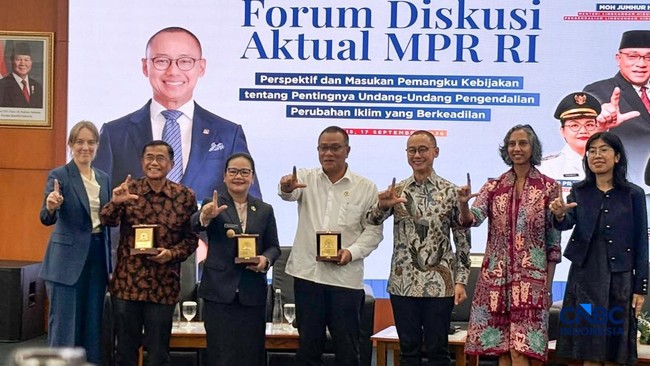
The People’s Consultative Assembly (MPR) of the Republic of Indonesia is urging that the Just Climate Change Control Bill (RUU PPIB) be discussed immediately at the parliamentary level. This is primarily intended to serve as a legal umbrella for addressing the national climate crisis.
The planned regulation is designed to govern carbon emission reductions, mitigation and adaptation activities, the provision of incentives and sanctions, and the strengthening of carbon economic value.
The Deputy Speaker of the MPR, Eddy Soep_arno, emphasised that the proposed regulation is highly urgent following the rise in hydrometeorological disasters, such as floods and forest fires, in various regions. Furthermore, the climate crisis has proven to threaten vital sectors of human life.
“The climate crisis threatens the most vital pillars of human life, such as health, food security, environmental sustainability, and biodiversity. Therefore, on this occasion, allow me to express my appreciation for our presence here to discuss a legal umbrella—a very important piece of legislation to control the climate crisis we currently face,” said Eddy during the MPR’s Actual Discussion Forum (FDA) in Jakarta on Thursday (17/09/2026).
Eddy urged that the discussion of the RUU PPIB begin by the end of 2026. He emphasised that parliamentary factions have welcomed the idea for this bill to be discussed as a standalone piece of legislation rather than being merged with other regulations.
“The aspect of justice will also be a key substance within the RUU PPIB, ensuring that climate crisis control provides affirmation and intervention for those directly affected, particularly coastal communities, low-income groups, farmers, fishermen, women, toddlers, the elderly, and including Global South nations,” he added.
In addition to gathering input from parliament and relevant ministries, the MPR continues to conduct public education activities at various universities and among stakeholders to deepen the understanding of the RUU PPIB substance and the energy transition.
Meanwhile, the Minister of Environment, Jumhur Hidayat, expressed his support for the RUU PPIB to be drafted separately from the revision of the 2009 Environmental Law. This is considered important so that the governance of climate crisis management has a clear specialty and focus.
“Ultimately, it was approved by the Special Envoy to the President for Climate Change and Energy, Mr Hashim, that there was a proposal from the Ministry of Environment to add the word ‘justice’. Thus, it became the RUU PPIB,” said Jumhur during the same event.
Jumhur explained that emission reduction efforts require the involvement of private companies and philanthropy, as they cannot be sustained by the government budget alone.
However, he underlined that the economic value of climate action should not only be enjoyed by investors but must be shared fairly with indigenous peoples and local communities.
“We do not want the previous patterns to repeat. Therefore, we want to ensure that whenever there are profits or benefits from these activities, they are shared with the ground people, indigenous communities, and local residents, so that the benefits can truly be felt,” he added.
Alongside economic justice for local residents, his office is also paying attention to the aspect of labour protection during the energy transition process. The government is preparing measures for the transition and upskilling of workers to ensure they can be absorbed into the emerging green jobs sector.
“Workers are being heavily considered; therefore, there will be reskilling and upgrading for new roles, as new green jobs will emerge during this transition,” he concluded.