
Moving Up a Class: Green Standards Introduced to Subsidised Housing Segment
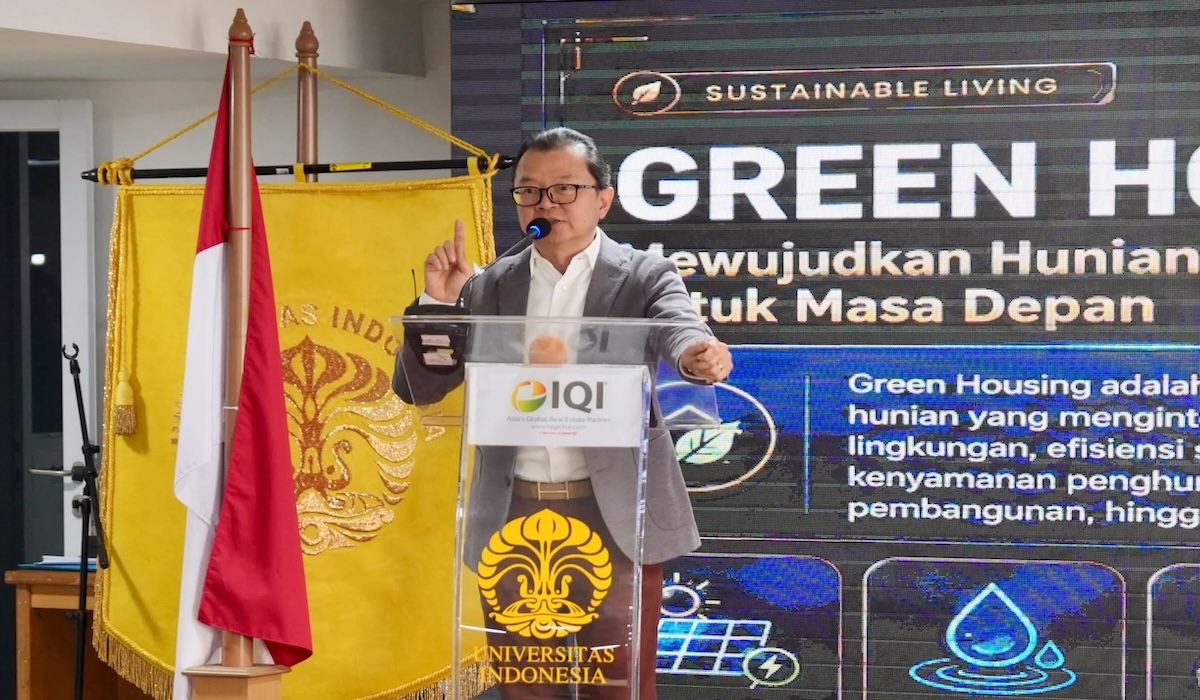
Subsidised housing for low-income communities (MBR) is entering a new phase with the application of sustainable building standards. Although this requires higher construction costs, several developers are beginning to offer eco-friendly housing concepts without altering the selling prices established by the government.
Samuel S. Huang, President Director of Infiniti Land and Treasurer of the Indonesian Real Estate Association (REI), stated that the implementation of Green Building (BGH) standards is a form of developer commitment to providing subsidised houses that are not only affordable but also high-quality and comfortable for the community.
“Our commitment is to build with heart. There is a struggle that must be undertaken seriously to achieve the Green Building certificate, considering that the production cost to build a house with the ‘Main’ BGH predicate is 8-12% higher than building a regular house,” said Samuel during a discussion titled “Owning a House, Having a Career, Is It Still Possible?” held recently at the University of Indonesia (UI) Salemba Campus, Jakarta.
Samuel explained that the Mulia Gading Kencana (MGK) Serang housing project serves as an example of applying green housing concepts to the subsidised segment. The project successfully obtained the ‘Main’ BGH certificate from the Ministry of Public Works and Housing (PUPendo), making it the first subsidised housing development to receive such a distinction.
According to him, this achievement was reached through a lengthy process of selection, surveys, and studies conducted by the government. Seven key aspects must be met, ranging from site management, energy efficiency, and water efficiency to indoor air quality, the use of environmentally friendly materials, waste management, and wastewater management.
One implementation of this green concept involves the provision of water management infrastructure. At MGK Serang, the developer has prepared more than two hectares of land for retention ponds, which function to collect rainwater and household waste before being processed according to standards for discharge into rivers.
In addition to water management, energy efficiency concepts are applied through building designs that maximise natural lighting and air circulation. These houses utilise LED lighting and room designs with optimal ceiling heights to ensure a comfortable indoor temperature.
“For air circulation and lighting inside the house, we have designed the living room ceiling at 3.5 metres and the bedroom ceiling at 2.8 metres. This keeps the air cool inside the room, making air conditioning unnecessary; however, if one does choose to install AC, a 1/2 PK capacity is sufficient,” he explained.
Samuel noted that implementing green building standards in subsidised housing presents both a challenge and an opportunity for the property industry. Developers must maintain building quality amidst the fixed selling prices set by the government.
“For subsidised housing, the requirement is not easy because the selling price is fixed by the government. However, we carry out these requirements wholeheartedly so that people buying their first homes can enjoy quality housing with adequate green open spaces,” he said.
Beyond building aspects, developers are also adjusting marketing strategies to technological advancements. Samuel mentioned that digital channels have become a primary source for property sales.
“We must follow the progress of the times and technology. We can share that 80 per cent of our current sales come from social media, rather than just distributing brochures,” he added.
According to Samuel, digital transformation and the application of sustainable housing concepts are part of the property industry’s evolution in responding to the needs of the younger generation, who are increasingly attentive to the quality of their living spaces.
Amidst the challenges of rising material prices and logistics costs, he believes developers must continue to innovate to ensure that the construction of subsidised houses continues without compromising quality.
“Developers must be creative and find solutions. The efficient use of materials and strict supervision must be implemented to ensure no materials are wasted,” he concluded.