
Mount Ungaran Geothermal Project Assured Not to Affect Cultural Heritage Sites
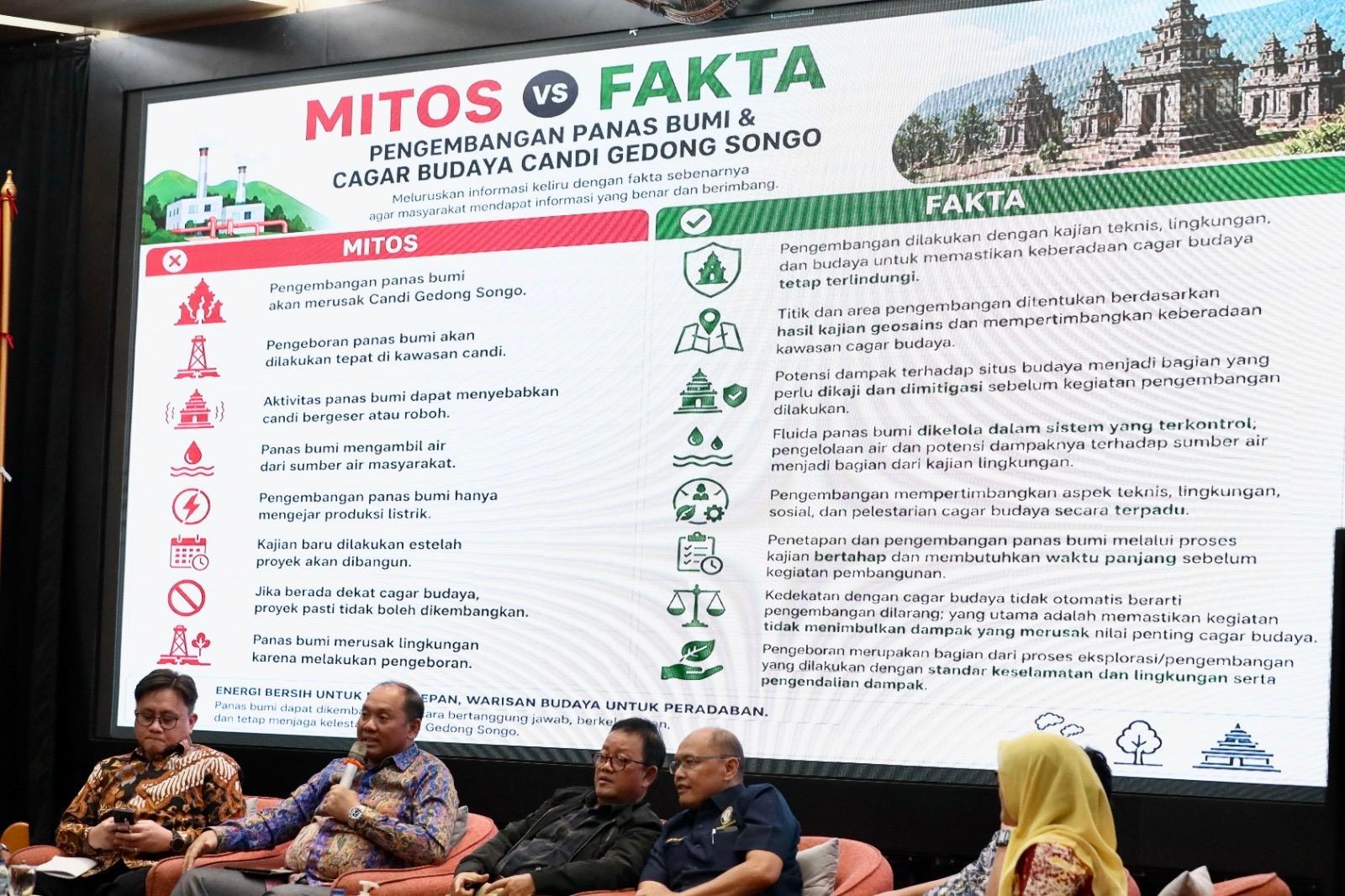
The planned development of the Mount Ungaran Geothermal Power Plant (PLTP) in Semarang Regency, Central Java, is guaranteed to take into account the existence of cultural heritage sites and environmental conditions.
The Director of Geothermal at the Directorate General of EBTKE, Ministry of Energy and Mineral Resources (ESDM), Priatin Hadi Wijaya, stated that the specific drilling locations for the Mount Ungaran PLTP have not yet been determined as the project is still in the study phase. The final selection of sites will be based on geophysical, geochemical, and geological studies, in coordination with both central and regional governments.
“The determination of drilling points will not be done arbitrarily and will consider various aspects, including the presence of heritage sites and environmental conditions,” Priatin said during a discussion and dialogue at the FISIP Diponegoro University (Undip) campus in Semarang on Thursday.
He cited the development of geothermal energy in Dieng, where the infrastructure is situated far from the Arjuna Temple area, as an example. He noted that a similar pattern will be applied to the Mount Ungerm development to ensure that the Gedong Songo Temple complex is not disturbed.
Executive Vice President of Geothermal Management at PT PLN, John Yudi Steve Rembet, stated that the planned PLTP location is more than two kilometres away from the Gedong Songo Temple. “The buildings and tourism activities at Gedong Songo Temple can continue intact, and we are committed to making every effort to avoid any disruption,” he said.
Meanwhile, the Director of the Indonesian Environmental Law Forum (WALHI) Central Java, Fahmi Bastian, has called on the government to re-examine the plan regarding energy needs, investment, and environmental risks. He argued that the planned PLTP capacity of approximately 55 MW, with an investment of Rp5.7 trillion, should be compared with alternative energy sources, including solar power (PLTS).
WALHI also highlighted potential issues regarding water usage, changes in land cover, and disaster risks resulting from geothermal infrastructure development in mountainous areas. “Geothermal is indeed zero-emission, but it is not zero-disaster. The impact on the context of disaster risk must also be taken into account,” said Fahmi.