
Mount Semeru Erupts Three Times, Sending Ash Columns Up to 1 km
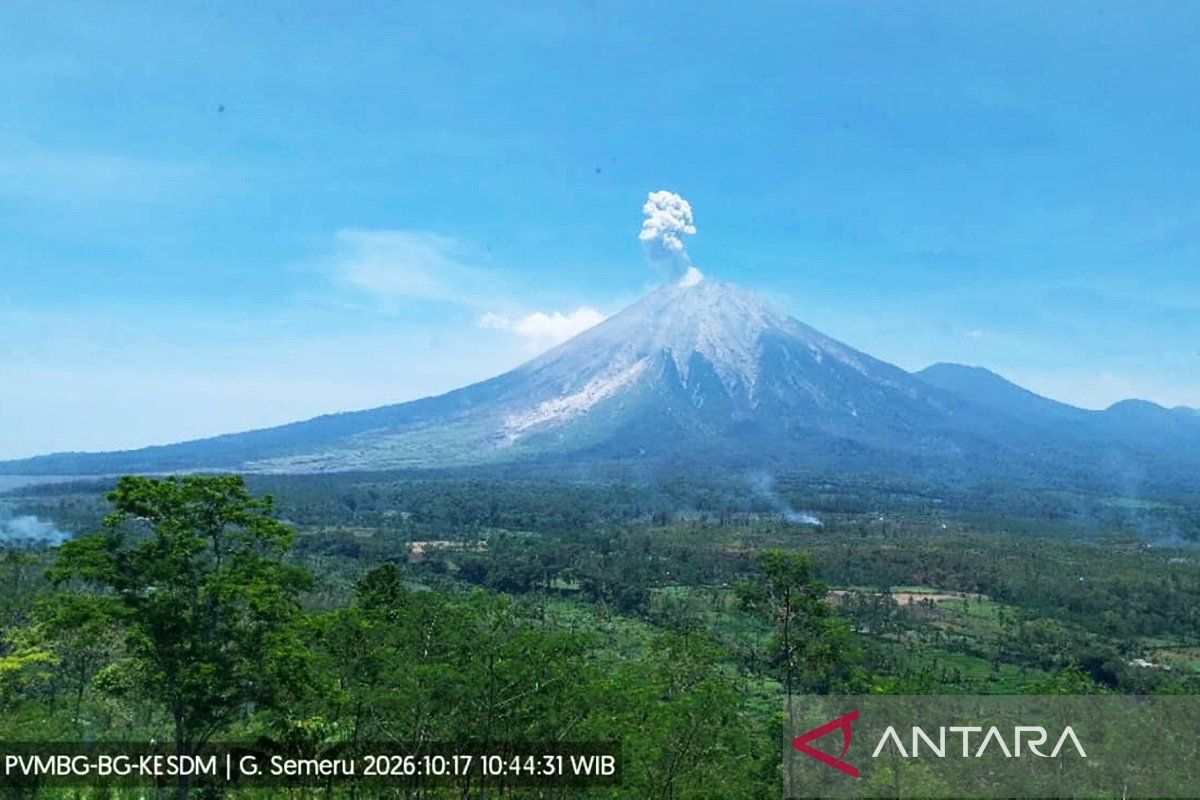
Mount Semeru, on the border of Lumajang and Malang regencies in East Java, erupted three times on Saturday, with eruption columns reaching up to 1 km high.
The first eruption occurred at 4.52 am, with the column observed at about 700 metres above the summit. The volcanic ash was grey, thick and drifting west. The eruption was recorded on a seismograph with a maximum amplitude of 22 mm and a duration of 125 seconds.
“The second eruption occurred at 6.35 am, with the eruption column higher, observed at about 800 metres above the summit, or 4,476 metres above sea level,” Agastya Rajendra, an officer at the Mount Semeru Observation Post, said in a written report received in Lumajang.
He said the ash column was white to grey, thick and drifting west. The eruption was recorded on a seismograph with a maximum amplitude of 25 mm and a duration of 90 seconds.
The highest mountain on Java erupted again at 10.42 am, with the column observed at about 1 km above the summit. The ash was white to grey and thick, drifting west.
“The eruption was recorded on a seismograph with a maximum amplitude of 25 mm and a duration of 137 seconds,” Agastya said.
He explained that Mount Semeru’s volcanic activity is currently at Level III, or Alert. People are advised not to carry out activities outdoors, particularly in the south-eastern sector along Besuk Kobokan, up to 13 km from the summit, which is the eruption centre.
Beyond that distance, people should also stay at least 500 metres from the riverbanks along Besuk Kobokan, as pyroclastic flows and lahars could spread as far as 17 km from the summit, he said.
People must not enter a 5 km radius around Mount Semeru’s crater or summit because of the risk of ejected incandescent rocks.
Agastya urged the public to remain alert to possible pyroclastic flows, lava avalanches and lahars along rivers and valleys originating at the summit.
“Particular caution is needed along Besuk Kobokan, Besuk Bang, Besuk Kembar and Besuk Sat, as well as regarding lahars in small rivers that are tributaries of Besuk Kobokan,” he said.