
Mount Semeru Erupts, Spewing Ash 1 Km Above Summit
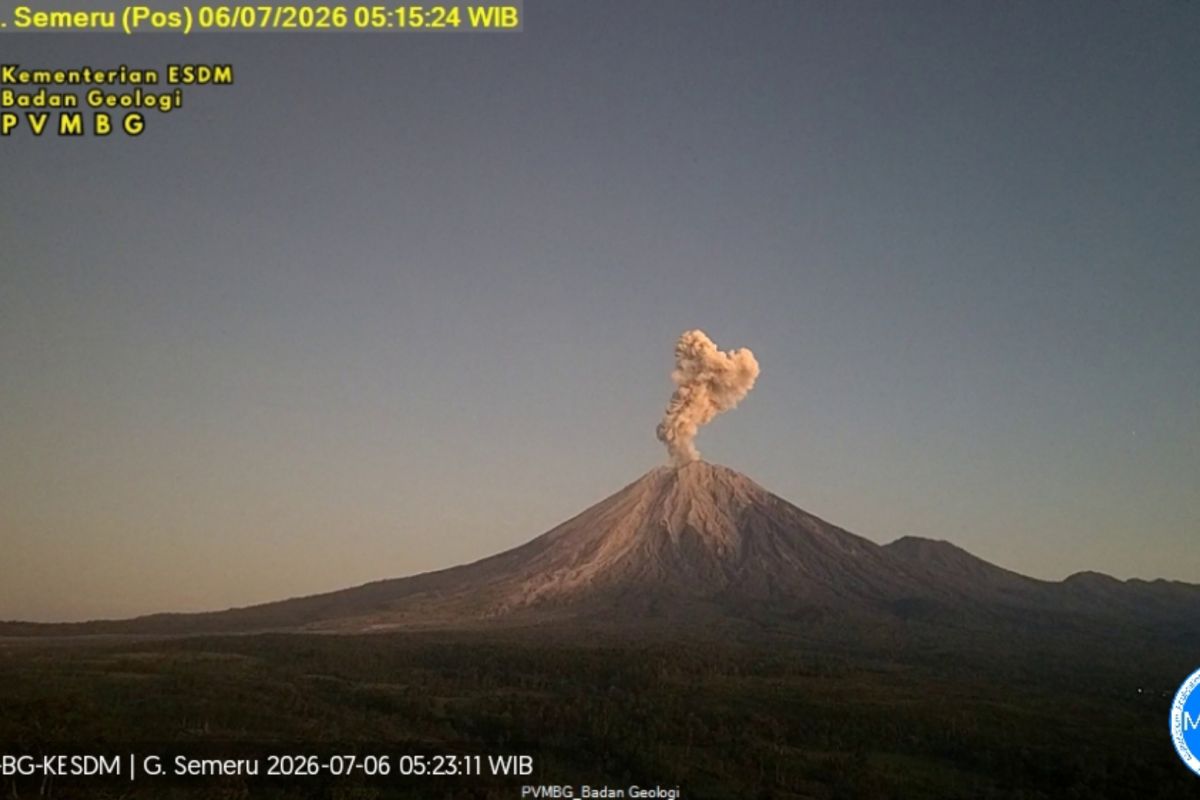
Lumajang, East Java - Mount Semeru, located on the border of Lumajang and Malang Regencies, East Java, erupted with an eruption height of up to 1 kilometre above the peak on Monday morning.
“An eruption of Mount Semeru occurred at 05:13 WIB, with the eruption column observed at approximately 1 kilometre above the peak, or 4,676 metres above sea level,” stated Yadi Yuliandi, an officer at the Mount Semeru Observation Post, in a written report received in Lumajang.
According to him, the ash column was observed to be grey with thick intensity moving towards the north. The eruption was recorded on a seismograph with a maximum amplitude of 22 mm and a duration of 167 seconds.
He explained that volcanic activity at Mount Semeru is currently at Level III (Alert) status. Recommendations have been issued for the public to avoid all activities in the south-eastern sector along Besuk Kobokan, up to 13 kilometres from the peak (the centre of the eruption).
Outside of that distance, he continued, the public should avoid activities within 500 metres of the riverbanks along Besuk Kobokan due to the potential for expanding hot clouds and lava flows up to 17 kilometres from the peak.
“The public is prohibited from conducting activities within a five-kilometre radius of the crater/peak of Mount Semeru, as it is prone to the danger of volcanic rock fragments (incandescent debris),” he said.
He urged the public to remain vigilant regarding the potential for hot clouds, lava flows, and lahars along the rivers and valleys originating from the peak of Mount Semameseru.
“Particularly along Besuk Kobokan, Besuk Bang, Besuk Kembar, and Besuk Sat, as well as the potential for lahars in small rivers that are tributaries of Besuk Kobokan.”
Meanwhile, the Lumajang Government has reminded the public, particularly sand miners, to increase vigilance against the danger of secondary explosions of volcanic material from Mount Semeru in the lava flow areas and mining zones.
The Regent of Lumajang, Indah Amperawati, stated that threats around active volcanoes do not only stem from eruptions or pyroclastic flows, but also from accumulations of volcanic material that still retain heat.
Material carried from the slopes of Mount Semeru can maintain high temperatures for a certain period, and these accumulations have the potential to trigger secondary explosions that endanger people working too close, especially in mining areas.
“Never assume that material accumulations in the Semeru area are completely safe. That material may still be hot and, under certain conditions, can pose a danger to the public, especially miners,” she said.
According to her, understanding the nature of volcanic material hazards is crucial, especially for residents who carry out daily activities around the Besuk Kobokan flow and other mining areas.
“Material that appears stationary or has settled is not necessarily completely safe to approach or mine,” she added.
She noted that the risk in the Semeru area can increase when rain falls on the peak and slopes of the mountain. Rainwater can move material stored in river flows, thereby increasing the potential danger to people active around lahar paths and mining areas.
“The public is urged not only to pay attention to information regarding eruptions or hot clouds, but also to understand the risks from volcanic material left over from eruptions that remains along river flows and mining areas,” she said.