
Mount Semeru Erupts Eight Times, Ash Column Reaches 900 Metres
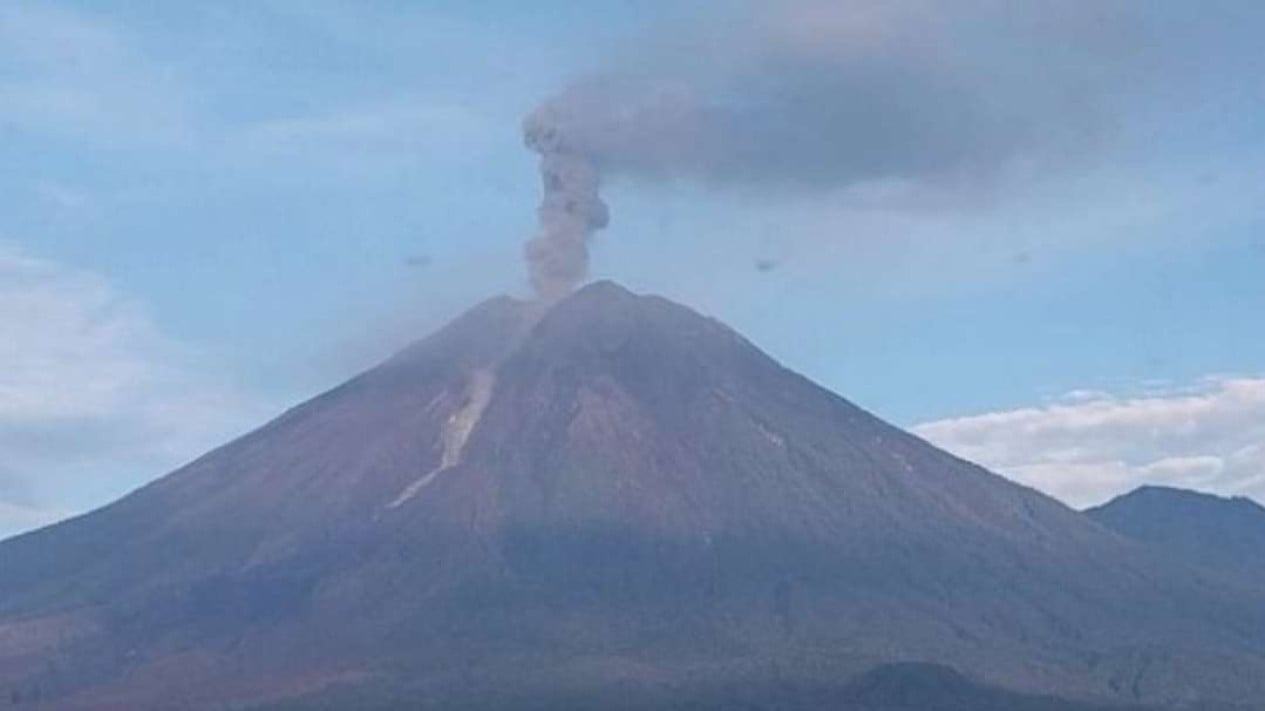
Mount Semeru, on the border of Lumajang and Malang regencies in East Java, erupted eight times on Sunday, 12 July 2026. The eruption column height reached up to 900 metres above the summit. The first eruption occurred at 05.50 Western Indonesian Time (WIB), with an observed column height of approximately 600 metres above the peak. The ash column was observed to be white to grey with moderate intensity, moving towards the southeast. Successive eruptions occurred at 06.23 WIB, 09.24 WIB, 12.55 WIB, 15.51 WIB, 16.39 WIB, 18.29 WIB, and the eighth eruption at 19.00 WIB. “The eruption of Mount Semeru at 19.00 WIB had an observed column height of around 900 metres above the peak, or 4,576 metres above sea level,” said Mount Semeru Observation Post Officer Liswanto in a written report received in Lumajang. According to him, the ash column was observed to be white to grey with moderate intensity moving northwards. At the time the report was made, the eruption was still ongoing. He explained that the volcanic activity of Mount Semeru is currently at Status Level III (Siaga), with a recommendation that the public not conduct any activities in the southeastern sector along Besuk Kobokan, as far as 13 kilometres from the peak (eruption centre). Beyond that distance, the public should not conduct activities within 500 metres of the riverbank along Besuk Kobokan, due to the potential for being affected by the expansion of pyroclastic flows and lava flows up to a distance of 17 kilometres from the peak. “The public is prohibited from conducting activities within a five-kilometre radius of the crater/peak of Mount Semeru because it is prone to the danger of incandescent rock projectiles,” he said. He urged the public to be aware of the potential for pyroclastic flows, lava avalanches, and lahars along the river flows and valleys originating at the peak of Mount Semeru. “Especially along Besuk Kobokan, Besuk Bang, Besuk Kembar, and Besuk Sat, as well as the potential for lahars in small rivers that are tributaries of Besuk Kobokan,” said Liswanto.