
Mount Semeru Erupts, Ash Column Reaches 1,000 Metres Above Summit
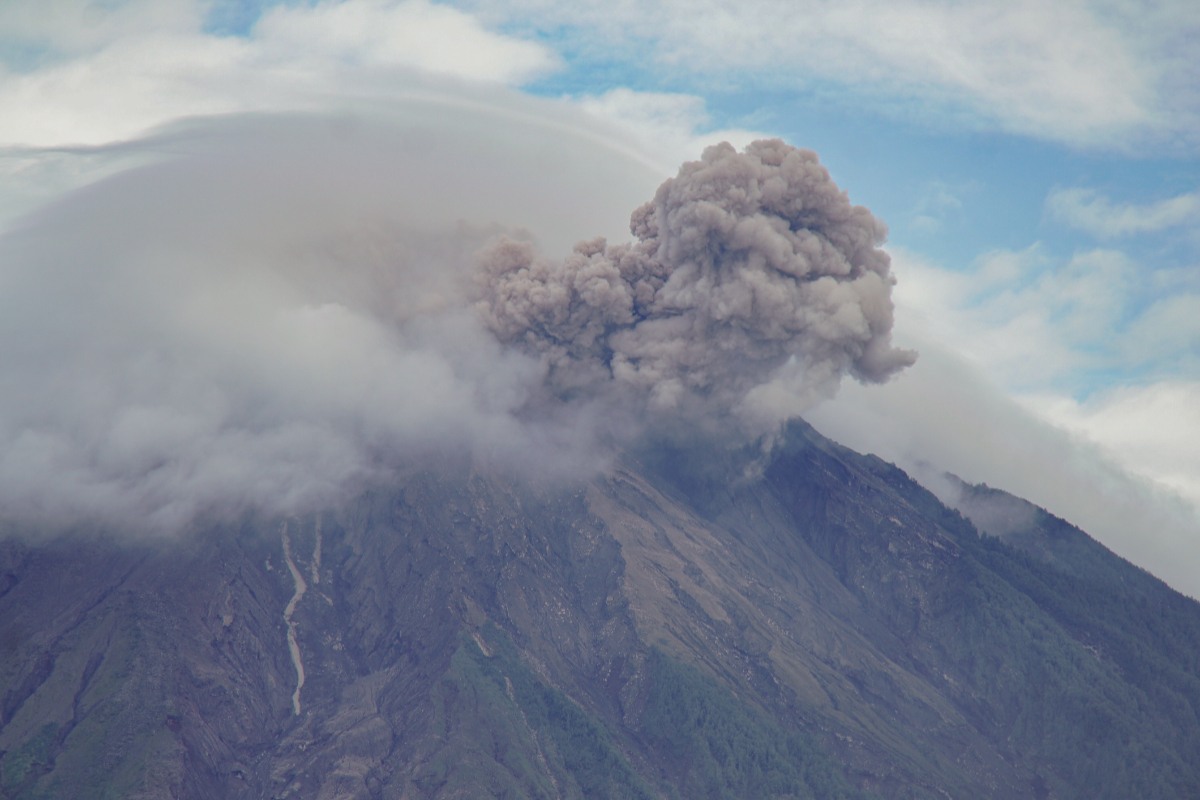
Mount Semeru, situated on the border of Lumajang and Malang Regencies, East Java, experienced an eruption with an explosion height reaching 1,000 metres above the peak on Thursday evening.
“An eruption of Mount Semeru occurred at 17:15 WIB, with the observed eruption column reaching approximately 1,000 metres above the peak, or 4,676 metres above sea level (masl),” stated Mukdas Sofian, an officer at the Mount Semeru Observation Post, in a written report received in Lumajang.
According to him, the ash column was observed to be white to grey in colour with thick intensity towards the southwest. The eruption was recorded on the seismograph with a maximum amplitude of 22 mm and a duration of 165 seconds.
Based on the officers’ records, Mount Semeru, the highest mountain on Java Island, experienced 12 eruptions between 05:00 WIB and 17:30 WIB, with eruption heights ranging from 500 metres to 1,200 metres above the peak.
He explained that volcanic activity at Mount Semeru is currently at Level III (Alert) status, with a recommendation for the public to avoid all activities in the southeastern sector along Besuk Kobokan, up to 13 kilometres from the peak (the centre of the eruption).
Outside of that distance, he continued, the public should avoid activities within 500 metres of the riverbanks along Besuk Kobokan due to the potential for expanding pyroclastic clouds and lava flows up to 17 kilometres from the peak.
“The public is prohibited from conducting activities within a five-kilometre radius of the crater/peak of Mount Semeru due to the danger of volcanic rock fragments (incandescent debris),” he said.
He urged the public to remain vigilant regarding the potential for pyroclastic clouds, lava flows, and lahars along the river/valley flows originating from the peak of Mount Semeru.
“Particularly along Besuk Kobokan, Besuk Bang, Besuk Kembar, and Besuk Sat, as well as the potential for lahars in small rivers that are tributaries of Besuk Kobokan,” Mukdas added.