
Mount Semeru Erupts Accompanied by Hot Clouds
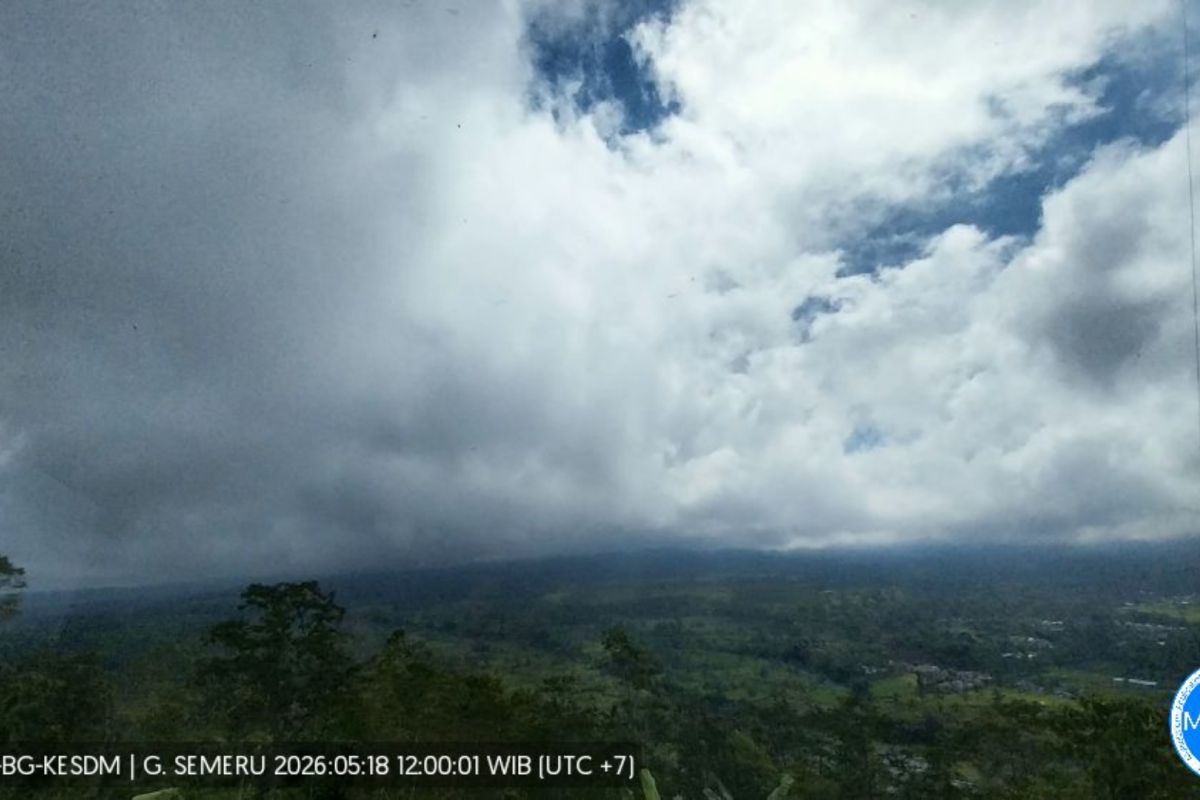
Lumajang, East Java - Mount Semeru, situated on the border of Lumajang and Malang Regencies, East Java, experienced an eruption accompanied by hot clouds on Monday afternoon.
“An eruption of Mount Semeru occurred at 14:38 WIB, but the height of the ash column could not be observed as it was obscured by fog,” stated Yadi Yuliandi, an officer at the Mount Semeru Observation Post, in a written report received in Lumajante. According to him, the eruption was recorded on the seismogram with a maximum amplitude of 22 mm and a duration of approximately 3 minutes and 53 seconds.
“The eruption of Mount Semeru was accompanied by hot clouds, but the distance of the cloud surge is unknown because the visual of Semeru was obscured by fog,” he said. Based on official data, Java’s highest mountain erupted twice: first at 07:40 WIB, where the visual eruption was not observed but recorded on the seismograph with a maximum amplitude of 22 mm and a duration of 115 seconds, and a second time at 14:38 WIB, which included hot clouds. Consequently, the public is urged to remain cautious and follow the directions of the local Regional Disaster Management Agency (BPBD).
He explained that Mount Semeru is currently at Level III (Alert) status. The recommendation is to avoid all activities in the southeastern sector along Besuk Kobokan, up to 13 km from the summit (the centre of the eruption). Outside of that distance, the public must not engage in activities within 500 metres of the riverbanks along Besuk Kobokan, as there is a potential for the expansion of hot clouds and lava flows up to 17 km from the summit.
Furthermore, the public is advised to avoid activities within a 5 km radius of the crater/summit of Mount Semeru due to the danger of volcanic rock fragments. Residents are also urged to remain vigilant regarding the potential for hot clouds, lava flows, and lahars along the rivers and valleys originating from the peak of Mount Semeru, particularly along Besuk Kobokan, Besuk Bang, Besuk Kembar, and Besuk Sat, as well as the potential for lahars in small rivers that are tributaries to Besuk Kobokan.